Guide · 15 October 2026 · by Pınar
Bag charms: the one accessory that wears the bag while you carry it
Every guide to this treats a charm as a question of taste — scale, colour, how many is too many. All of that is true and none of it is the first question. A charm is the only thing you add to a bag that is in permanent physical contact with it, swinging against the same square centimetre a few thousand times a day. It is a wear decision before it is a styling one.
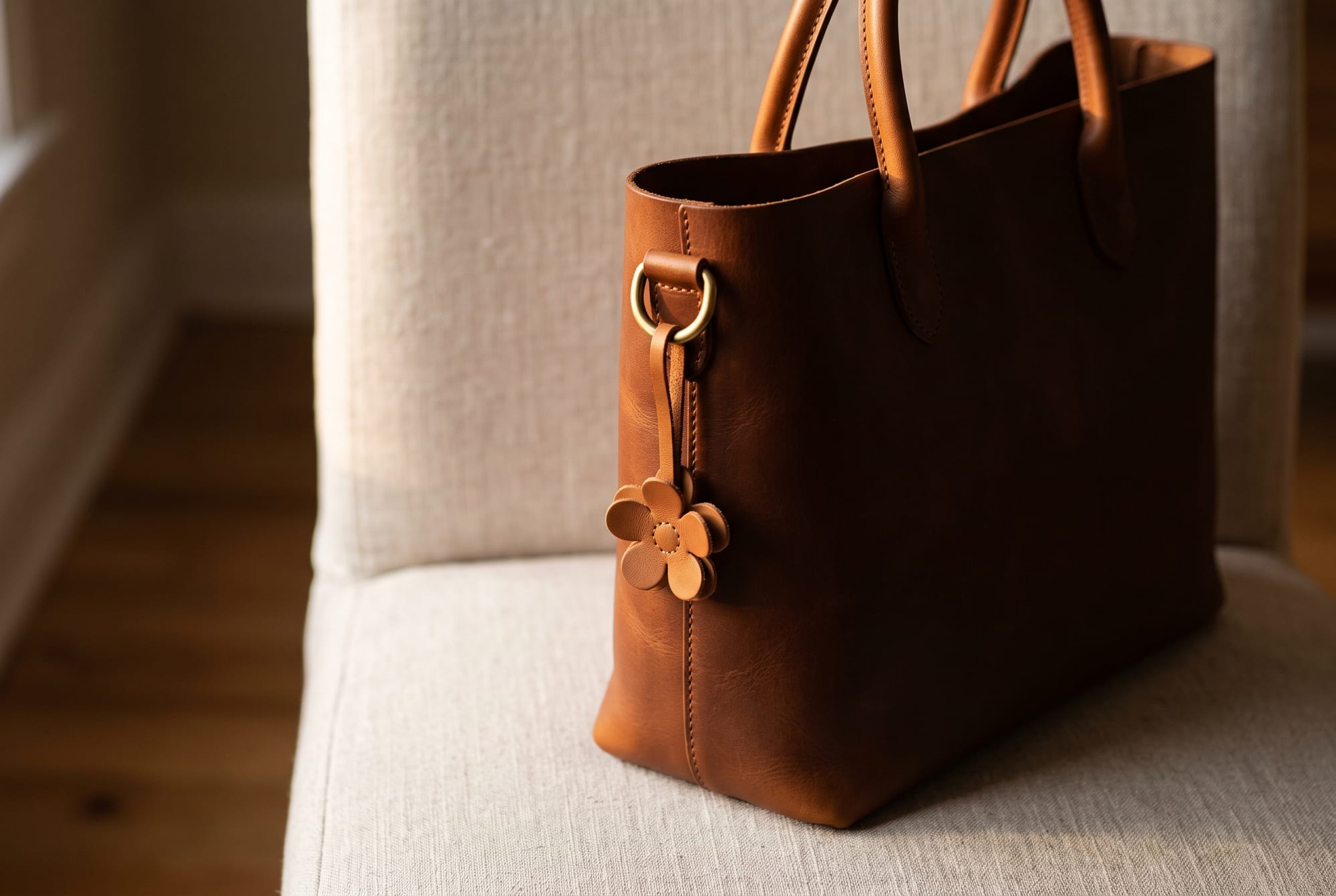
A customer brings a tote back to the atelier because of a mark she cannot explain. It is on the front panel, about a hand’s width below the handle: a shallow crescent, slightly paler than the leather around it, with the grain polished flat inside the curve.
She has not caught it on anything. Nothing has spilled. The bag is three years old and otherwise close to perfect.
It is the charm. A small brass ring, a lovely object, hung from the base of the handle so that it rested against the front face — and then eighteen months of walking.
The thing nobody mentions about charms
Charms have gone from a novelty to the defining accessory of the last two seasons, and the trend has matured in a direction I like: away from the plush toys and toward tassels, miniature pouches, pendants and leather. The styling advice has multiplied along with it. Almost all of it is about composition — and all of it quietly assumes the charm is a picture rather than an object.
Here is the thing it leaves out. A bag is worn, not displayed. Whatever hangs off it moves with every step you take, and it moves against something. Two hours of walking is a few thousand small contacts between a hard edge and a soft surface, repeated in exactly the same place.
A charm is the only accessory that touches your bag constantly. Everything else you put on a bag is a decision about how it looks; this one is also a decision about how it wears.
There are three ways that goes wrong, and all three are avoidable with a decision made in the first five minutes rather than a repair made in the third year.
Abrasion. A metal ring or clasp is far harder than a hide. Where it rests, it burnishes — polishing the grain flat, then thinning it. On a full-grain hide this begins as a faintly glossy shadow that looks almost deliberate, which is why it is usually ignored for a year. The shape gives it away: a crescent or an arc, matching the swing rather than any natural wear pattern.
Colour, in both directions. A cheaply dyed charm against a pale bag will give up colour exactly where it rubs — crocking, and warmth and friction are precisely the conditions that encourage it. It also runs the other way: a pale charm against a new, richly dyed bag picks up a shadow from the bag. The full explanation of transfer in both directions applies here in miniature, with the aggravating detail that a charm never moves, so the transfer is concentrated instead of spread.
Load, in the wrong place. This is the one I would most like people to change. The base of the handle is the obvious place to clip something, and it is the worst available choice: the handle attachment is already the hardest-working point on the whole bag, carrying the entire weight of the contents every time it is lifted. Adding a swinging mass to it is not adding a few grams — it is adding a repeated dynamic load to the one joint that was already closest to its limit. Hardware fails long before the leather does, and this is one of the few ways an owner can genuinely accelerate it.
Why a leather charm is a different proposition
I would say this even if we did not make them, because it is the clearest argument in the whole subject and it is about time rather than taste.
A bag changes. It darkens, softens, gathers patina at the corners and handles, and after three years it is visibly a thing that has been lived with. A resin, acrylic or plated charm does not change at all. It is exactly as new in year five as it was in week one — and sitting against a surface that has aged beautifully, the unchanged object is the one that looks wrong. This, rather than fashion cycling, is why charms date so visibly: the bag moved on and the charm did not.
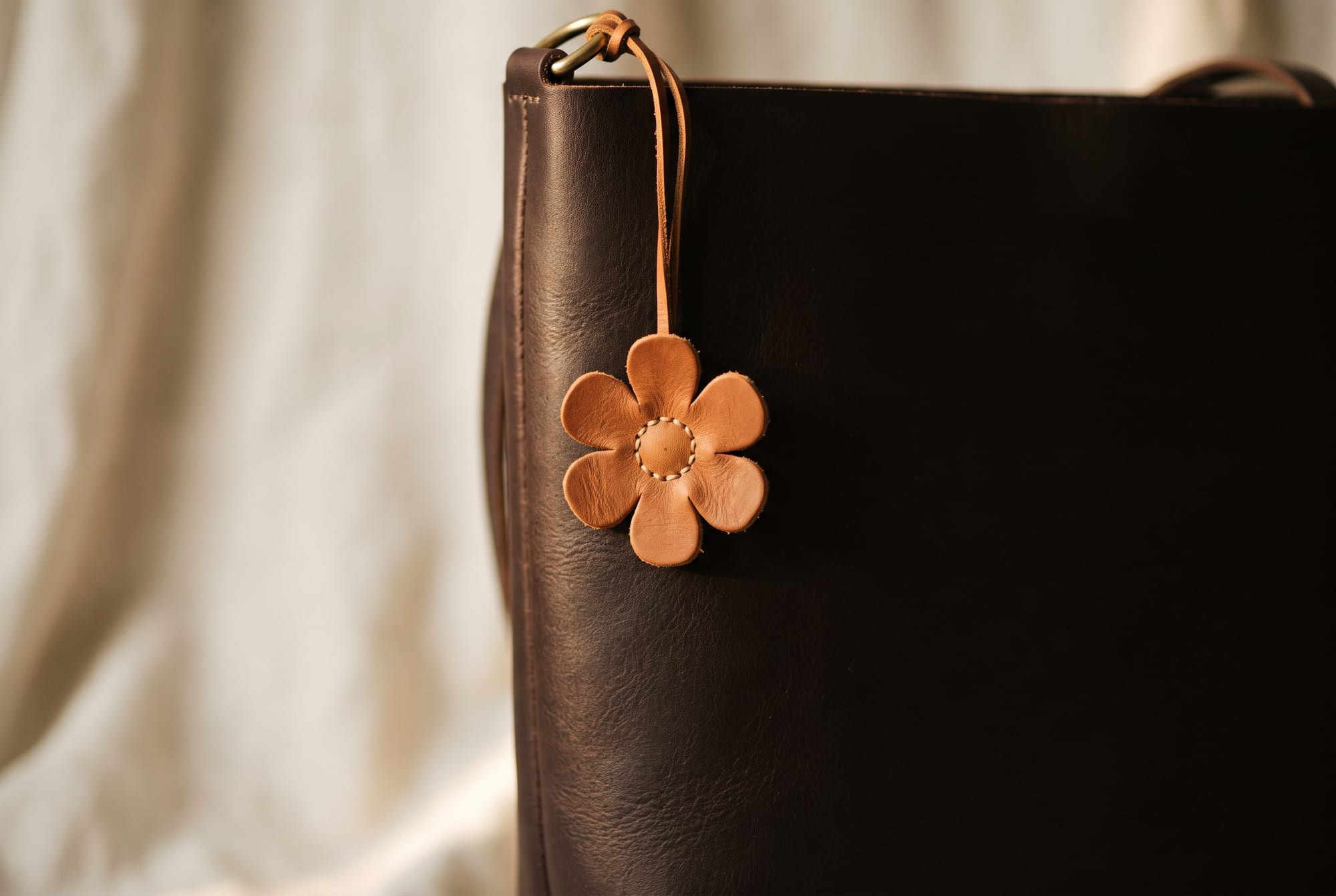
A leather charm is the only one that ages at the bag’s own rate. Five years in, it has not become the obviously newer thing hanging off something old.
Cut from the same kind of hide, it darkens on the same curve, takes the same polish where fingers find it, and absorbs the same oils from the same hands. Two vegetable-tanned pieces carried together stay in step with each other almost indefinitely.
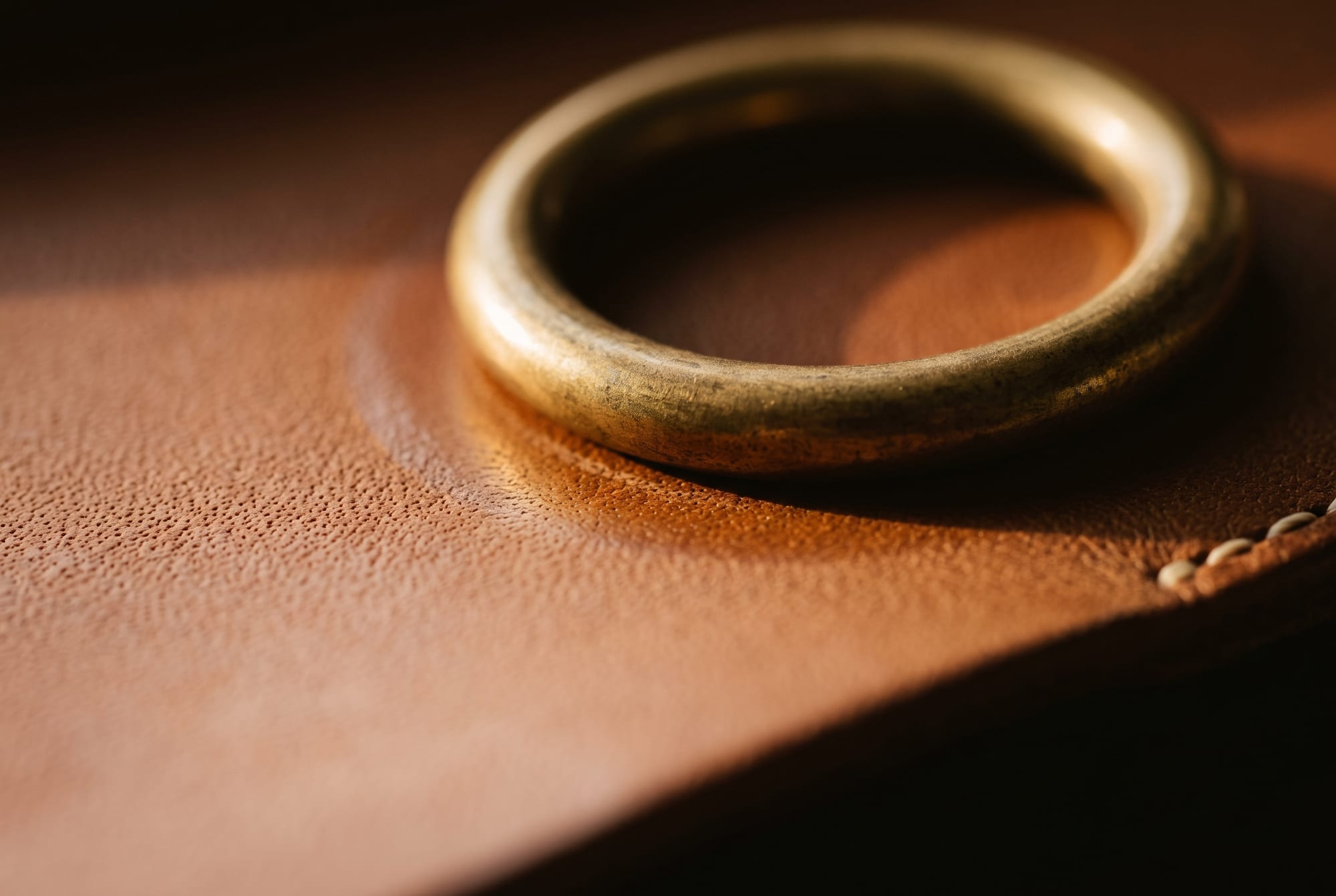
Two practical notes on choosing one. First, the ring is more important than the charm: look for brass or stainless rather than plated base metal, and prefer a smooth, closed ring over a split ring with a step in it, because the step is a cutting edge. Second, a charm that is itself soft leather — a flower, a tassel, a folded form — cannot burnish a panel the way a metal body can, which quietly solves the abrasion problem at source and is the real reason soft leather charms are the sensible version of this trend.
Composition: one anchor, one contrast, one useful thing
Now the part everyone came for, and the trend has actually improved here. The early version of this was accumulation — as many things as would fit. What has replaced it is better and harder: scale, texture, and deliberate empty space.
The formula I keep coming back to is three elements at most, each doing a different job.
- An anchor that belongs. Something that reads as though it could have come with the bag — the same hide, the same hardware finish, a leather tag, a tonal tassel. It does the work of looking intentional, and it is what stops the whole arrangement reading as clutter.
- One contrast, and only one. This is the piece with the personality: a colour that is not in the bag, an unexpected texture, something handmade and one-of-a-kind. One is a statement. Two is a collection. Three is a keyring.
- Something that earns its place. A small pouch, a card sleeve, a key clip. The most interesting direction in this trend is charms that are quietly functional, which is also the only category that survives the trend ending — a coin pouch is still a coin pouch next year.
Two proportions worth holding on to. Keep the charm to roughly a quarter of the bag’s face height or less — past that it stops being a detail and starts competing, and a charm competing with a bag is a fight nobody wins. And it must hang clear of the closure; a charm that has to be moved to open the bag will be resented within a fortnight and taken off within a month.
The restraint is not an aesthetic preference, incidentally. It is the same point as the rest of this piece from a different angle: one considered thing against a plain field reads as more expensive than a cluster, and it also weighs less and touches the bag in fewer places.
Three questions
Do bag charms actually damage bags?
A badly hung one does, reliably and slowly. The damage is never dramatic — it is a burnished crescent where a hard ring has rubbed, a strained handle attachment, or a faint colour shadow where two leathers have been pressed together for a year. A charm hung from a side ring, with a smooth brass or steel ring, that cannot reach a panel, does no harm at all in my experience. The object is not the problem; the hanging point is.
How many charms is too many?
Visually, more than three. Physically, the honest limit is weight and contact points rather than count: two light soft charms on a side ring are kinder to a bag than one heavy metal one on a handle. If you want to carry several, put them on a single ring at one attachment so there is one contact point to supervise instead of four — and take the whole arrangement off before the bag goes into storage, because a year of a charm resting in one place with nobody moving it is how a shadow becomes permanent.
Does a charm make a good gift?
It is one of the few accessories that does, because it sidesteps the two things that make leather gifts difficult: it needs no size and it does not require you to guess what someone carries. A handmade leather charm is also small enough to be personal without being presumptuous — which is roughly the test the gift guide sets for everything. The only thing to get right is the colour: pick something that works with a bag you have actually seen.
Further reading
- Bag hardware: why the metal fails long before the leather
- Dye transfer both ways: when one leather marks another
- Quiet luxury is a material, not a logo
- Patina: the story your leather writes about you
- How to choose leather as a gift: two questions that answer it
- How to store a leather bag, and what to take off it first