Essay · 7 September 2026 · by Pınar
Quiet luxury is a material, not a logo: a bench-side definition
A customer from Spain stood in the atelier, turned one of our placemats over in her hands, and said: “This is exactly what people mean by quiet luxury.” We’d been making it for years. She gave us the word.
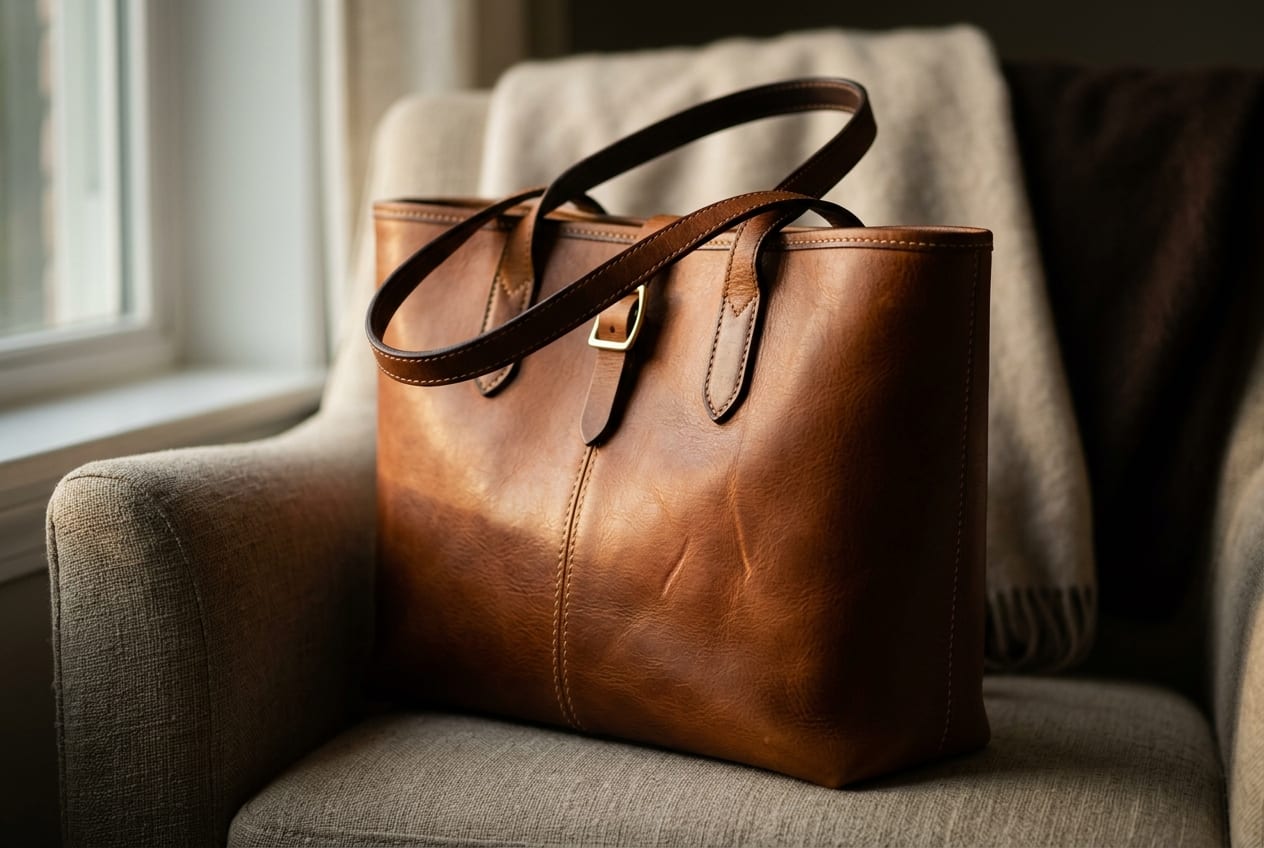
The trend pieces define quiet luxury by what it lacks: no logos, no monograms, no hardware spelling anybody’s name. That’s true, but it’s a definition with a hole in the middle — remove the logo from a mediocre bag and you don’t get quiet luxury, you get a quiet mediocre bag. From where I sit, between a design desk and Zafer’s bench, the real definition is simpler and harder to fake: quiet luxury is when the material is the label.
The five tells that read without a logo
Watch what people actually notice when they handle a piece with no name on it. It’s always the same five things, and every one of them is legible only up close — which is the whole grammar of quiet: loud design is legible from ten metres, quiet design from ten centimetres.
- Grain. Visible pores, a scar somewhere, tonal depth — full-grain hide wearing nothing over its own skin.
- The slant of the stitches. Saddle stitching leans like italic handwriting; anyone who has ever held quality recognises it before they can name it.
- Edges. Burnished to dark glass, not painted. The two-second tell of a piece someone finished by hand.
- Hardware. Solid brass, unbranded, already promising to age alongside the hide.
- The beginning of a patina. A piece that is visibly becoming rather than depreciating — the strongest quality signal there is, and the only one that can’t be bought at the counter.
The arithmetic nobody prints on the tag
Here is the part I find genuinely funny after twenty years in design: quiet luxury is usually cheaper than loud luxury, because of what each price is made of. A monogram bag’s price is mostly everything around the bag — the brand’s advertising, the flagship rents, the retail chain, the margin the name commands. The materials are a sliver; that’s not a scandal, it’s the business model. An atelier piece inverts the ratio: the price is mostly hide and hours, because there is nothing else to pay for. Same money, opposite direction.

The rules, if you want them
One quiet piece does the work. Quiet luxury is not a total look; a single honest leather object next to ordinary things elevates all of them — the same one-per-surface rule I gave for runners holds for a wardrobe.
Choose the colours that age. Natural, cognac, tobacco, oxblood if you want this autumn’s mood without its expiry date — the colours whose ten-year version is better than their day-one version. Trend colours are loud by definition: they announce a season.
Let the metal be metal. Unbranded solid brass, and nothing engraved on it that isn’t for you. If there must be a name anywhere, let it live inside the flap, where only your fingers find it.
Buy the boring shape. The tote, the bifold, the belt with one buckle. Quiet luxury is radical in material and conservative in silhouette — that’s why it photographs like nothing and outlives everything.

Patina: the anti-logo
Here is the quietest thing about quiet luxury, and my favourite. A logo identifies the brand’s ownership of the object’s image — every monogram bag belongs, visually, to the house that made it, forever. A patina does the opposite: with every month of carrying, the piece becomes more identifiably yours — darkened where your hand lives, creased where your day bends it. Loud luxury is mass-produced identity. Quiet luxury is identity produced by use, one owner at a time, and it cannot be counterfeited because it hasn’t happened yet at the point of sale.
One honest caveat
The moment quiet luxury became a trend, the fast-fashion floor filled with “quiet” bags: minimal, logo-free, beige — and made of coated splits that will peel before the trend does. Minimal is a style; quiet is a material standard. The difference takes sixty seconds to check, and we’ve already written the inspection. A blank surface with nothing underneath it isn’t quiet. It’s just silent.
Loud luxury asks the room to read a name. Quiet luxury lets the room read the stitching.
If you’re building a quieter wardrobe or table and want one piece that does the work, write to info@pazleather.com and tell us what your days look like — we’ll tell you which piece, in which colour, and what it will look like in ten years.
Further reading
- Bag hardware: why the metal fails long before the leather
- Leather placemats: what size to buy, and what hot plates really do
- How to decorate with leather: five surfaces and four pairings
- What is full-grain leather, really? A maker’s anatomy lesson
- Why does handmade leather cost more? The honest arithmetic
- Patina: the story your leather writes about you
- Saddle stitch vs machine stitch: the seam that decides how long a bag lives
- What customers say at the atelier