Guide · 18 September 2026 · by Zafer
Bag hardware: why the metal fails long before the leather
Ask anyone why they stopped carrying a bag they loved and you will almost never hear “the leather wore out”. You will hear that the zip stopped catching, or that the gold came off the buckle and left something grey underneath. The hide was fine. It is nearly always fine. Something cheaper gave up first.
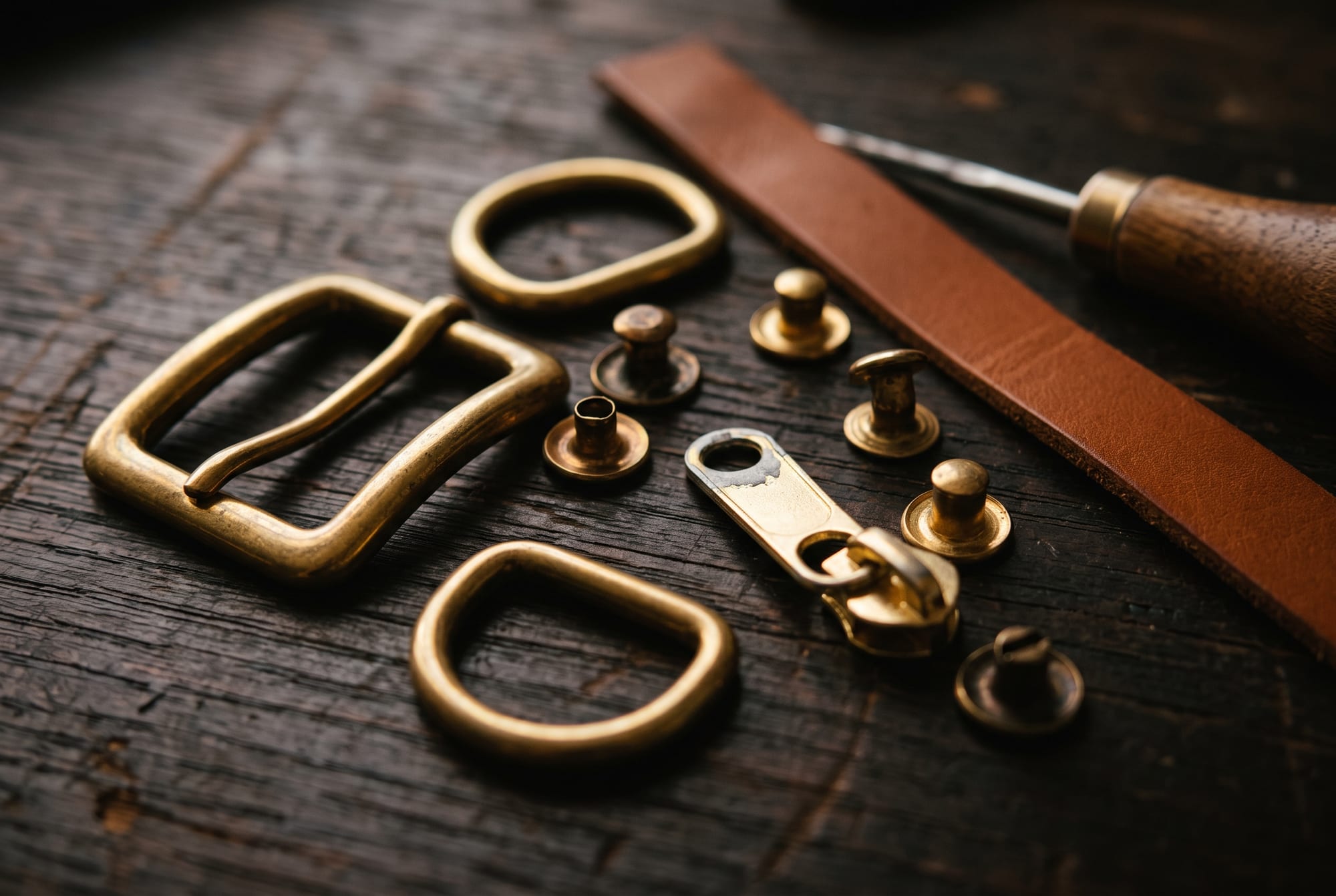
A woman brought me a bag last spring that her mother had carried through the nineteen-eighties. Thick vegetable-tanned hide, dark as treacle at the handles, a scuff on one corner you could read like a scar. Beautiful. The zip would not close — it would run the length of the bag and leave the teeth yawning open behind it, which is the classic symptom and, as it happens, the easiest thing on this entire list to fix.
Forty years of leather, defeated by a component the size of a thumbnail that cost the factory almost nothing.
That is the normal way a leather bag dies, and it explains an odd gap in how these things are sold. Listings will tell you the hide, sometimes the tannery, occasionally the weight in ounces. Hardly any will tell you what the fittings are made of — and the fittings are the part with a countdown on it.
The order things actually fail in
Here is what I see across the bench, arranged honestly. These are ranges for ordinary daily use, not laboratory figures, and a bag used twice a year will beat all of them.
Read the chart and the design problem becomes obvious. A well-made hide will do thirty years, and hand stitching will get most of the way there with it. Everything metal is on a much shorter clock. So the entire craft question about hardware is not “how do we make it last as long as the leather” — you cannot — but how do we make sure it can be changed.
Zippers: it is the slider, not the teeth
Nearly every zip failure I am handed is the same failure, and almost nobody names it correctly. People say “the zip is broken” and mean the teeth. The teeth are usually perfect.
A slider works by squeezing two rows of teeth into each other as it travels. It is doing that under load, thousands of times, and its jaws slowly spread. Once the gap is wide enough the teeth pass through without locking, and the zip opens behind the slider like a wake. Squeeze the slider very gently with pliers and it often works again for another year; replace the slider and the zip is genuinely new. The teeth, the tape and the stops are all untouched.
Two things follow from that, and they are the useful part of this section:
- Buy the zip by brand, and accept that this is one place where a brand name earns its keep. YKK is the default for good reason — consistent alloy, consistent tolerances, and, crucially, available: any competent repairer anywhere can source a matching slider in the right size and finish. RiRi and Lampo are the premium end and feel it. An unbranded slider costs a factory a fraction of a cent less and leaves a repairer guessing.
- Prefer metal teeth on a bag, coil on a pocket. Coil (the spiral nylon kind) is lighter, cheaper and self-healing — force it and it usually springs back. Metal teeth are stiffer, last longer under load and look right on leather, but a bent tooth is permanent. On a main opening carrying weight, metal. Inside, coil is fine and flexes better around a curve.
The numbers — #3, #5, #8 — are roughly the width in millimetres of the closed chain. A bag's main opening wants #5 as a floor; #8 is for luggage and heavy outerwear; #3 belongs on an inside pocket. A #3 zip on a main compartment is a straightforward sign that someone was saving money.
Brass, zinc alloy, and the test that does not work
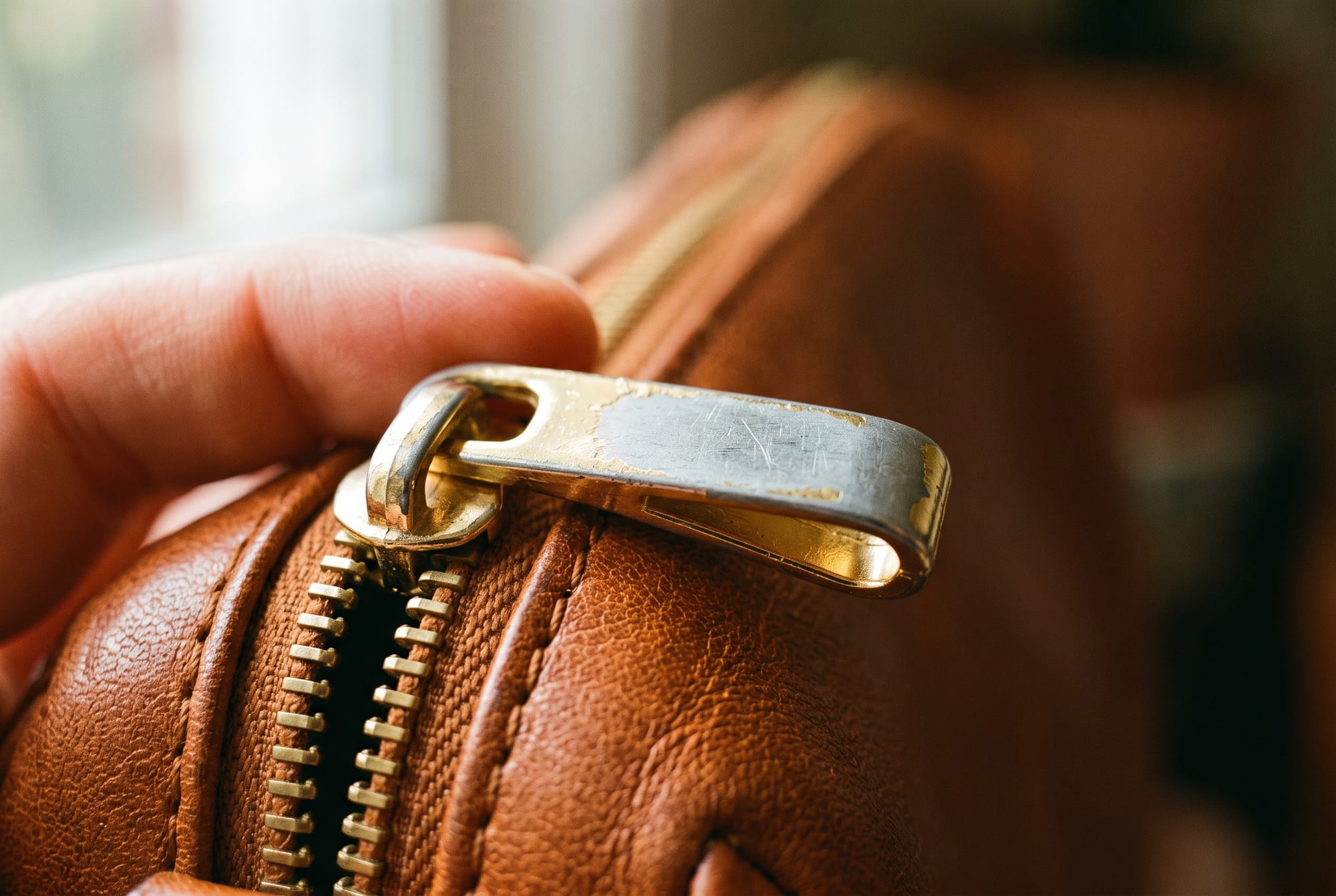
Most bag fittings are one of three things. Solid brass is a copper-zinc alloy all the way through, so wear just exposes more brass. Plated brass is brass with a thin layer of something else on top — nickel, gunmetal, gold tone — and when that layer wears you find brass underneath, which is no tragedy. Plated zinc alloy (the trade calls it Zamak) is a soft, cheap, easily die-cast metal with a decorative skin over it, and when that skin wears you find a dull grey that no amount of polish will change, because it is not a tarnish. It is the substrate.
Now, the test you have probably read about. I have recommended a version of it myself, in our sixty-second inspection, and it deserves a correction here:
A fridge magnet tells you whether the fitting is steel. It does not distinguish solid brass from plated zinc alloy — neither of them is magnetic. Plenty of shoppers have run the magnet test, got the answer they wanted, and bought Zamak.
What actually separates them is density. Brass is roughly a third heavier than zinc alloy for the same volume, and on a buckle or a D-ring in your palm that difference is unmistakable once you have felt it twice. Zamak feels like the right shape in the wrong weight — the way a prop feels. Brass also rings faintly when you tap two pieces together; Zamak gives a dead little click.
Then look at the wear points, which on a bag in a shop means the underside of the buckle tongue and the base of the zip pull. If a different colour is showing through anywhere, you have your answer, and you have it about five years earlier than the owner would have.
Tarnish is not damage

Here is where hardware and hide turn out to be arguing for the same thing. Unlacquered brass — what the architectural trade has taken to calling a living finish — darkens as it oxidises, and darkens unevenly, deeper where it is handled least and burnished bright where a thumb goes. It is doing exactly what the leather beside it is doing. Over a few years a brass buckle and a patinating hide converge on each other, which is a large part of why old bags look coherent and new ones look assembled.
Lacquered brass is brass with a clear coat to keep it bright. It works, for a while. Then the lacquer wears through at the contact points only, and you get a shiny field with dull patches in it — the worst of both, and unfixable without stripping the whole piece. This is precisely the argument we have already had about coatings on leather, in a different material: a film applied to something that wants to age will not age with it, it will fail in patches.
If you like your brass bright, polish it. Five minutes, twice a year. If you like it dark, do nothing, which is easier. What you cannot do is buy a coating and expect it to look after itself.
Rivets, snaps and magnets — where the leather fails, not the metal
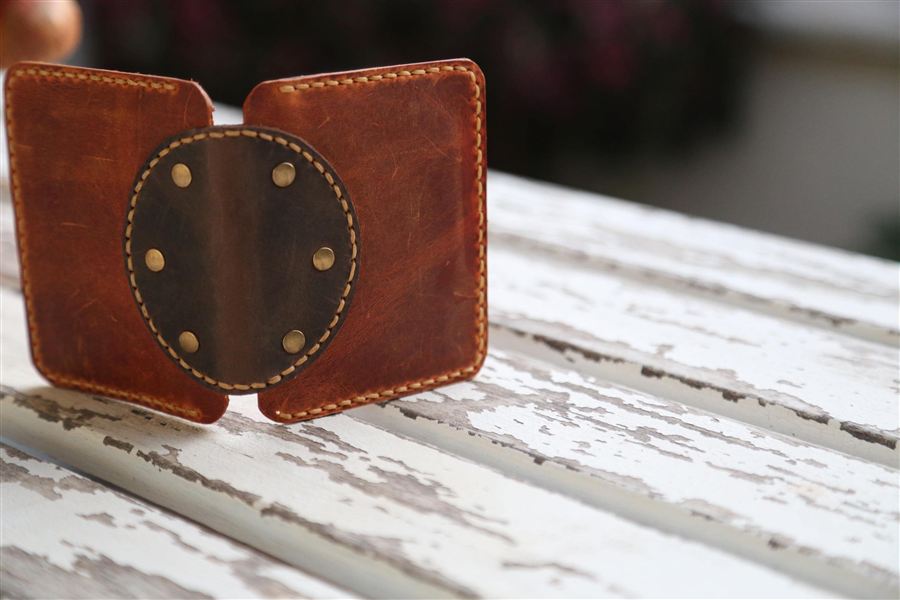
This group is different, and it is the part most buying guides get wrong. When a rivet fails, the rivet is fine. What has happened is that the leather around it has torn, because a rivet concentrates every bit of load onto a ring a few millimetres across.
So the thing to judge is never the rivet. It is what it was set into: is there enough thickness there, is there a second layer reinforcing it, is it set far enough from the edge that there is material to tear through? A good maker doubles the leather at every rivet and every strap anchor. A bag with a single-layer strap tab and a bright rivet through it is telling you where it will fail, in advance, and the metal will be blameless.
Snaps fail differently — the spring inside the socket fatigues, so the snap gets loose long before it gets broken. That is a genuine wear part and a cheap replacement, provided it is not buried. Magnetic closures almost never lose their magnetism; what fails is the thin prong-plate behind them working its way through the leather, which, again, is a leather-thickness problem wearing a metal costume.
The question that actually matters: can it be opened?
Everything above converges here. Since the fittings will outlive their welcome before the hide does, the real quality signal is not how good the hardware is. It is whether the bag was built to let someone change it.
What makes hardware replaceable:
- A stitched seam you can unpick. Saddle stitch comes apart stitch by stitch and goes back the same way. A lockstitch seam sealed under a thick painted edge is a rebuild, not a repair — another reason the edge tells you so much.
- Standard sizes. A #5 YKK slider, a 20 mm buckle, a common snap: parts anyone can get. Proprietary branded hardware is a locked door in five years' time.
- Nothing structural glued. Glue in leatherwork is for holding pieces still while you stitch them. Where it is doing the actual work, disassembly means damage.
- Reachable fixings. A strap anchor you can get a hand to, rather than one sealed inside a bonded lining.
And the sixty-second version, for a shop: heft the buckle and feel for density, not shape. Check the zip for a brand mark on the slider — it is stamped on the underside. Run a thumbnail over the pull and look for a colour change. Find a rivet and feel behind it for a second layer. Work the zip four or five times and listen: a good one is quiet and even, a bad one grinds at the same point each pass.
None of this is about buying gold-plated everything. It is about matching the lifespan of the parts to the lifespan of the material, and where you cannot — and with hardware you cannot — making sure the short-lived part is the one you can reach.
We use solid brass, unlacquered, in standard sizes, and we saddle stitch, which means every seam on our work can be opened by anyone with a pricking iron and an afternoon. That is not generosity. It is the only way a thirty-year object survives a five-year component. If something of ours ever needs a part changed, write to us — info@pazleather.com — and if it is easier for you to take it to someone local, we will tell you exactly what to ask for.
Further reading
- Saddle stitch vs machine stitch: the seam that decides how long a bag lives
- How long does a leather bag last? The honest numbers
- How to buy leather accessories: a maker’s 60-second inspection
- Leather thickness: what an ounce means, and why thicker is not better
- The art of leather restoration: bringing old leather back to life
- Glossary: saddle stitch