Guide · 13 October 2026 · by Zafer
How many cards should a leather wallet hold? A slot stretches once
The number in the product description reads like a capacity — four slots, eight slots, twelve, and more must be more generous. It is not a capacity. A leather card slot is a one-way mechanism that stretches exactly once, to the shape of whatever you put in it, and then stops — which means the first few weeks of a wallet’s life decide what it will be for the next twenty years.
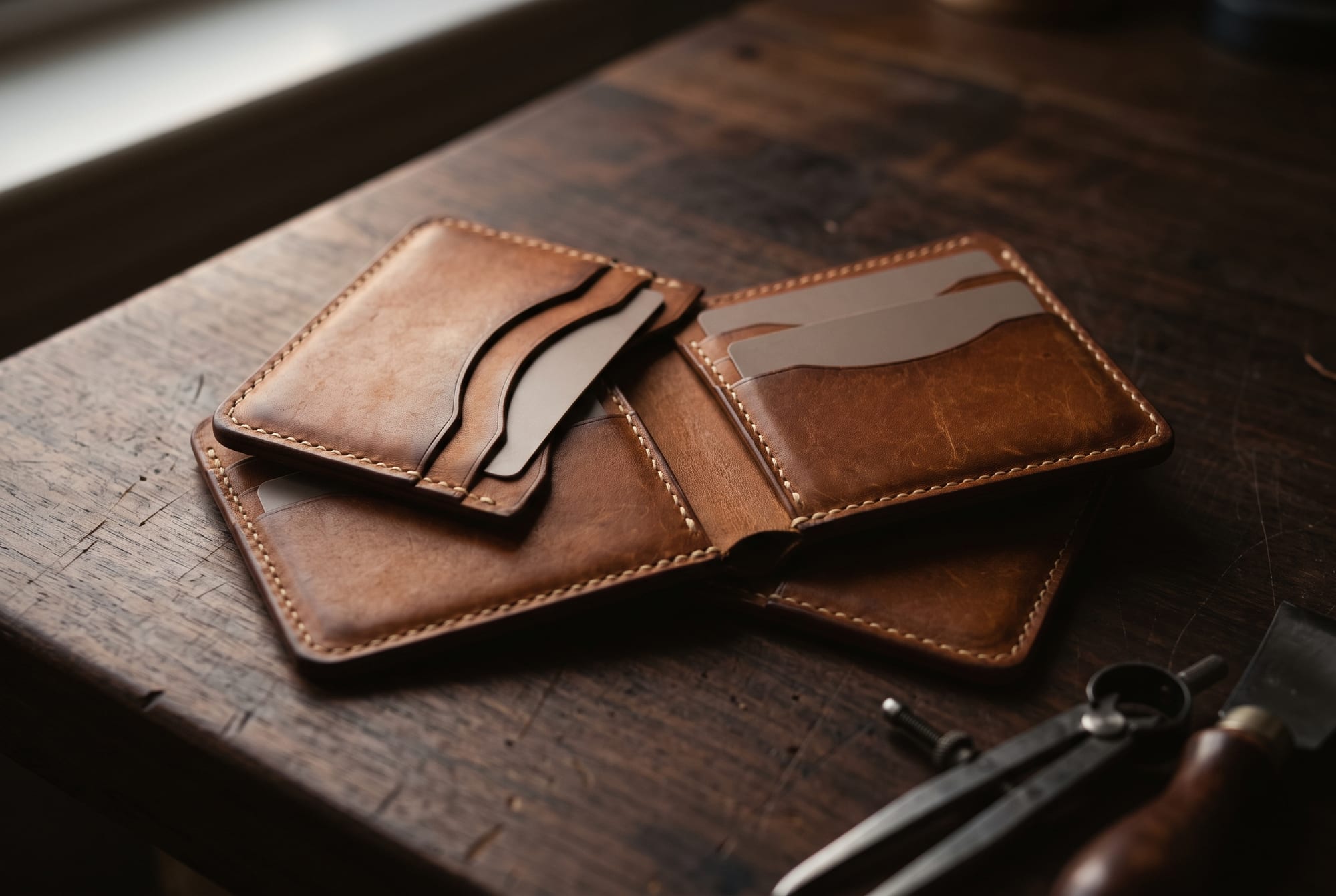
A wallet comes across the bench for a new lining and I do the thing I always do first, which is tip it and watch.
Three of the four slots hold. The fourth lets its card slide out under its own weight, and the mouth of that slot stands visibly open even with nothing in it — a small permanent yawn in the leather.
Nothing is broken. No stitch has gone, the hide is sound, the edges are still tight. That slot simply spent its first two months with four cards in it, and leather does not forget.
A slot is a mechanism, not a pocket
The useful shift here is to stop thinking of a card slot as a container and start thinking of it as a clamp.
A slot holds a card because the leather has taken the exact shape of that card and is pressing back against it. There is no catch, no elastic, no friction coating — the grip is the deformation. Which means a new slot is supposed to be tight, and a slot that has conformed to one card is working exactly as drawn.
The trouble is that leather in tension does not behave like elastic. Collagen fibres in a hide are crimped and interwoven, and a load does two different things to them: it takes some of the crimp out, which recovers when you take the load off, and it slides and reorients the fibres against one another, which does not. That second part has a name — set, or fibre creep — and it is the majority of what happens in a card slot.
Stretch is use. Set is permanent. A card slot stretches exactly once, to the largest thing it has ever held, and then it stops.
So the mechanism is one-way. A slot stretched by three cards has three cards’ worth of shape in it for good, and it will never grip one card properly again. There is no putting it back: no amount of conditioning, drying, cold or clamping reverses fibre set, because nothing has been damaged that could be repaired — the fibres are simply lying somewhere else now.
Which puts an unexpected weight on the break-in period. The first three or four weeks, when the hide is newest and gives most easily, are when the wallet is quietly being set to a shape. Whatever is in the slots during those weeks is the shape you keep.
Why slot leather has to be thin, and what that costs
The second half of the explanation is in the thickness, and it starts with an arithmetic problem the maker has to solve before the first stitch.
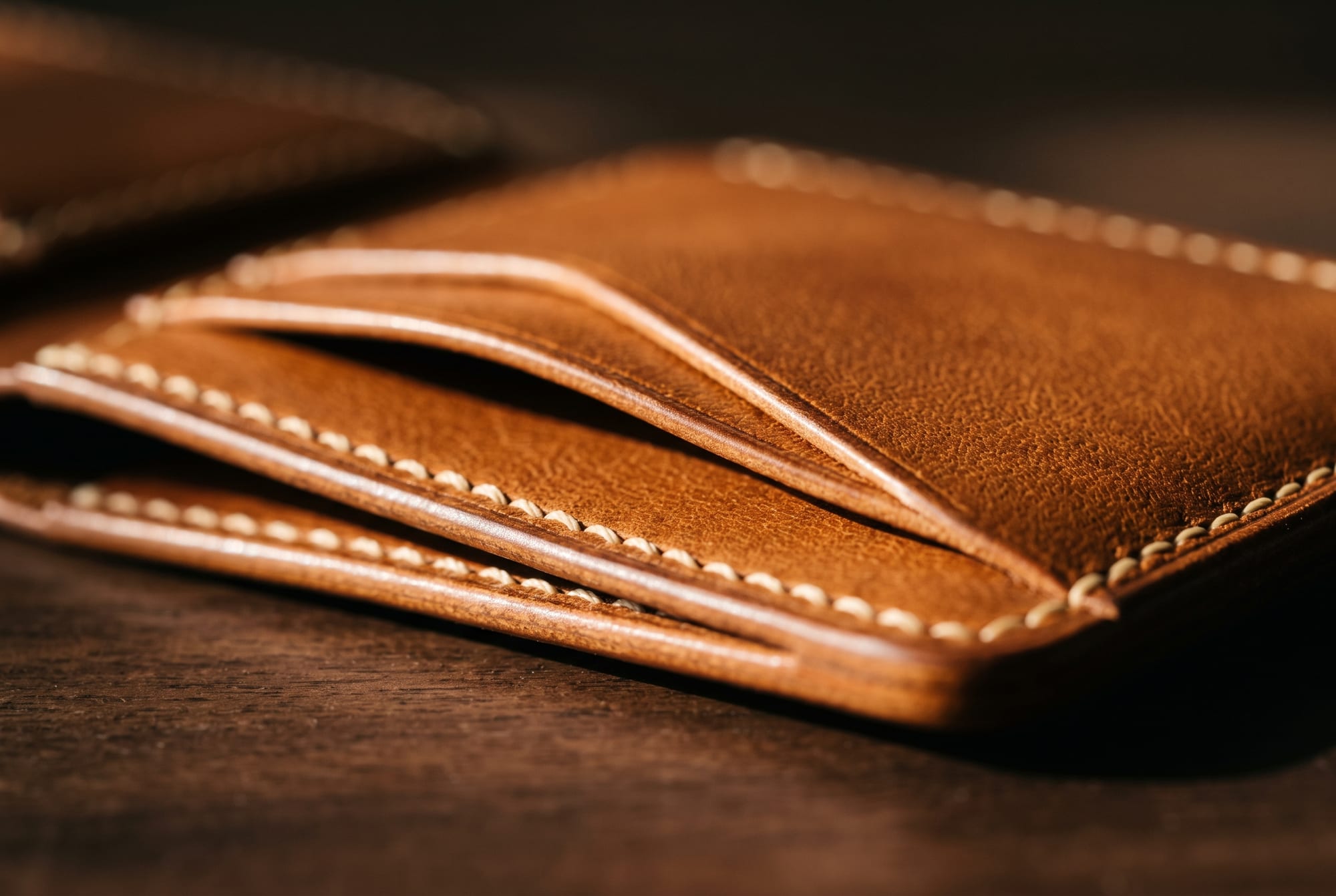
A payment card is 0.76 mm thick — that is fixed by standard, which is unusually convenient for a trade where almost nothing is. Everything else in a wallet is a decision. If I cut the slot leather at the thickness I would use for a strap, a four-slot wallet is a brick before anything goes into it; so slot leather gets skived — shaved down, usually to well under a millimetre, and often tapered so it is thinnest right at the mouth where the layers overlap.
That is the trade, and it is worth naming plainly: thin enough for the stack to lie flat is thin enough to have no reserve. A slot face at 0.6 mm has very little material to resist being stretched, which is exactly why it conforms so beautifully to a card — and exactly why the mouth of the slot, not the stitching, is where almost every wallet actually wears out.
What a maker can do about it is limited and worth looking for: fold the leather at the mouth so the opening is a doubled edge rather than a cut one, or bind it, or run the stitch line close enough to the opening to carry some of the load. What a maker cannot do is make a thin slot behave like a thick one. For the longer argument about why thicker is not better in general, there is a whole piece on ounces and where the weight should go.
The fold is the other half of the problem
Everything above is about one slot. The second failure has nothing to do with the slots at all, and it is the one that ends wallets.
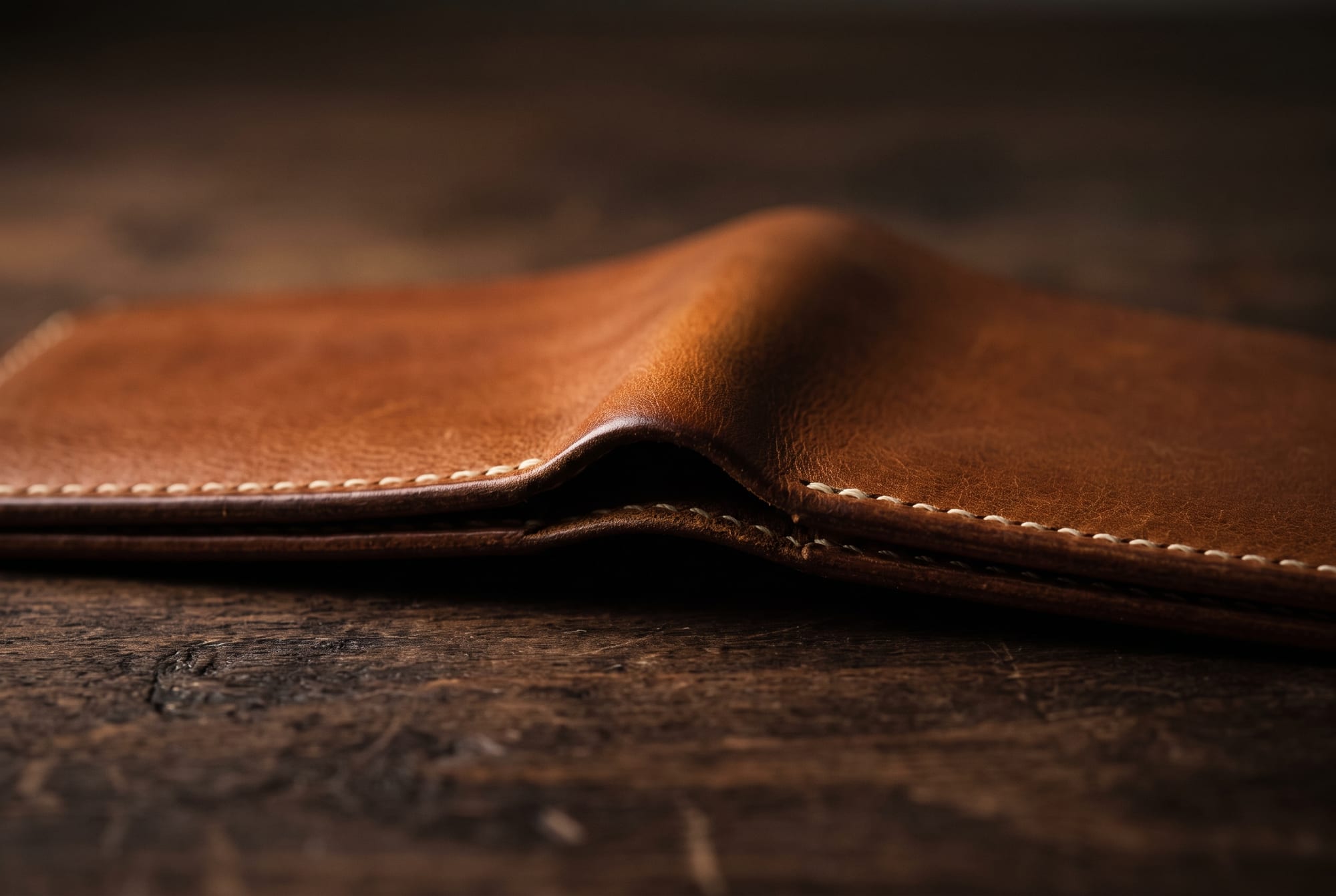
A bifold has to close around its own contents. The outer panel — the spine — is on the outside of that curve, so it travels furthest and stretches most every single time the wallet shuts. That is fine, and leather is good at it, as long as the curve stays gentle.
Add cards and the geometry moves against you quickly. Every card you put in raises the stack, the stack sets the radius the spine has to arc around, and a bigger radius means the outer fibres travel further on each close. Past a point the fold stops being a fold and becomes a crease: a single hard line where all of the bending is concentrated instead of being spread across a curve. Creases are where finish cracks and where, eventually, the grain splits.
A slim wallet and a fat one do not wear differently in degree. They fail in different places — the slim one at the slots, the fat one at the spine.
The seam at the fold shows it first, which makes it a useful thing to look at on a used wallet. This is also one of the few places where the stitching method genuinely changes the outcome: a saddle stitch is two independent threads locked at every hole, so a thread cut by a cracked spine stays put, while a machine lockstitch at the same spot will run. And the edge tells you how much care went into the fold in the first place — a burnished edge or a painted one behave differently where the leather is working hardest.
So: how many?
Here is the answer, since it is the reason anyone searched for this.
Count what you actually touch in a week, add one, and buy for that number. Not what you own; what you use. For most people the honest count is between three and six, and almost everybody guesses high before they go and look.
The spread, by object:
- A slim card wallet: three to six. No fold to worry about, or a very shallow one. This is the format that ages best, because the only thing that can go is a slot mouth and the slots are usually the easy part to make well.
- A bifold: four to eight. It will physically hold more and it will cost you the spine to do it. Eight is a real eight; twelve in a bifold is a wallet being asked to be a different object.
- Anything advertising twelve or more: judge it as a small organiser, not a wallet. That is not an insult — some people genuinely need one, and a gusseted or zip-around format handles the thickness honestly because it was designed around it rather than stretched to it. What it is not is a pocket wallet, and buying it as one is how people end up disappointed in a perfectly good piece.
One adjustment: a cash pocket changes the arithmetic in your favour. Notes compress and cards do not, so a few folded notes add far less to the closed thickness than the same millimetres of card would. If a wallet has a cash pocket, spend the thickness there.
And it is worth being blunt about what is in most wallets that does not need to be: the second bank card for the account you do not use, the loyalty card for a shop in another city, four receipts, and a card that expired in the spring. None of those are carried. They are simply stored in the one container nobody ever empties — and they are setting your slots while they sit there.
Four things to do in the shop
All of this reduces to a few seconds of handling, and none of it requires knowing anything about leather.
- Put your own cards in. All of them. Then close it. Nothing else tells you as much. If the open edge gapes, or the wallet will not sit shut in your hand, that is your answer before you have looked at a single stitch. Take your cards with you.
- Pull one card out and watch the mouth. It should close back on itself. If a brand-new slot stays open after one card has been in it for a minute, the leather there is too thin or too soft for the job.
- Look at the mouth edge. You are looking for leather that has been skived to a taper and then folded, bound or burnished — not a raw cut edge left as it came off the knife. This is a thirty-second check that separates a great deal of work.
- Look at the spine. Does the stitch line carry through the fold, or stop short of it? Is there a single hard crease already, on a wallet that has only been handled in a shop? The rest of the sixty-second inspection applies here as it does anywhere.
Living with one
Three habits, and the first is the only one that really matters.
Break it in with the stack you intend to carry. Not everything in your old wallet “just while you sort it out” — that is precisely the fortnight in which the slots are being set. If you want a four-card wallet, carry four cards from day one.
Do not store it stuffed. A wallet put in a drawer for a year with ten cards in it comes out with ten cards’ worth of shape and a crease where the fold was held. Empty it before it goes away. Done reasonably, a wallet is a thirty-year object, and almost all of the ways it does not get there are decisions rather than accidents.
Expect it to mark a pale pocket lining at first. A new dark or richly dyed wallet carries surplus dye at the surface, and a trouser pocket is exactly the warm, slightly damp, constantly rubbing situation that lifts it. It is finite and it stops — the full explanation, in both directions, is here.
Three questions
Will a leather card slot loosen up over time?
Yes, and the trap is in the word up. It loosens to the shape of whatever is in it and then stops; it does not keep giving, and it does not come back. So a tight new slot will be comfortable within a week or two of carrying one card, and that is the loosening you were hoping for. What will not happen is a slot getting roomier and roomier in a useful way — past the shape of its contents, loosening is just slackness.
How do I stretch a tight new card slot?
Mostly by leaving it alone. Put the card in, leave it in, and carry the wallet — the slot takes the shape within a few days, which is faster than any method you could apply and more accurate, because the card doing the shaping is the card that will live there. If it genuinely will not take the card, work it gently with the actual card rather than something thicker: in and out, a little further each time, over an evening. No heat, no pliers, no wooden formers that are larger than a card. And no oil: oiling a slot to loosen it softens the fibre everywhere at once, you cannot aim it, and you will overshoot into the third panel of that first diagram with no way back.
Is a slim wallet actually better for the leather?
Better for the fold, which is the failure that ends wallets — so yes, materially. The slots work the same either way; it is the spine that is spared. The honest cost is not a leather question at all: fewer slots means deciding what you carry, and that decision is the part people are really resisting when they ask for one more slot.
Further reading
- Monogramming leather: blind deboss, foil, and whether to do it at all
- Leather thickness: what an ounce means, and why thicker is not better
- How to buy leather accessories: a maker’s 60-second inspection
- Saddle stitch vs machine stitch: the seam that decides how long it lives
- Burnished vs painted edges: why makers read the edge first
- How long does leather last? The honest numbers
- Dye transfer: why a new wallet marks a pale pocket, and when it stops