Guide · 11 September 2026 · by Zafer
Leather thickness: what an ounce means, and why thicker is not better
A listing will tell you the colour, the dimensions, sometimes even which tannery the hide came from. It almost never tells you the thickness — which is the number that decides whether a bag holds its shape, whether a wallet ever closes, and what the thing weighs before you put anything in it.
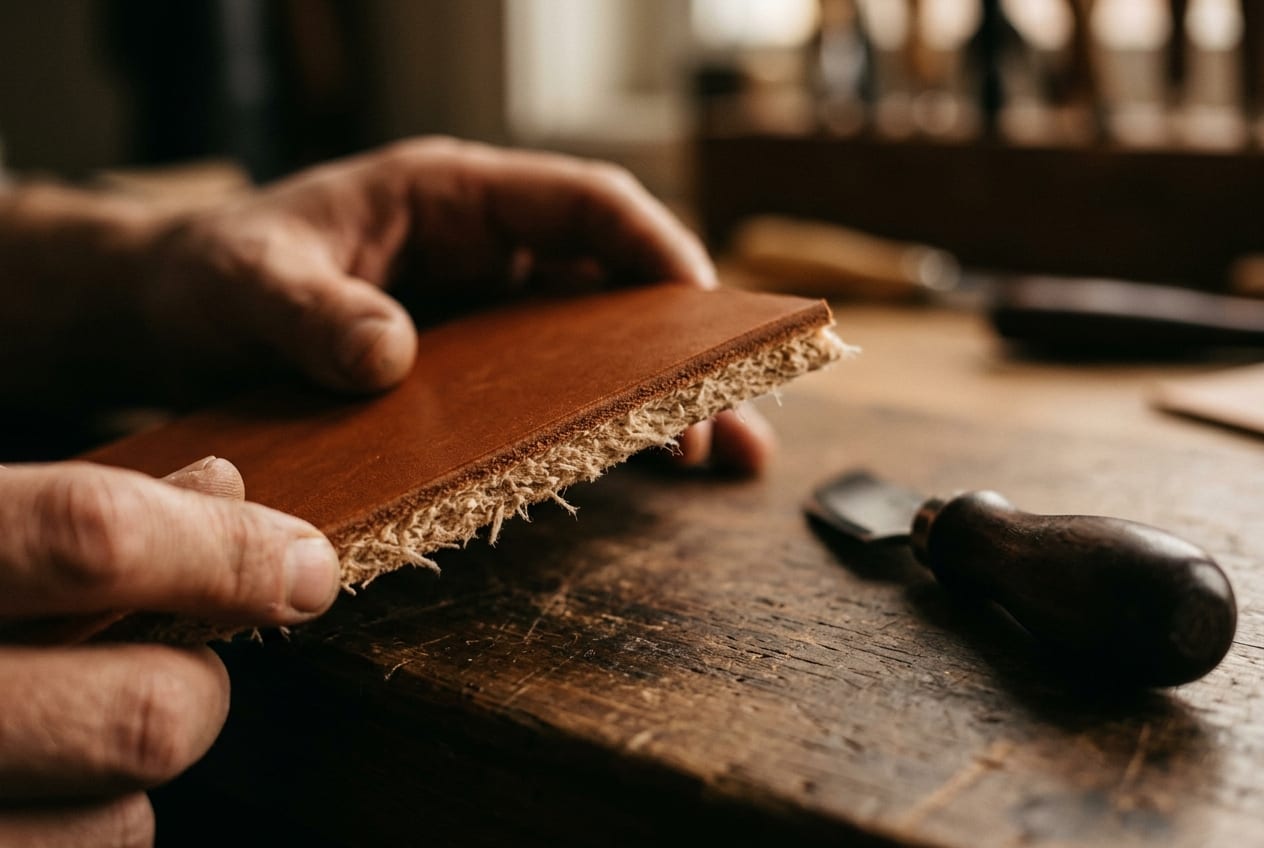
Customers ask me about grain, about tanning, about whether the stitching is really done by hand. I have never once been asked how thick the leather is. Makers, meanwhile, ask each other almost nothing else — because it is the first decision of a build and the hardest one to undo. Cut a wallet from the wrong weight and no amount of skill later will rescue it.
So this is the spec that goes missing between the bench and the shop window, and how to read it.
The number nobody lists
Thickness is doing four jobs at once. It decides whether an object stands or drapes — the difference between a tote that keeps its mouth open and one that slumps into a puddle. It decides weight, which I will come back to, because the maths is more brutal than people expect. It decides how tightly the thing can fold, which is the whole argument in a wallet. And over a decade it decides what wears: a thin strap does not fail because the leather was bad, it fails because there was never enough of it.
It goes unlisted for an unglamorous reason. Colour and dimensions flatter a listing. Thickness invites a follow-up question, and answering it honestly means admitting a choice was made — usually the choice to use less material.
What an “ounce” is doing on a leather listing
Leather is one of the last trades still quoting a weight when it means a thickness, and the reason is historical: hides were bought and sold by area, so tanners described them by what a square foot weighed. Leather weighing one ounce per square foot turned out to be about one sixty-fourth of an inch thick, and the shorthand stuck.
That gives you the only conversion you need:
One ounce = 1/64 inch ≈ 0.4 mm. So divide the ounces by two and a half and you have millimetres. Four ounce leather is 1.6 mm. Eight ounce is 3.2 mm.
Two honest caveats. First, it is a weight standing in for a thickness, and that equivalence assumes ordinary density — a dense, firm vegetable-tanned shoulder and a soft garment hide at the same nominal ounce are not quite the same calliper reading. Most European tanneries have given up and simply measure in millimetres, which is why you will see both units on the same shelf. (Shoe soles keep a third unit entirely, the iron, at 1/48 inch. Nobody has ever explained this satisfactorily.)
Second, you will almost always see a range — 4–5 oz, never 4 oz. That is not vagueness, it is honesty. A hide is an animal, not a sheet of plywood, and it is thicker down the backbone than at the belly. The range is the band the tannery will guarantee.
The ladder, object by object
Read the diagram from the top and you are watching a material change its mind about what it is for. At 1–2 oz leather behaves like heavy cloth: it drapes, gathers and lines things, and it has no opinion of its own. By 4–5 oz it has become a structural material — stand a panel on its edge and it stays there. By 8–10 oz it is closer to a board: you cannot fold it at all, you can only bend it wet, or carve it.
A few of the rungs are worth arguing about:
- Wallets live at 2–4 oz, not higher. Every extra tenth of a millimetre gets multiplied by the number of layers, which is the next section and the most common mistake in the whole craft.
- Bags are two weights, not one. The body can be 3–5 oz; the handles and shoulder strap want 6–8 oz, or two layers of 3–4 oz glued and stitched back to back. A strap is the only part of a bag that carries everything, and it is the part most often cut from the same panel as the body to save a hide.
- Flat objects need more than people think. Placemats and table runners want 2–3 mm, because a flat thing has nothing to hold its shape but its own stiffness. Thin hide curls at the corners within a season and never lies flat again.
- Belts at 8–10 oz are not machismo. A belt is a strap under constant tension with a hole punched through it. Under about 3 mm it stretches, the holes elongate into slots, and within two years it is a different length than it started.
Why thicker is not better
There is a persistent idea that thickness is a proxy for quality — that a heavier bag is a better bag. It is the same instinct that makes people trust a heavy door. In leather it is wrong often enough to be worth dismantling, for two reasons.
The first is weight, and the maths is unforgiving. Remember that an ounce is literally a weight per square foot. So you can weigh a bag before it exists. A medium tote holds roughly five square feet of leather in its finished panels. At 4 oz that is twenty ounces — about 570 grams. Take the same pattern up to 8 oz “because it feels more substantial” and it is forty ounces: a kilo and a hundred grams of empty bag, before hardware, before lining, before anything you actually want to carry. That is the difference between a bag you take out and a bag you admire in a cupboard.
The second is folding. Leather bends around a radius, and the working rule at the bench is that the inside of a fold wants a radius of roughly the leather’s own thickness. At 1.2 mm that is nothing — a crisp hinge. At 3 mm the same fold becomes a fat, rounded knuckle that will not lie down, and the grain on the outside of the curve is being stretched hard every time it closes. Cracks, when they eventually come, start there. Thickness in the wrong place does not add durability; it manufactures a stress line.
Strength in leather comes from putting the right weight where the load is, not from putting more weight everywhere. A heavy bag is usually not a strong bag. It is an undesigned one.
Why a 1.2 mm wallet is never 1.2 mm thick
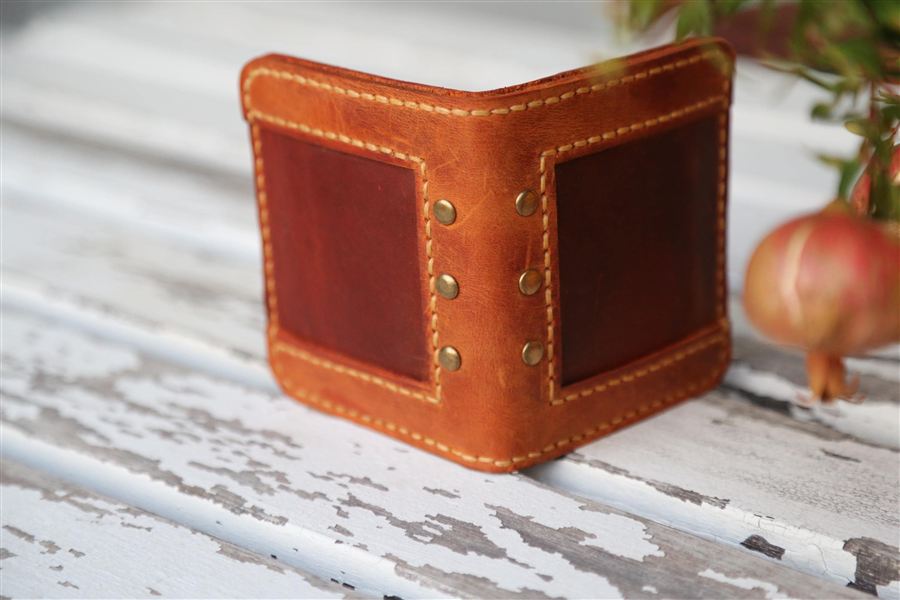
Here is the thing customers cannot see and makers think about constantly. A wallet is not made of leather; it is made of stacks of leather. At the card slots of an ordinary bifold you have the outer shell, the lining, and two slot panels overlapping — four layers. Cut all four from a reasonable 1.2 mm and the stack at the stitched edge is 4.8 mm. Fold that wallet in half and the spine is carrying nearly a centimetre. It will not close, it will not sit flat, and it will wear a rectangle into a trouser pocket.
The answer is skiving: shaving the flesh side of each layer down to a feather along the last centimetre or so before it meets another layer. Done properly, four layers of 1.2 mm close to something near 2.6 mm at the seam. The leather is exactly as strong where the strength is needed — in the middle of the panel, where nothing has been removed — and thin where it only needs to be joined.
This is also, quietly, one of the places where hand work shows up in the price. Skiving is slow, it is done with a very sharp blade against a stone or glass surface, and a slip ruins a finished panel rather than a scrap. It is invisible in a photograph and unmistakable in the hand — the same reason makers read the edge of a piece first. A thick, blunt, square edge on a small item usually means nobody skived anything.
The same hide is three different thicknesses
One more complication, and it is the one that separates people who buy leather from people who buy from a hide. A cow is not uniform. Along the backbone and over the rump — the bend, or butt — the fibre is dense, even and firm; that is where belts and straps come from, and why bends are sold separately and cost the most per square foot. The shoulder is slightly softer and carries growth wrinkles, which some of us like and some customers read as damage. The belly is thin, loose-fibred and stretchy.
All three can be sold as the same nominal weight, because tanneries even them out by splitting: running the hide through a band-knife machine that shaves it from the flesh side to a set thickness. The upper layer keeps its original surface and stays full-grain — splitting from underneath does not touch the grain. The lower layer becomes the split: suede, and the raw material of a great deal of cheap “genuine leather”.
Which means two panels of identical 2 mm full-grain, from the same hide, can behave completely differently — one cut from the bend that will stay flat for thirty years, one cut from the belly that will stretch the first time you load it. Thickness tells you a great deal. It does not tell you everything, which is why it belongs next to grade and tannage rather than instead of them.
How to check it yourself
You do not need a workshop for any of this.
- Use a credit card. It is 0.76 mm by international standard — almost exactly two ounces. Hold it against the edge of the leather and compare. Thinner than the card is lining weight. About the card is wallet weight. Twice the card is a bag body. Three times is a belt.
- Find a cut edge. The inside of a flap, a strap end, the mouth of a pocket. A cut edge is the only place leather tells the truth — about thickness, and about what it is made of.
- Bend it and watch the outside of the curve. Firm leather that folds cleanly and springs back is doing its job. Leather that creases into a permanent white line is either too thick for the fold or coated.
- Ask. “What weight is this in?” is a completely ordinary question, and the answer tells you as much about the seller as about the leather. Anyone who made the thing knows the number without checking. Anyone who resells it will change the subject.
And if you want an honest rule to leave with: for anything that folds, thinner than you expect; for anything that must stay flat or carry a load, thicker than you expect. Almost every disappointing leather object I have ever handled got that backwards.
If you are having something made and are not sure which way to go, tell us what the thing has to do rather than how thick you want it — info@pazleather.com. Weight is our decision to get right, not yours to specify.
Further reading
- The leather desk pad: what size to buy, and what it becomes in five years
- What is full-grain leather? The part of the hide that does the work
- Leather grades explained: full-grain, top-grain, “genuine” and bonded
- Burnished vs painted edges: why makers read the edge first
- How to buy leather accessories that last
- Glossary: skiving
- Glossary: grain & corium