Guide · 1 September 2026 · by Zafer
Burnished vs painted edges: why makers read the edge first
Hand me a bag at a fair and I won’t look at the logo, the lining or even the stitching. I’ll turn it over and find an edge — because an edge is the only place a bag shows you its own cross-section.
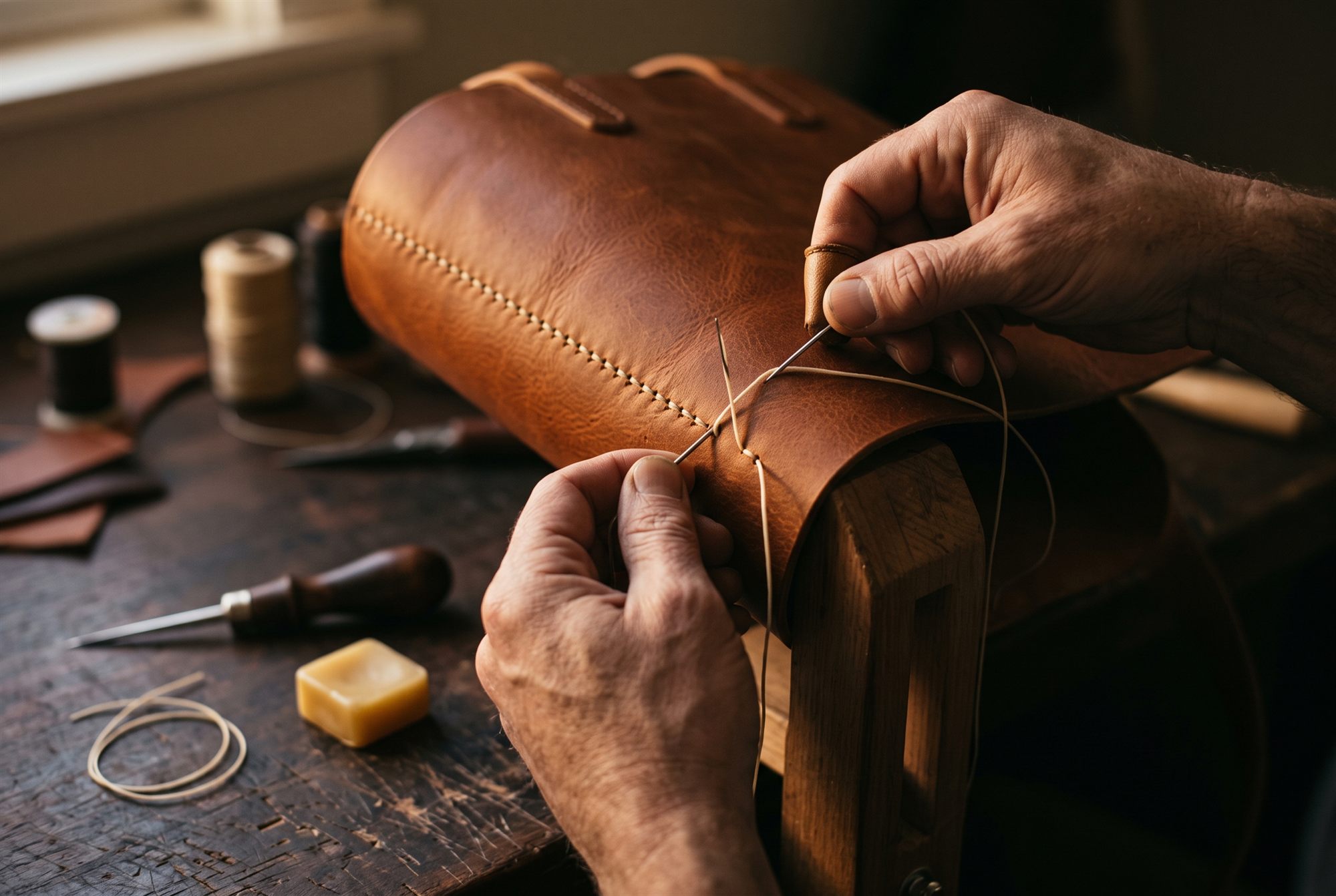
A label can claim anything. A photograph can be lit until any surface looks expensive. But the moment leather is cut, the inside of the material is on public display — and nobody has ever invented a way to make a cheap edge look like a finished one from arm’s length. That is why the edge is the first thing every maker checks, and the last thing most buyers think to look at.
An edge is a cross-section
Everywhere else, a bag shows you its surface. At the edge it shows you its section: the dense grain layer at the top, the looser corium fibres beneath, the glue line where two panels meet, the thread passing through. Everything a finish can hide on the face of a hide is visible in that two-millimetre band. A coated split can be photographed to look like full-grain all day long, and then its edge shows uniform fluff under a skin of paint.
So an edge is not a decorative detail. It’s an admission.
Four ways to close an edge
Burnishing — slicking, to most of the trade — is friction and water. You damp the cut, then rub it hard with canvas, wood or bone until the heat and pressure fuse the fibres into a band that reflects light like glass. Nothing is added but water and a final pass of wax. That’s why a burnished edge is the leather’s own colour, only deeper, and why it can be renewed forever: there is no film to fail, just fibre that can be re-compressed.
Edge paint is the opposite logic: a flexible acrylic applied in thin coats, each sanded and set before the next. And here is the part the internet gets wrong — paint is not a cheat. Chrome-tanned hides, soft lambskin, oily pull-ups and anything padded will never burnish; their fibres are too loose or too greasy to fuse. On those leathers, a patiently built edge coat is the honest, correct answer, and some of the finest workshops in the world do nothing else. What’s cheap isn’t paint. What’s cheap is one thick dip, no sanding, thirty seconds, done.
A burnished edge is the leather sealing itself. A painted edge is something else promising to hold it shut. Both can be excellent — but only one of them can be repaired with water.
Why corners go first
An edge coat is a rigid-ish film glued to a material that bends every time you use it. On a straight run it flexes with the leather and survives. At a corner — a strap end, the bottom of a flap, the mouth of a pocket — three things happen at once: the flex is sharpest, the abrasion is highest, and the film is thinnest because paint pulls away from tight radii as it dries. So the first chip appears there. Then moisture reaches the raw fibre behind the coat, the fibre swells, and the paint loses its grip along the edge like a lifting sticker.
This is exactly why we spend the twenty minutes per metre that burnishing costs instead: a dipped coating chips by year eight, and by then a burnished edge has only got darker. Two hours of a tote’s thirteen bench-hours go on its edges — more than the cutting.
How an edge gets to glass
Two details decide whether it works. The first is the preparation: if the layers aren’t sanded to one plane and both corners bevelled, no amount of rubbing will make a round edge — you’ll just polish a lumpy one. The second is patience at step five. Beginners stop when the edge looks smooth; it’s finished when it feels hot and starts throwing back a highlight. That’s the moment the fibres actually fuse, and it always takes longer than anyone expects.
The edge test: reading a bag in a shop
- Run a fingernail along an edge. Nothing should catch. A burnished edge feels like a polished dowel; a good painted edge feels like a smooth bead. A lifted lip, a ridge or a fuzzy patch is the whole story.
- Then look at the corners — strap ends, flap bottoms, pocket mouths. This is where a coat chips first, so it’s where a shop-worn sample tells the truth about year eight.
- Look for a colour line. Paint sits on the edge, so it usually reads as a slightly different tone, sometimes proud of the surface like piping. A burnish is the same leather, only darker — no boundary.
- Check the edges nobody photographs: inside the flap, the back of a strap, the interior pocket. Speed shows up where the camera doesn’t go, and a maker who finished those edges finished all of them.
- Bend one. Flex a strap gently and watch the edge: leather-on-leather just creases; a brittle coat shows hairline cracks along the fold. Do this to your own bag, not to the shop’s.
Five seconds each, no tools, and together they’re very hard to fool — the same logic as the rest of the buying checklist.
Living with each kind of edge
Burnished: edges dry out before faces do, because they’re end-grain and they take the friction of every day. Once or twice a year, run a fingertip of conditioner along them, and when one looks tired, damp it and rub it briskly with a scrap of denim or canvas for a minute. It comes back. That’s the whole repair.
Painted: never pick at a lifting flake — you’ll take the neighbouring millimetres with it. Keep the edge dry, keep oils off the coat (it isn’t leather, and it doesn’t want feeding), and when it does start to go, a workshop can sand the run back and rebuild it in thin coats. It’s a genuine repair job, not a five-minute fix, which is worth knowing before you buy.
Folded: almost maintenance-free until the glue line lifts, at which point it needs a maker, not a tube of adhesive.
Stitching is the part people photograph. Edges are the part makers argue about — because they’re the last hour of the job, and the first thing to fail.
Every piece that leaves this atelier is full-grain and vegetable-tanned, which means we get to burnish — the fibre is dense enough to seal itself, so we finish with water, canvas and wax and nothing that can peel. Not because paint is beneath us, but because on this leather it would be a downgrade: a film that ages badly on a material that ages well.
Holding a bag and not sure what you’re looking at? Photograph an edge and a corner and send them to info@pazleather.com — burnished, painted or dipped, we’ll tell you which, and what it means for year ten.
Further reading
- Leather thickness: what an ounce means, and why thicker is not better
- Saddle stitch vs machine stitch: the seam that outlives the bag
- Why handmade leather costs more: a maker opens the ledger
- How to buy leather that lasts: the shop-floor checklist
- What is full-grain leather, really? A maker’s anatomy lesson
- Glossary: burnishing
- Glossary: edge finishing