Guide · 12 October 2026 · by Zafer
Mould on leather: why it starts at 60% humidity, and what you can actually save
A bag that was clean when you put it away comes out of the cupboard in September with a grey-green bloom across the gusset. Nothing happened to it — and that is the whole point. Mould is the only leather problem that gets worse while the piece is doing nothing at all, and it needs one thing you can genuinely control.
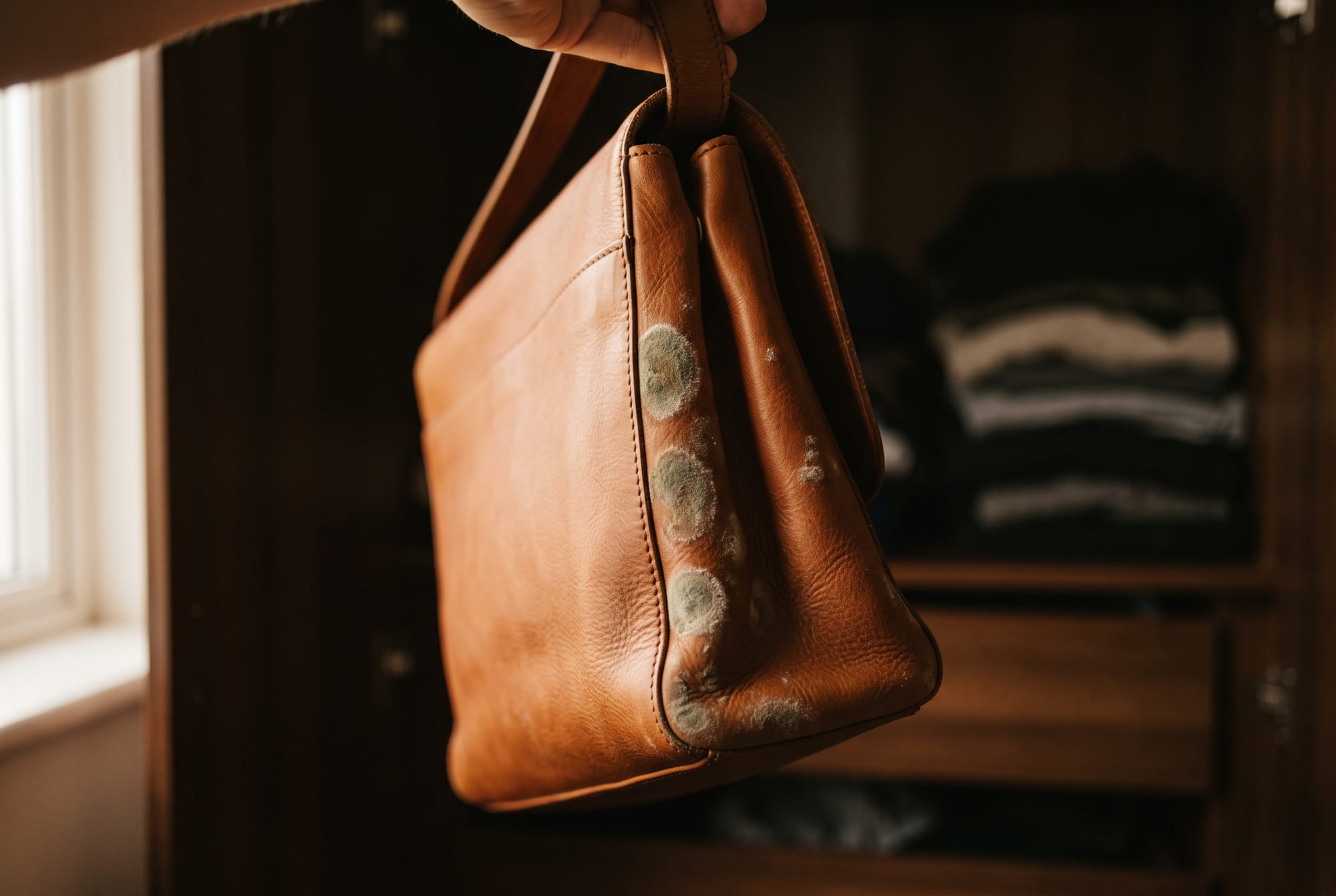
The bag comes out of the cupboard at the end of September and the smell arrives before I have the dust bag open — not the sour note of a hide that has been wet, something earthier than that, like the back of a greenhouse.
Inside, along the gusset where the leather has been folded against itself for five months, there is a soft grey-green bloom with a fuzzy edge. It is thickest on the face that was resting against the outside wall.
Nothing happened to this bag. Nobody spilled anything on it, it was not caught in the rain, and it went away clean. That is the part worth sitting with, because it is the difference between this problem and every other water problem we have written about.
Mould does not arrive. It waits for water
There is a reflex in the question “where did it come from”, and it sends people looking for a source — a leak, a damp towel, something that touched the bag. Usually there is nothing to find, because the spores did not come from anywhere. They were already there.
Mould spores are in the air of every room, on every shelf, and on the hide from the day it was tanned. You cannot remove them from a wardrobe and there is no product that will. The hide is also, from a fungus’s point of view, an unusually good meal: collagen, the fats and oils worked into it, and — in a vegetable-tanned hide especially — residual sugars and plant tannins left behind by the tannage.
So two of the three requirements are permanent features of owning leather. The third is water, and water is the entire subject.
Not rain. Water vapour. Leather is hygroscopic: it exchanges moisture with the air around it until the two are in balance, which is also why a hide feels different in February and August. Above roughly 60% relative humidity that balance puts enough water into the fibre for a spore to germinate, the fibres swell slightly as they take it up, and in warm damp air a colony can establish in 48 to 72 hours. Below about 50% it cannot start at all, however many spores are sitting on the surface.
Every other water problem on this site is an event — it was rained on, something was spilled. Mould is a condition. It is the only damage that gets worse while the piece is doing nothing at all.
Which reframes the job. You are not cleaning a bag, and you are certainly not sterilising a cupboard. You are managing the humidity of a volume of still air, and the leather is simply the thing in that air which is edible.
It also explains the two conditions people mix up. Cold and wet is survivable — cold air holds little vapour, and a hide that gets wet and is dried properly is fine. Warm and damp is the hard case, and it is the one that quietly ruins things: a loft in August, a ground-floor cupboard on an outside wall, a bag shut inside a plastic bag “to protect it”.
Three white things, and only one of them is alive
Before anything comes off, it is worth knowing what is on there, because most of the photographs sent to us captioned mould are not mould. There are three pale films that turn up on leather and they want completely different responses.
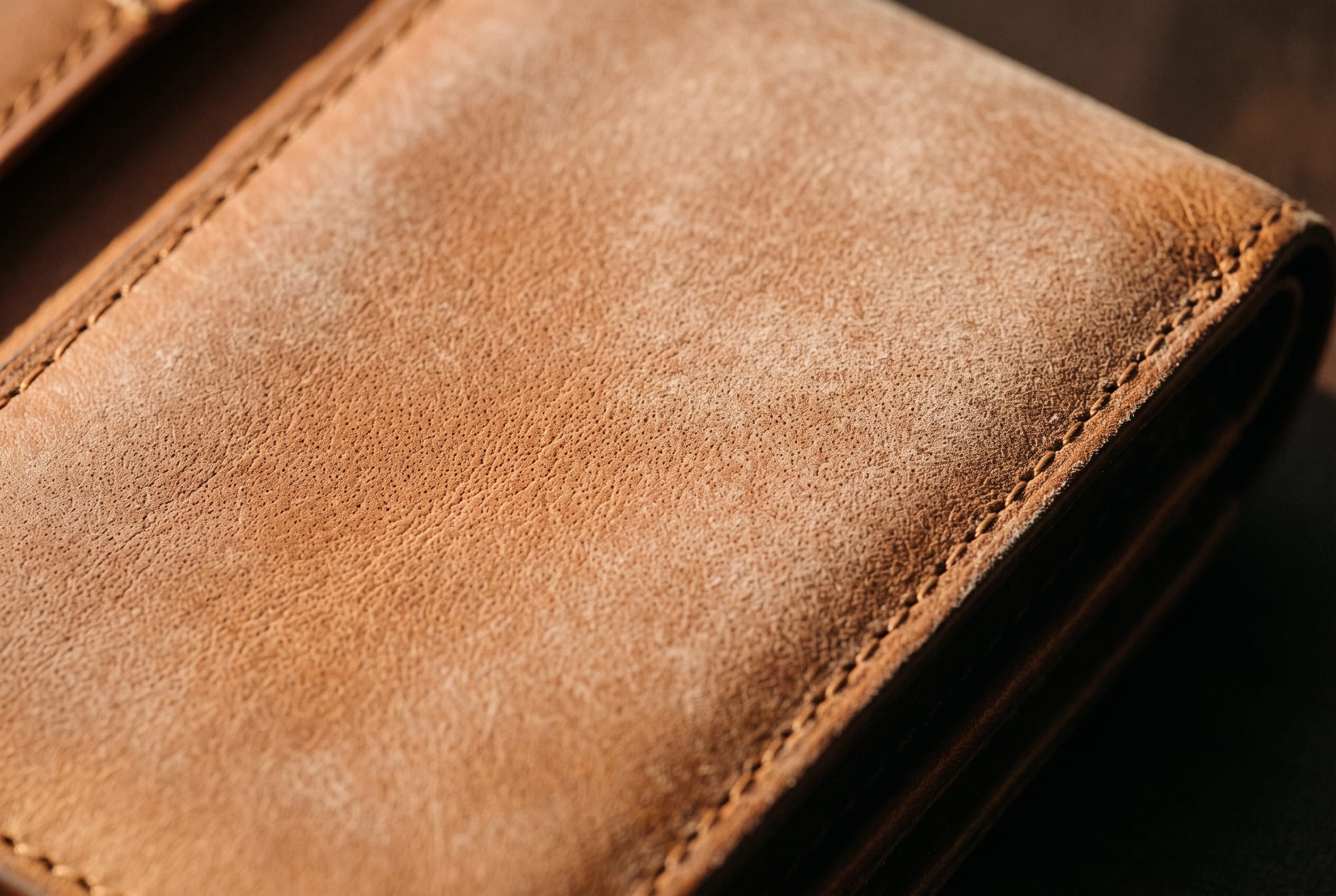
Fat bloom, or spew. The waxes and fats in the hide migrate to the surface in cool conditions and crystallise there as a fine, even, dry white film. It lies flat. It has no smell. Wiped, it smears rather than lifting, and it comes back in a week. Warmth — a warm room, a hand, a hairdryer held well back — makes it disappear into the leather, which is the test that settles it in thirty seconds. It is harmless, and it is usually a sign the piece has been fed more than it needed.
Salt or mineral haze. Water that dried in place and left its dissolved solids behind. It is gritty under a fingertip, it follows a tide line rather than spreading as a patch, and it concentrates at the edge of where the water stopped. Common in winter, from road salt.
Mould. It has depth. Under a raking light it stands up off the surface with a soft fuzzy edge, in roughly circular colonies rather than an even film, and it can be grey, green, white or black. It smells — earthy, cellar-like, distinct from the ordinary smell of a hide. And it maps onto the damp geography of where the piece was kept: inside a fold, under a flap, against the wall, in the corner that never saw moving air. Warmth does nothing to it.
The three deciding tests, in order of speed: smell it; look at the edge of the patch under a light held almost along the surface; then warm a small area and see whether it vanishes.
Taking it off, in the order that does not spread it
If the triage says mould, the sequence matters more than the materials. Almost all of the lasting damage I see was done in the first ten minutes by someone working quickly indoors with a wet cloth.
- Take it outside before you touch it. Brushing a colony in a bedroom seeds the room, and the next thing it finds will be the wardrobe it came out of. Not over a bed, not over other bags, not in a bathroom.
- Let it dry completely first. This is the step people skip and it is the expensive one. Wiping a damp colony grinds it into the pores and converts a surface problem into a stain. An hour in moving shade, out of the sun, until the surface is dry to the back of a finger.
- Dry-brush it off. A soft brush, short strokes, working away from you and away from the piece. Nothing wet has touched it yet, so what comes off is the colony rather than a paste of it.
- Then a cloth, lightly damp with half water and half isopropyl alcohol. Not soap. Soap means more water sitting on a hide that has just proved it holds too much, and water is what started this. Alcohol denatures what is there and then evaporates, taking itself out of the problem — which is the whole reason it is the right tool here. Test it on a hidden patch first: alcohol can lift an unfixed dye or dull an aniline finish, and you would rather discover that under the flap.
- Dry it slowly, in moving air, out of the sun. Stuffed loosely to hold its shape, away from any radiator. A hairdryer or a sunny windowsill will cook the surface stiff and set a new problem in place of the old one.
- Condition last, and sparingly. You have just stripped a surface, so it needs feeding — but a thin coat on leather that is genuinely dry all the way through. Feed a still-damp hide and you will get a white film in a fortnight, decide the mould is back, and treat it again. It is not back. It is bloom.
Two exceptions worth stating plainly. Nubuck and suede take the dry brush and nothing else — alcohol will mat and darken the nap permanently, and everything that feeds smooth leather ruins it. And a lining that is mouldy through to the fabric is not a wiping job; that is a repair, because you cannot dry the inside of a laminated panel by rubbing the outside of it.
The honest part: what does not come back
I would rather say this early than let anyone work through the method above expecting more than it gives.
The fuzz comes off completely. It is a surface growth and a brush takes it. What a colony leaves behind is the consequence of what it was doing while it sat there, which was eating — the collagen, the fats, and the tannins. A patch that was active for a fortnight usually cleans up to nothing. A patch that sat through a whole summer tends to leave two things: a faint shadow in the colour, and sometimes a small area where the surface has gone soft and very slightly powdery because the fibre structure itself has been consumed.
The fuzz comes off. The ghost often does not. Mould is the only leather problem where the damage you are looking at was done by something that was feeding.
Of those two, the shadow is usually fine. On vegetable-tanned leather it will blend as the piece darkens and gathers patina — a year of handling and it is genuinely hard to find. The softened patch is permanent. No amount of conditioner rebuilds a fibre that has been digested, and anyone who tells you otherwise is selling conditioner. That is a repair conversation: a patch, a reline, or living with it.
Which is the real argument for the next section. Everything above is damage control on a thing that did not need to happen.
Prevention is four decisions about air
None of these are about hygiene, because hygiene was never the variable. They are all about keeping the air around a hide dry and moving.
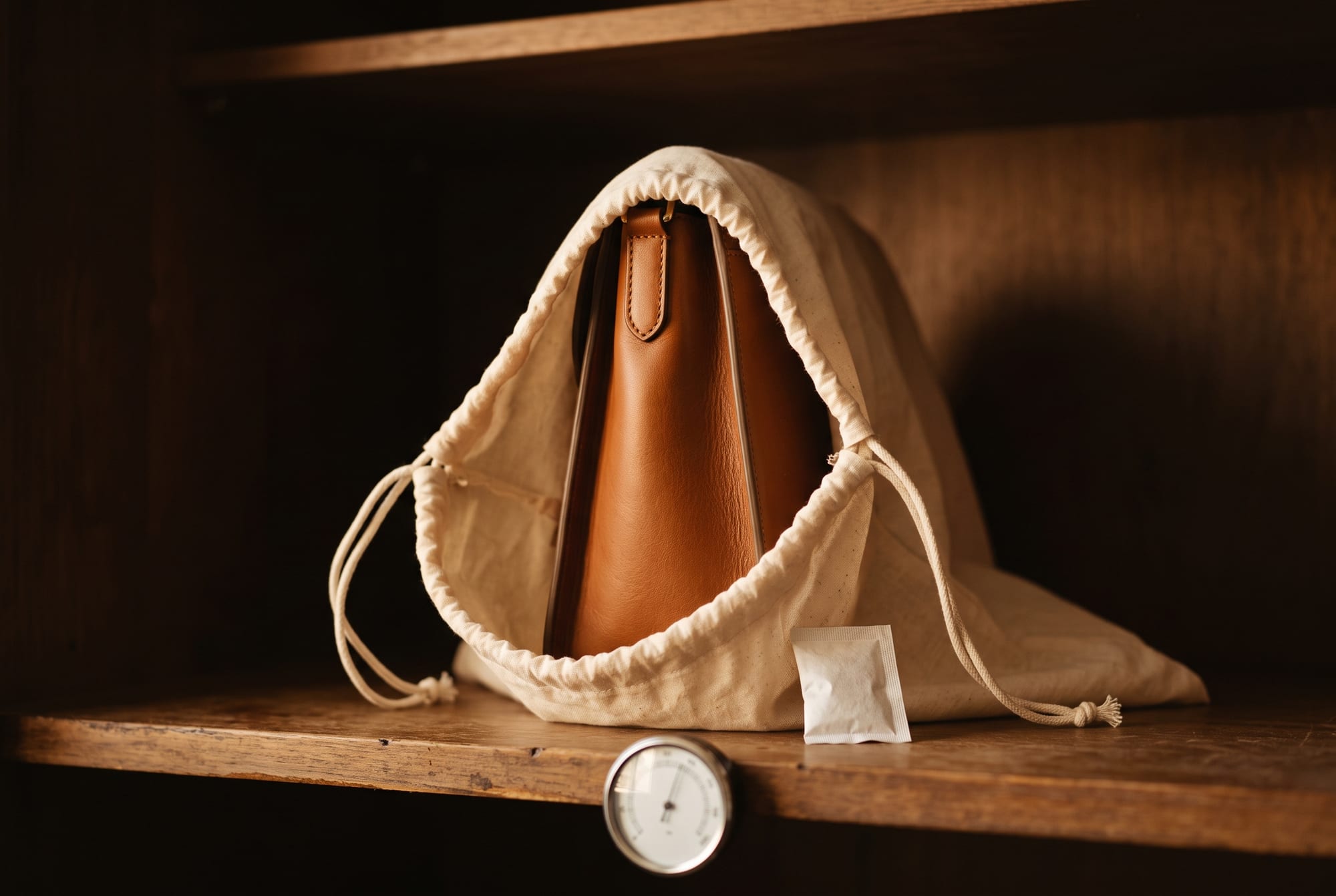
- Never a plastic bag or a sealed box. This is the one that causes most of the cases we see, and it is done out of care. A hide put away with any moisture in it inside a sealed bag has nowhere to lose that moisture to, so the air next to the leather sits at the top of the scale indefinitely. A breathable cotton dust bag, always — and the bag the piece arrived in, if it came in one.
- Silica gel, maintained. Sachets inside the piece and beside it on the shelf. The part nobody mentions: silica gel saturates. Once full it is an ornament. Dry it in a low oven or replace it — twice a year is enough for most cupboards, more in a humid flat. Indicating gel that changes colour removes the guesswork.
- An air gap on every side. Off the floor, off any outside wall, and not pressed between two other bags. Still air against a cold surface is where condensation forms and where the first colony always is. A hand's width is plenty.
- Look at it. This is the one that actually prevents the loss. Six months unopened is the real risk factor — not the humidity, which only costs you something if nobody notices it for a season. Open everything at the changeover between summer and winter, which is also when the rest of the storage routine happens anyway.
And buy a hygrometer. They cost less than a bottle of conditioner, they settle every argument about whether a room is damp, and they turn this entire subject into a number you can glance at. If it reads under 50, you have nothing to think about. If it reads 65 in August, you know exactly what to do before anything grows.
Three questions
Will vinegar kill mould on leather?
It is the folk answer and I would avoid it. Vinegar is mostly water, which is the one thing the colony needed and the one thing you are trying to remove — and unlike alcohol it does not evaporate away cleanly, so it lingers in the fibre. It is also acidic enough to work against a vegetable tannage over time, and on a pale hide it can leave its own mark. Alcohol does the same job and then leaves.
Can I put a mouldy bag in the sun to kill it?
Direct sun does kill it, and it will cost you more than the mould did. Strong sunlight fades the colour, drives out the moisture the hide actually needs, and hardens the surface — light is doing two opposite things to leather at once, and neither is reversible. Bright shade with air moving through it dries the piece just as effectively, and that is all the drying step needs to achieve.
Is mould on leather dangerous to me?
Treat it the way you would treat mould anywhere: the spores are an irritant, some people react to them considerably more than others, and the sensible precautions are the obvious ones. Work outdoors, do not shake or brush it out in a small unventilated room, and wear a mask if you are at all sensitive. I am not the person to ask about your lungs. I will say that the reason to deal with it promptly is the leather — left alone it keeps eating.
Further reading
- How to store a leather bag: dust bags, mould and the wardrobe changeover
- Over-conditioned leather: the white haze that is not mould
- Can leather get wet? The honest guide to leather and water
- Suede and nubuck care: why the nap needs the opposite treatment
- Why leather smells the way it does — and how to fix a bad one
- Leather in winter: the damage happens when it is dry, not when it is wet