
Guide · 28 September 2026 · by Zafer
Leather in winter: the damage happens when it is dry, not when it is wet
Every autumn we are asked how to protect a bag from the rain. It is the wrong question. Rain is survivable and we have written about it three times. The piece that comes back to the bench cracked in March was never rained on — it spent four months in a heated room at twenty per cent humidity.
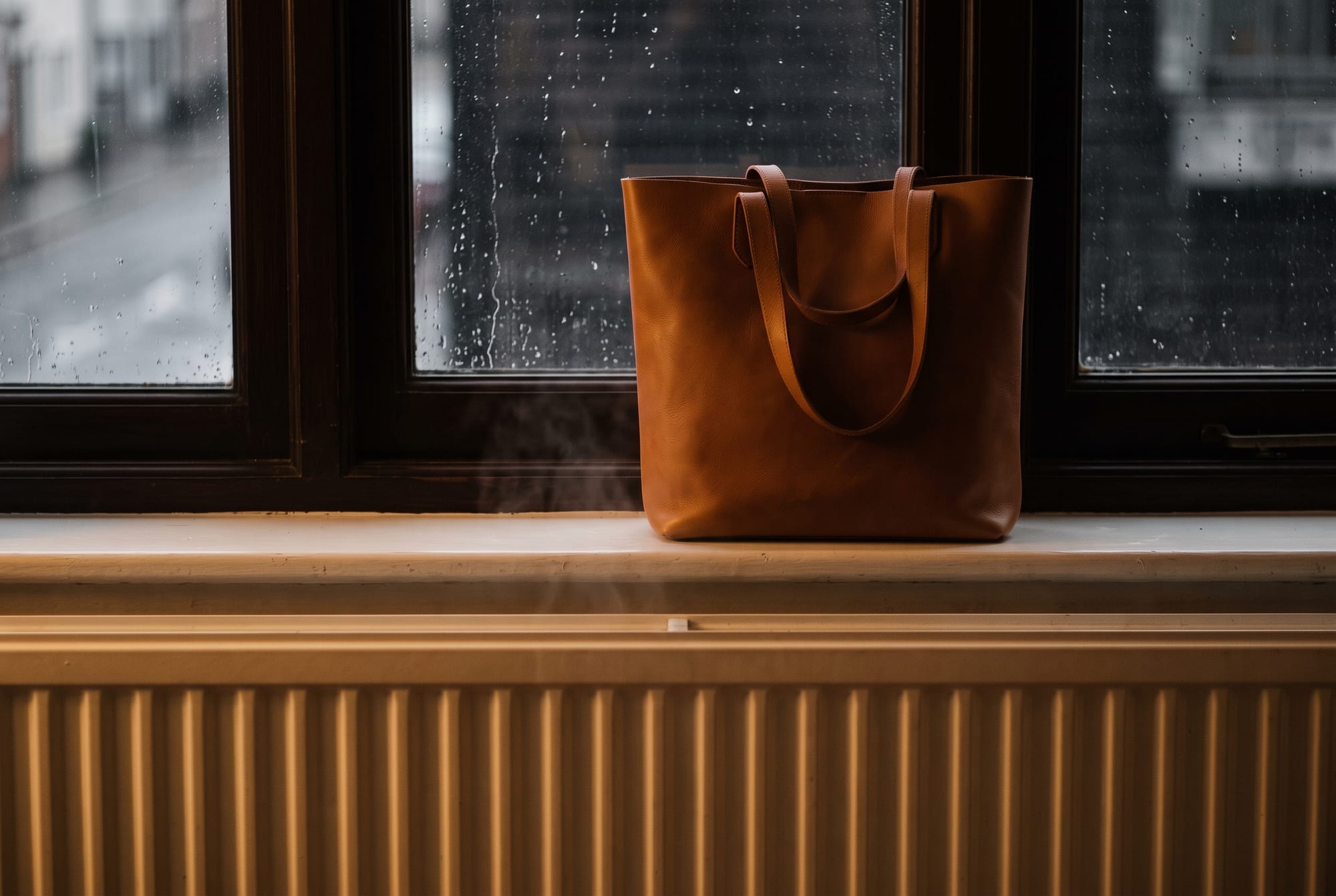
The messages start in the last week of October, and they are all the same message. Rain is coming, the bag is new, what should I put on it?
We answer, because it is a fair question and we have answered it at length: what water actually does inside a hide, and which materials survive a soaking and which do not. But it has never been the question that matters, and after enough winters you stop pretending otherwise.
Here is what actually comes back to the bench in March. A bag, three or four years old, perfectly clean. No stain, no scuff worth mentioning. And along the fold where the flap turns over, a line of fine cracks, like the surface of an old painting.
That bag was never caught in the rain. It sat on an open shelf, a metre above a radiator, in a flat where the heating ran from the first week of November until the end of March. It was not damaged by winter weather. It was damaged by winter indoors, which is a completely different thing and gets almost none of the attention.
Heat the air, and the humidity falls through the floor
This is the part that sounds wrong until you look at the numbers.
Relative humidity is relative. It is not a measure of how much water is in the air; it is a measure of how much water is in the air compared with the most that air could hold at that temperature. And warm air can hold dramatically more than cold air.
So take a genuinely miserable January day: zero degrees outside, eighty per cent humidity, the sky the colour of a wet pavement. That air is damp in every sense you care about. Now open a window and let it into a room at twenty-one degrees.
Nothing has been added. Nothing has been removed. The same water is still in the same air. And it is now at roughly twenty per cent relative humidity, because the air around it got much better at holding water and the water did not increase to match.
Twenty per cent is desert air. You are keeping it in your living room for four months, and everything organic in that room is slowly handing water over to it.
Winter does not soak your leather. Winter is the season you install a dehumidifier in your flat and call it central heating.
What a dry room does inside the hide
Water in leather is not contamination. It is structure.
A finished hide holds a meaningful amount of water bound in among the collagen fibres, and that water does a specific mechanical job: it lets fibre bundles slide past one another instead of gripping. It is, in the most literal sense, a plasticiser. It is a large part of why leather drapes, folds, and springs back rather than behaving like a sheet of card.
Take that water away and the fibres grip. The hide gets stiffer and loses its ability to spread a bend across a wide area. And then the bend happens anyway, because you keep using the bag — the flap turns over, the strap doubles back, the wallet closes — and all of that movement now concentrates in a narrow line instead of being shared.
A stiff fibre bundle does not stretch. It breaks.
This is why dryness cracks announce themselves at folds and never in the middle of a flat panel. A crack in the centre of a panel is an accident. A line of fine cracks along a fold is a humidity record.
Museum conservators keep leather objects somewhere around forty-five to fifty-five per cent relative humidity, and treat sustained readings below forty as a preservation problem. Your living room in January is at twenty. The leather in it is not in danger of dying this week — it is being aged, quietly, on a four-month schedule, every year.
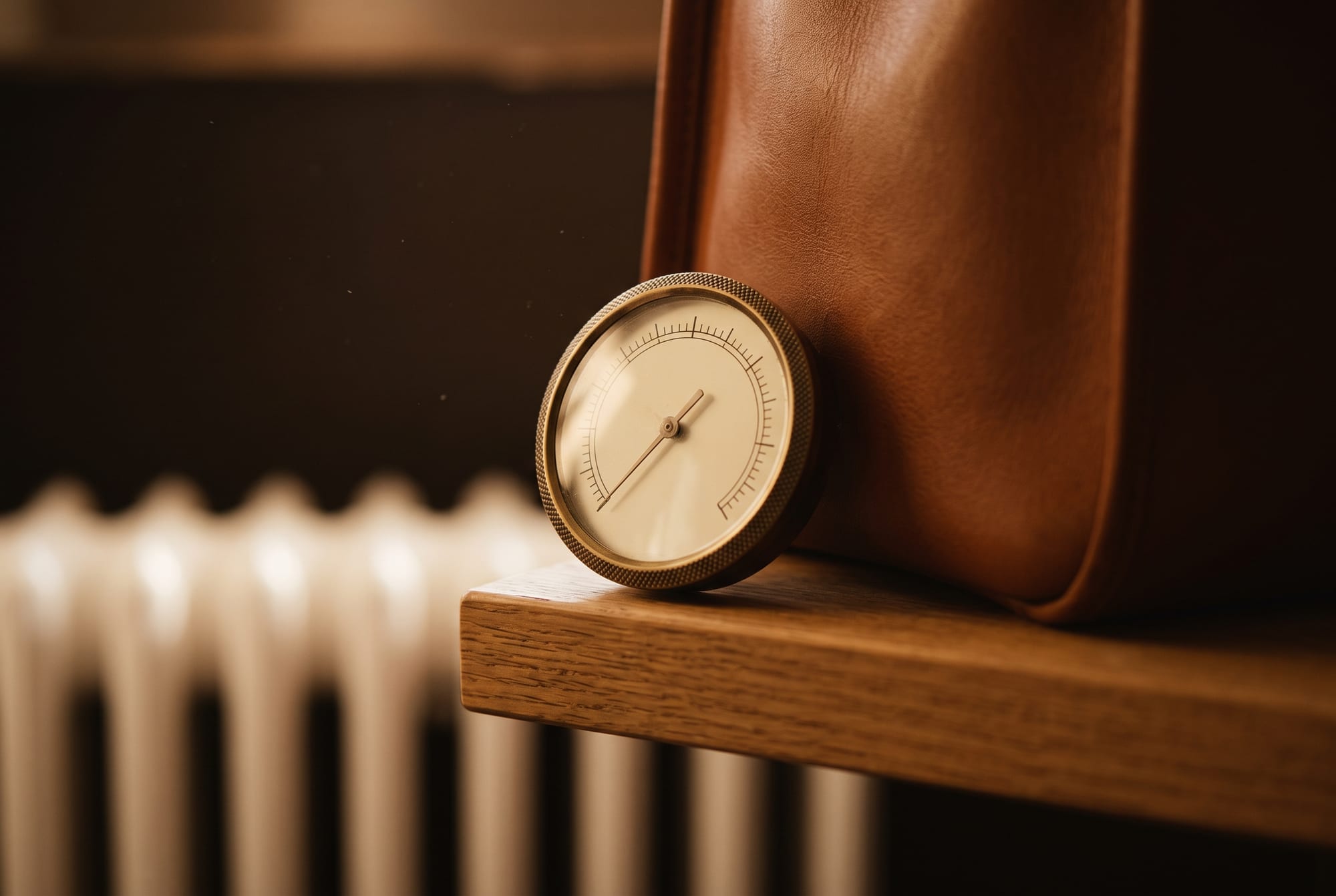
Note what this does not mean: it does not mean pour oil on it. A dry room is not solved by a wet hide, and the list of kitchen cures that make it worse is its own article. It means the timing of what you already do should follow the heating season, which is the last section of this piece.
The radiator is not a shortcut. It is the mechanism.
We have said before that heat is the enemy, not rain. Winter is where that sentence earns its keep, because winter is the only season in which a piece gets soaked and baked within the same hour.
The sequence is always identical. Sleet on the walk home. Bag is wet, hands are cold, the flat is warm. The bag goes on the radiator, or over the back of a chair pulled up to it, or — the worst version — into a car with the heater aimed at the footwell.
Dry leather tolerates a surprising amount of heat. Wet leather does not. We put a number on this in the placemat piece: dry hide copes with temperatures around boiling point far better than people expect, but wet vegetable-tanned leather starts to shrink irreversibly somewhere around 75–80 °C, and shrunk leather does not come back.
An honest caveat: a domestic radiator usually does not reach that. It does not have to. It only has to be the hottest thing in contact with a damp hide for an hour, driving water out of one face far faster than the other, while the fibres set in whatever position they happen to be in.
The drying rule does not change with the season. Room temperature, air on every side, stuffed to its own shape, as slowly as you can stand. Winter only makes the shortcut more tempting.
The white bloom, and why it is not a stain
The other winter arrival is a pale, chalky tidemark on the lower half of a boot or the bottom corner of a bag, usually noticed in the hallway, usually rubbed at with a thumb.
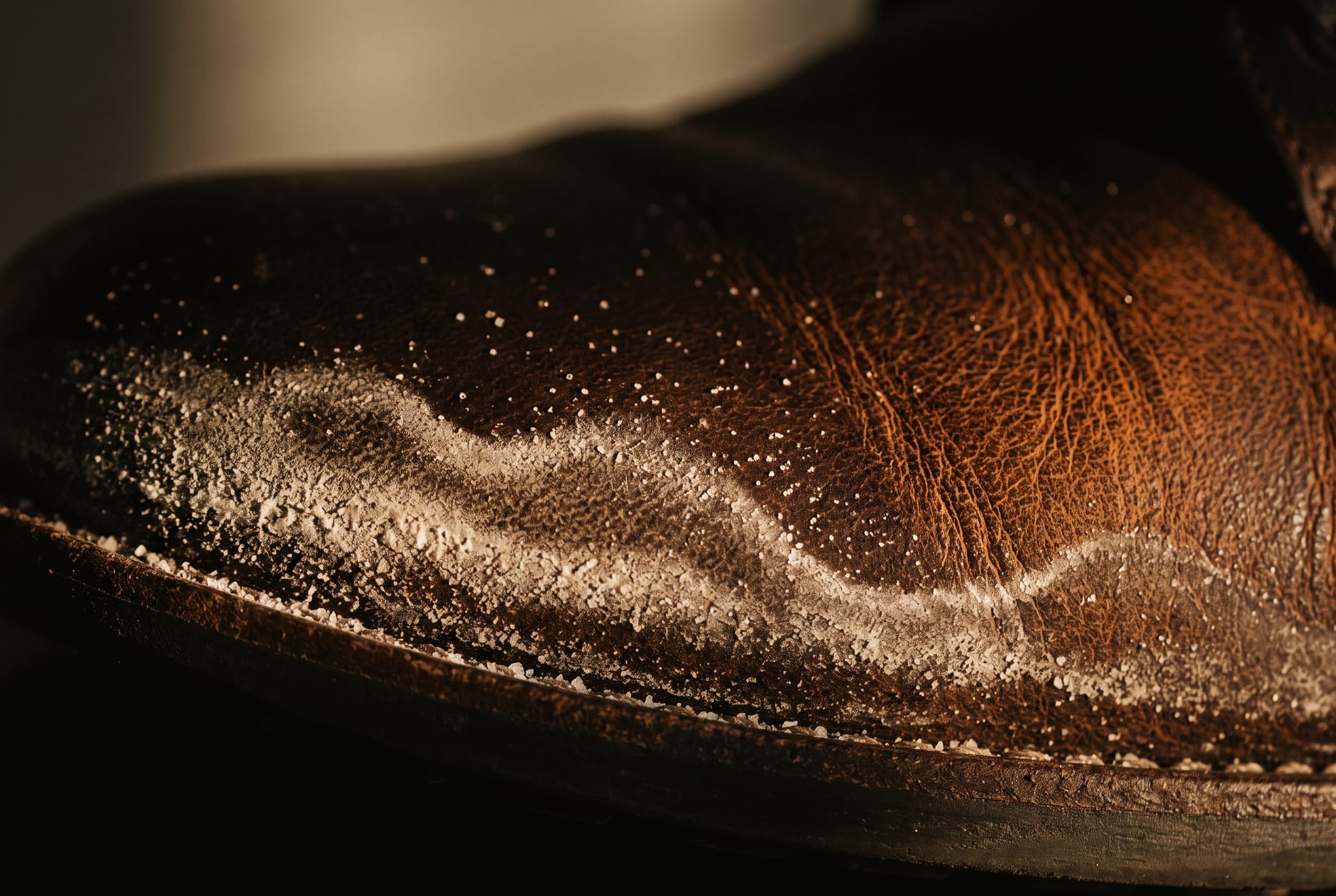
That is road salt, and it is worth understanding what it is doing, because almost everyone treats it as a mark to be removed and it is better understood as a chemical that is still working.
Slush carries dissolved de-icing salt. It lands on the leather, the water evaporates, and the salt is left behind as crystals sitting in and on the grain. Two things follow. First, salt is hygroscopic — and modern de-icers frequently use calcium or magnesium chloride, which are considerably more so than table salt. The deposit pulls moisture in, releases it as the room changes, and puts that patch of hide through a wetting and drying cycle every single day it stays there. Second, salt crystals are harder than the grain layer, so the instinctive response — rubbing at them — is abrasive.
Two cautions on the vinegar step, because it is the one people over-apply. Dilute it properly — the one-to-one recipe that circulates online is far stronger than the job requires, and acid on a vegetable-tanned hide is not a neutral event. And keep it away from anything iron: vinegar plus iron on vegetable-tanned leather is not a cleaning accident, it is the traditional recipe for turning that leather permanently black. Steel wool, an iron pan, a rusty bowl — any of those will teach you this the expensive way.

One genuinely useful note on suede and nubuck, which take the worst of the salt season: none of the above applies in the same way, because on nap the fibres are the finish. Brush first, dry completely, and do not reach for a damp cloth as step one.
Cold leather is stiff leather, and stiff leather does not forgive being forced
There is a third winter effect, smaller than the other two but responsible for a specific kind of damage we see every year.
The fats and waxes worked into a hide during finishing firm up when they get cold. A bag left in a car overnight in February is a measurably different object in the morning: less willing to fold, more inclined to crease sharply rather than curve.
And that is the moment people force things. Cramming a cold tote, pulling a cold strap hard through a keeper, snapping a cold wallet shut on a full set of cards. Each of those is a hard bend applied to a hide that has temporarily lost its ability to spread the load — the same mechanism as the dry-room cracking, arriving in one movement instead of over four months.
Give a cold piece twenty minutes indoors before you ask anything of it. This is the entire technique.
It is break-in running backwards: everything that makes a new hide soften to you over months depends on it being able to flex without a single line taking all of the movement.
The winter timetable
Our standing advice is to condition twice a year and no more. People generally accept the number and then ask, reasonably, when. Winter answers it.
- The week the heating goes on. This is the one that matters. You are topping the hide up immediately before the four driest months it will face, not chasing the damage in spring. Thin coat, both sides of the piece, left a day to absorb.
- The week the heating goes off. The recovery pass, and the moment to look properly at the folds for the fine lines described above.
Between those two, three habits are worth more than any product:
- Move it off the heat. Not the shelf above the radiator, not the hook on the wall the boiler backs onto, not the windowsill over a convector. This single relocation does more than a year of conditioner.
- Buy a hygrometer. They cost almost nothing. If the room reads under thirty all winter, your leather is not the only thing in trouble — and you now know it, which is the whole point.
- Deal with salt the day it appears. Not in March. Every day it stays is another wet-dry cycle on the same square centimetre.
For pieces that spend the winter put away rather than carried, the storage rules apply as written, with one winter-specific addition: the cupboard against a cold outside wall is where condensation and mould happen, and the cupboard beside the radiator is where hides go brittle. You want the boring one in the middle of the flat.
What the season actually asks of you
Very little, is the honest answer, and almost none of it is the thing people are worried about in October.
Rain will not ruin a well-made hide. Slush will not either, if the salt comes off within a day or two. What quietly takes years off a bag is a dry, heated room, four months long, repeated annually, with the piece parked in the warmest spot in it — and it is so slow, and so undramatic, that almost nobody connects the crack they find in March to the radiator they switched on in November.
Winter is not a wet season for leather. It is a dry one with wet weather attached.
Move the bag off the shelf above the radiator. That is the article.
Further reading
- Can leather get wet? What water actually does inside the hide
- Can suede, patent or vegan leather get wet? Every material, answered
- How to care for handmade leather: the complete guide
- How to store leather so it survives the months you are not using it
- Olive oil, Vaseline, baby wipes: what not to put on leather
- Suede and nubuck care: why everything that feeds smooth leather ruins nap
- How to soften stiff leather without ruining it
- Glossary: grain & corium