Guide · 2 October 2026 · by Zafer
Over-conditioned leather: limp, sticky, dark — and what comes back
Nearly every care guide on the internet, including ours, tells you to condition your leather. Almost none of them tell you what happens if you do it twice as often as that, which is the far commoner mistake and the much harder one to undo. Here is what too much oil does inside the fibre, which symptoms are reversible, and which are not.
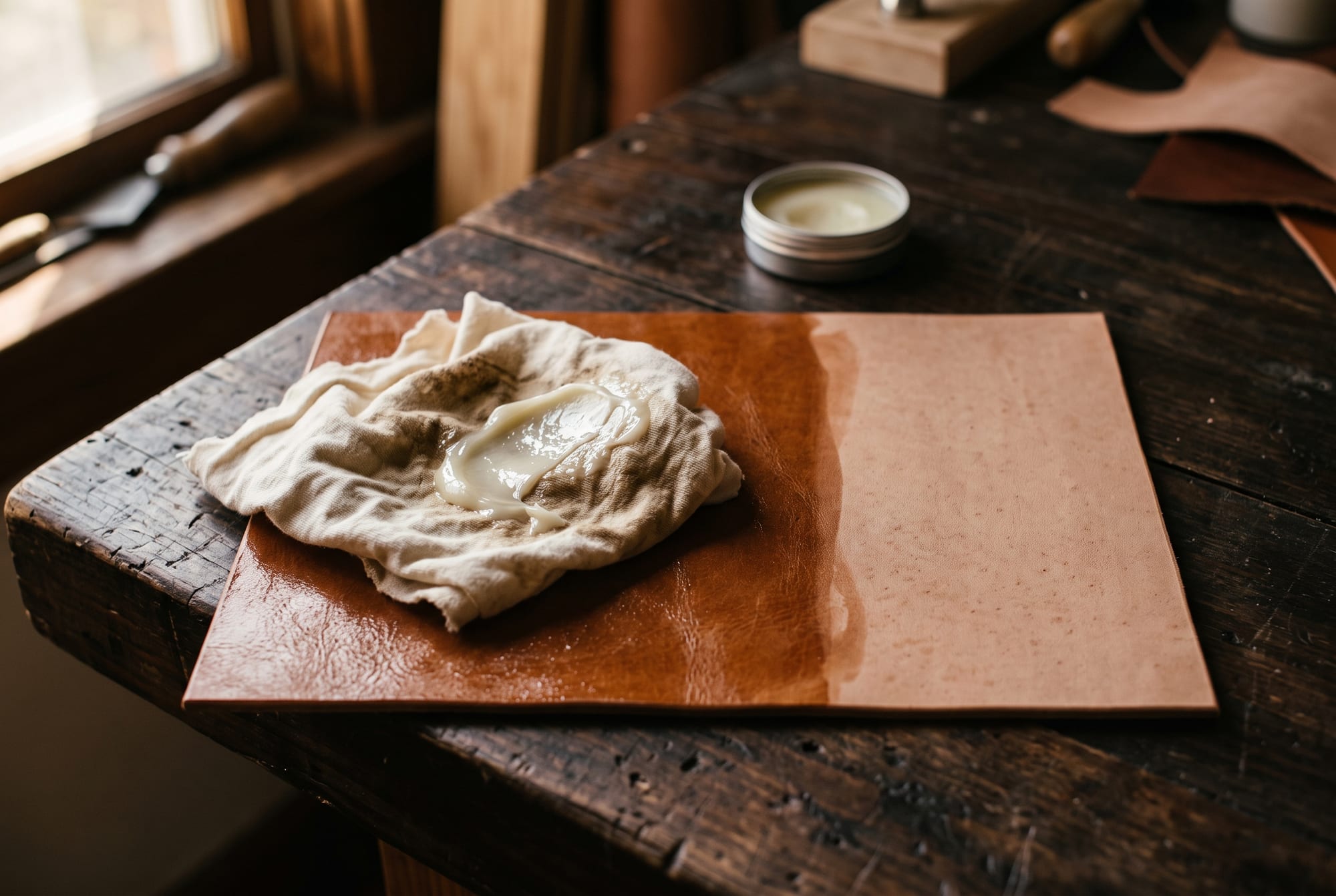
Twice a year. A pea-sized amount. Worked in with your fingers, then buffed off. That is the entire conditioning routine we recommend, it appears in our leather guide in almost exactly those words, and it is deliberately dull.
The trouble is that a dull instruction reads like a minimum. Hardly anybody treats it as a maximum.
So the piece gets a little more, because it looked thirsty. Then a little more a month later, because the first application “soaked right in”. Then a generous go-over before it gets put away for the winter, on the reasonable theory that stored leather needs protecting. And somewhere in that sequence the bag stops feeling like the bag. It goes soft in a way that is not nice. It picks up every speck of dust in the room. It is a shade or two darker than it was, unevenly. Or it comes out of the cupboard wearing a grey film that looks, alarmingly, like mould.
I want to be straight with you about this group of problems, because they are all one problem, and because the honest answer is partly bad news. Some of what over-conditioning does will buff out in ten minutes. Some of it will not come out at all, and no product sold anywhere will bring it back.
“Feeding” is a good word and a bad instruction
We talk about feeding leather. I use the word myself, at the bench, every week. It is a useful shorthand: it gets across that the hide holds something which slowly leaves, and which you have to put back.
But it is also precisely why this goes wrong, because feeding is something you do to a thing that is hungry. Leather is not hungry. Nothing in it is alive, nothing in it metabolises, and it has no mechanism for using a second helping or for declining one. It cannot be full. It can only be wet.
You are not feeding leather. You are oiling a bearing — and an over-oiled bearing does not grip again just because you have wiped the outside of it.
Here is what that bearing actually is. Leather is a three-dimensional felt of collagen fibre bundles, woven together densely at the top — the grain — and more loosely below, in the corium. At the tannery, after tanning and before drying, the hide goes through a stage called fat-liquoring: a measured emulsion of oils is drummed into it so that a film of lubricant ends up between the fibre bundles. Without it, the fibres would dry hard against one another and effectively glue themselves together, and the hide would come out of the drum as something closer to board than to leather.
Two things about that stage matter for the rest of this article. First, the dose was measured, by people whose whole job it is, with the hide tumbling in a drum so the oil went everywhere evenly. Second, it was done once, from the inside, before the leather was ever a bag.
Conditioning is you topping that up from the outside, years later, with your fingers and no way of knowing how much is already in there. It is a genuinely useful thing to do, because fat-liquor does slowly migrate out and oxidise, and a hide that runs dry is a hide that cracks at the folds. But you are working blind, through the one surface that absorbs least, on a material that cannot tell you to stop.
Why limpness is the one that does not come back
This is the part worth understanding properly, because it explains why most of the advice you will find online quietly does not work.
The stiffness of a piece of leather — its body, the thing that makes a bag stand up and a wallet close with a snap rather than a sag — is not a property of its thickness. It is a property of friction. Those fibre bundles are interwoven, and they hold their arrangement because they press against each other hard enough to resist sliding. Put too much lubricant between them and they slide freely. The leather is exactly as thick as it was yesterday. It simply has nothing holding its internal geometry in place any more.
Now ask where that lubricant is. The surface is the least absorbent part of the hide, so the oil that caused the problem is not on the surface; it is down in the corium, distributed between thousands of fibre bundles. To get it out you would need a solvent that reaches the full thickness of the leather, and anything that aggressive will take the dye and the grain's own structure with it on the way through. Degreasing is a real tannery operation, performed on bare hides, in controlled conditions, before anything is dyed or stitched. It is not a thing you can do to a finished bag.
You can take oil off leather. You cannot take oil out of it. Everything reversible in this article is reversible because it is sitting on the surface.
This is also why a soft, floppy hide is not the same thing as a broken-in one. Breaking a piece in works by flexing the fibre structure so that it learns a shape — your shape. The bundles still grip; they have just been persuaded into a new arrangement. Over-oiling skips the learning and removes the grip, which is why the result reads as limp rather than supple, and why it keeps getting worse rather than settling. It is the same distinction we make about belly leather in the piece on natural marks: softness that comes from an absence of structure is not a pleasant quality, it is a missing one.
The five things people are actually describing
“I think I over-conditioned it” covers at least five different states, with different causes and very different outcomes. Sorting out which one you have is most of the work.
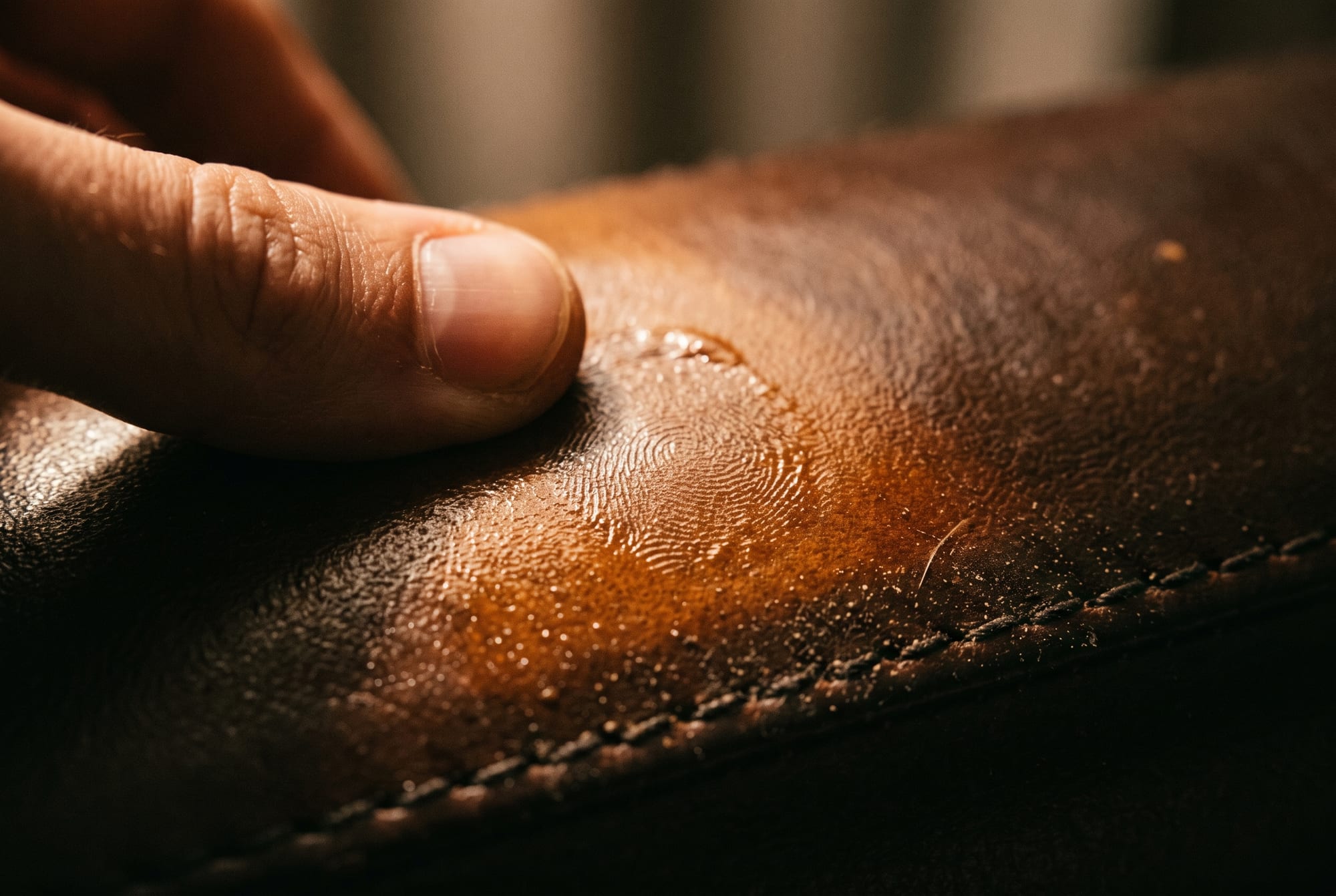
A tacky or sticky surface. The commonest, and the most fixable. The usual explanation online is that you have “clogged the pores”, which is a tidy image and not really what has happened — leather's pores are not a drainage system that blocks. What has happened is simpler: you applied more oil and wax than the fibre was able to draw in, the excess has stayed on the outside, and over days it has begun to oxidise into a soft, half-set resin. You have accidentally applied a varnish that will never finish curing. It is on top of the leather, which is exactly why you can get it off.
A grey or white haze. Usually appears a week or more after conditioning, very often after the piece has been in a cupboard, and it causes more panic than everything else combined because it looks like mould. Most of the time it is not. More on this below, because it deserves its own section.
Blotchy, uneven darkening. Patches a shade or two deeper, usually with soft edges, sometimes in the shape of the circles you rubbed. Conditioner darkens leather as it goes in, and it went in unevenly — partly because you applied it unevenly, and partly because the hide itself drinks unevenly. Fibre density varies across a hide, so dye and oil are always taken up at slightly different rates in different places. This one mostly settles.
Uniformly darker, and still going. The whole piece is a shade or two deeper than it was and it has not come back. Two separate things cause this, and they get conflated everywhere. The first is optical and temporary: oil fills the microscopic air gaps at the surface, less light scatters back out, and the leather reads darker until the oil disperses. The second is not temporary. Oil that has gone deep into the fibre does not stay the colour it was — it oxidises, slowly and permanently, and it darkens as it does. Which is why a heavily over-oiled piece can carry on getting darker for months after you have stopped touching it. People read that as the conditioner “still working in”. It is the oil ageing.
Limp, with no body. The structural one, described above. A bag that will not stand up, a flap that no longer wants to lie closed, a strap that feels like a ribbon. This is the one to take seriously, and the one no product reverses.
The white haze is very probably not mould
If you conditioned a piece, put it away, and found it a few weeks later wearing a fine pale bloom, the most likely explanation is fat spew — sometimes called fatty spew or simply bloom.
The mechanism follows directly from everything above. Leather holds a finite amount of oil within its fibre. Load in more than that and the surplus has nowhere to live, so it migrates slowly back towards the surface. Out there, as the temperature drops, the heavier fatty acids in it come out of solution and crystallise into a fine pale deposit. Cool, still, dark conditions make it worse, which is precisely why it shows up on a bag that has been conditioned and then stored rather than carried. It is the leather handing you back the portion of the dose it could not use.
This matters because the instinctive response to something that looks like mould is to attack it — vinegar, surgical spirit, an antifungal spray. Doing that to fat spew means stripping a perfectly healthy finish for no reason. And since the underlying cause is excess oil that is still down there, the bloom will come back anyway, which convinces people the “mould” is winning and escalates the chemistry. That cycle does real damage.
Three tests separate them, and you can do all three in under a minute:
- Warmth. Spew is wax and fat, so it melts. Warm the area gently — a hairdryer on its lowest setting held well back, or honestly just the flat of your hand held there for thirty seconds — and spew goes translucent and disappears into the leather as it re-absorbs. Mould does not care how warm it is.
- Smell. Put your nose right on it. Mould has a smell: damp, earthy, unmistakable once you have met it. Fat spew smells of nothing at all, or faintly of the balm you used.
- Texture and pattern. Spew is smooth, waxy, evenly spread, and often heaviest along seams and creases where the most product collected. Mould is fuzzy, raised, grows in discrete colonies, and prefers the damp corner rather than the thickly-conditioned edge.
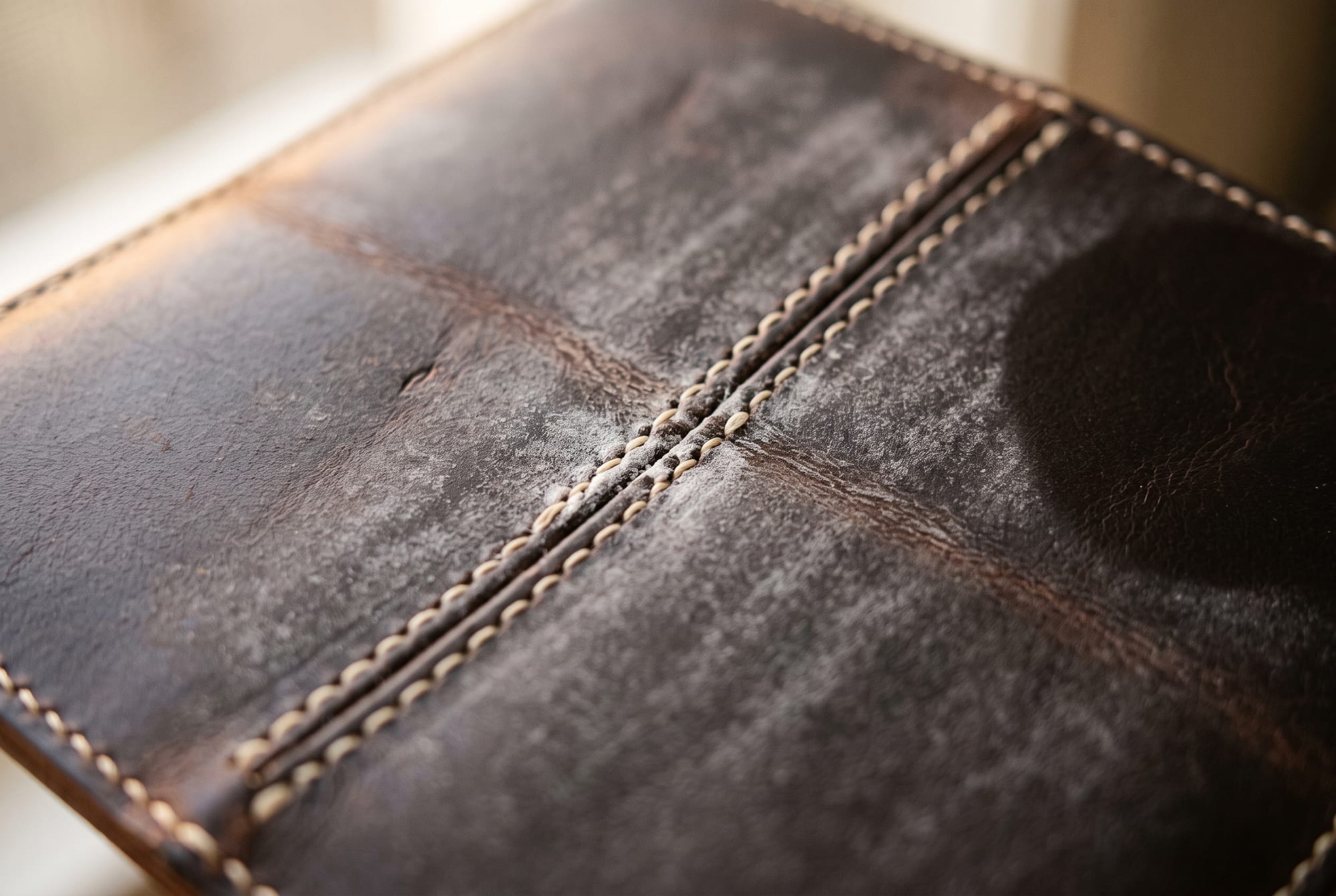
If all three point to mould, treat it as mould — that is a storage problem with its own protocol, and it needs airflow and dry warmth rather than more product. If they point to spew, the answer is pleasantly boring: warm it, wipe it with a dry cloth, and then leave the piece alone and in use for a season. Handling is what redistributes surplus oil. It may bloom again once or twice as it works through the surplus. That is the piece recovering, not relapsing.
What it does to the stitching
This one is worth correcting, because the version circulating online is wrong in a specific and commercially convenient way. You will read that neatsfoot oil rots stitching, with the strong implication that some other product — usually the one on the page telling you this — does not.
The real distinction is not between brands of oil. It is between kinds of thread.
We saddle-stitch everything in this atelier with waxed linen thread, and linen is a natural fibre: it absorbs. That is ordinarily fine, because the beeswax drawn through it before stitching keeps moisture out and locks the twist. Flood the seam with oil and two things happen. The wax is softened and floated away, and the linen itself takes up oil and holds moisture against itself with no way to dry. Damp organic fibre, kept damp, warm and airless, eventually degrades — and a seam is the most airless place on a bag. The thread goes dull, furry, and loses its tension; eventually it parts, usually where it turns a corner.
A polyester or nylon thread is largely immune to this, because it does not absorb water in the first place. That is a genuine advantage of synthetic thread and I will not pretend otherwise. We stitch with linen anyway, because it beds into the leather, ages at the same rate as it, and is repairable with the same materials in thirty years' time. But it does mean that on a hand-stitched piece the seams are the part you should be most careful about flooding, and the part worth keeping product away from rather than working it in.
The good news is that this one is genuinely repairable, even when it is not reversible. A saddle stitch can be unpicked and re-sewn from any point along its length, which is the whole argument for the technique. A rotted seam on a hand-stitched bag is an afternoon at a bench. A rotted seam on a machine-lock-stitched bag is a different conversation.
Getting a tacky piece back
If you are in the top three rows of that table, here is the sequence. The ordering is the important part: every step is less aggressive than the one after it, and most pieces are finished after step two.
- A dry cloth, and more patience than you want to give it. Cotton or an old T-shirt, no water, no product. Work in small firm circles and keep turning to a clean area of cloth — otherwise you are moving the same oil around. This alone removes most of what is loose.
- Warmth, to encourage absorption rather than removal. Some of what is on the surface can still go in, if you make it mobile. Your hand is the safest heat source there is. A hairdryer on its coolest setting, kept moving and a good distance back, is acceptable. Anything hotter than comfortably warm to the back of your hand is not: heat is the one thing that damages leather faster than neglect.
- A drawing agent, only if it is genuinely greasy. For a surface still wet with oil rather than merely tacky, cornstarch or talc left on it overnight will lift some of the surplus — the same method we use for fresh oil stains. Brush it off with something soft. Expect a modest improvement, not a rescue.
- Use it. Genuinely. Handling moves surplus oil around and evens tone far better than anything you can apply, and a piece in daily use is in warm, moving, ventilated conditions — the opposite of the cupboard where bloom forms. Six weeks of ordinary use does more than any product in this list.
And the two things not to do, both of which are the natural instinct. Do not use a solvent — spirit, acetone, degreaser or washing-up liquid will take dye, finish and the hide's own remaining fat-liquor with them, and you will have swapped a tacky bag for a dry patchy one. And above all, do not apply more conditioner. An over-oiled piece often looks thirsty, because it is blotchy and uneven, and the blotchiness invites you to even it up with another coat. That instinct is how a recoverable surface becomes a permanent one. The same trap is why we say never to spot-treat a mark.

A test instead of a calendar
Twice a year is a sound default and I stand by it, but it is a default for a piece in regular use in a temperate climate, and defaults are exactly what gets over-applied. A piece that lives in a cupboard needs less. A piece carried daily through a hard winter may want slightly more. The way out of guessing is to stop asking how long has it been? and start asking what does the leather say?
Two checks, both free:
- The fold. Bend an unobtrusive part of the piece gently over on itself and let go. Leather with enough oil in it relaxes back and the crease fades out over a few seconds. Leather that is genuinely dry holds a sharp pale line, and you will often see very fine lines in the crease. That pale sharp crease is the only reliable invitation to condition.
- The back of the hand. Dry leather feels cool, slightly papery, a bit toothy under the fingertip. Correctly fed leather feels cool and smooth. Over-fed leather feels faintly warm, slightly soft, a little plasticky, and your finger does not quite want to slide. If it feels like that, no amount of time elapsed means it needs feeding.
Almost nobody arrives at over-conditioning through carelessness. People arrive at it through attentiveness — they like the object, they want to look after it, and conditioning is the one maintenance task available, so it is the one that gets done. That is the whole trap. Leather asks for very little, and the gap between the little it asks for and the amount an interested owner would like to give it is where nearly all avoidable damage lives.
Dryness is a slow problem with loud symptoms, and you will see it coming for years. Over-oiling is a fast problem with quiet ones, and by the time it looks wrong it is already in the fibre.
If you are not sure which of the five you are looking at, photograph the piece in daylight — one straight-on shot and one raking across the surface at a low angle, plus a close-up of a seam — and send them to info@pazleather.com. Spew, mould, tack or genuine structural loss are four very different photographs, and it is worth knowing which one you have before you decide to do anything about it.
Further reading
- The leather care guide: the whole routine, and why it is so short
- What not to put on leather — and what to do instead
- How to soften leather without wrecking it
- Leather winter care: dry heat, salt and the cracking season
- How to store a leather bag — and how to keep mould out of it
- Leather stain first aid: the first five minutes
- Saddle stitch vs machine stitch: why a hand seam is repairable
- Glossary: waxed thread