Guide · 21 September 2026 · by Zafer
Suede and nubuck care: why everything that feeds smooth leather ruins nap
Almost every article on this site tells you to feed your leather. Put the same balm on suede and you will wreck it in an afternoon — not because nap is fragile, but because of one structural fact: in suede, the fibres are the finish. Change that one thing and every rule downstream runs backwards.
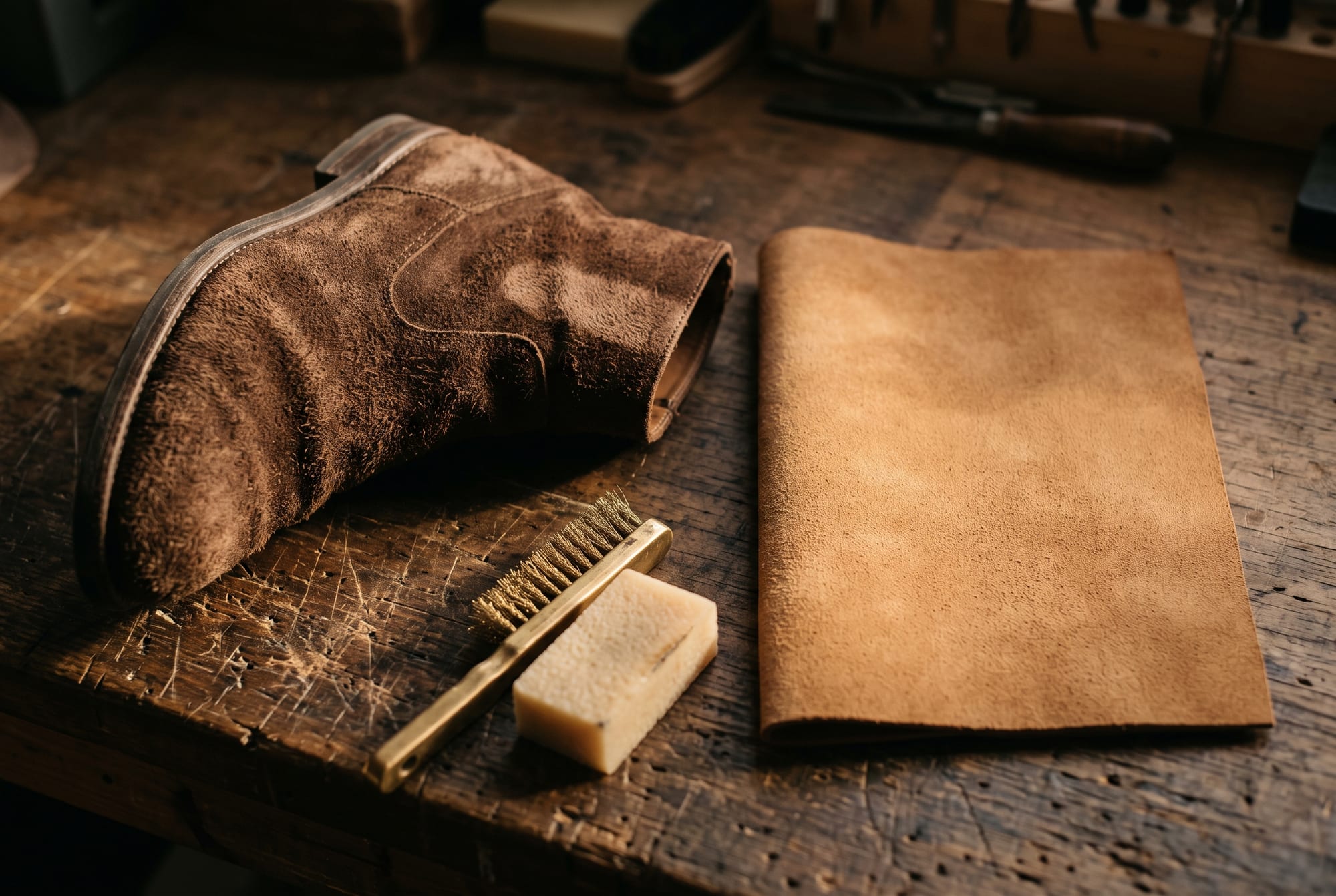
A message arrived at the bench a few weeks ago with a photograph of a pair of chocolate suede boots and one sentence: “I followed your care guide.”
She had. That was the problem. Two thin coats of a good balm, worked in with a soft cloth exactly the way we describe it, left to rest overnight. The boots came out of it dark, flat, shiny in patches, and faintly scented with beeswax. Nothing she did was careless. Every instruction she followed was one we had written. It simply did not apply to what she was holding, and we had never said so loudly enough.
So this is the article that runs the other way. The care guide, the softening piece, the restoration one — all of them are about getting fats back into a hide. On suede and nubuck, that is the fastest route to ruining it. Not because nap is delicate; a suede work boot will outlast almost anything in your wardrobe. Because of one structural fact that changes everything after it.
Suede is not a kind of leather. It is a direction.
There is no suede animal. There is no suede tannage. Suede is a face of an ordinary hide, and so is nubuck, and the difference between them is simply which face you are looking at.
Every hide has two. The grain side is the outside, where the hair was: fibres packed tight and fine, woven almost horizontally, the densest and strongest part of the skin. The flesh side is the inside: the corium, where the same collagen fibres run looser, coarser and more openly.
- Full-grain is the grain side, untouched.
- Nubuck is the grain side, buffed with a fine abrasive until the very top of the grain breaks open into a short, dense velvet nap.
- Suede is the flesh side — usually the flesh side of a split — raised into a longer, looser, shaggier nap.
In neither case has anything been added. Something has been taken away.
Here is the version of that fact you can check right now: reach inside any unlined full-grain bag you own and feel the surface your fingers land on. That soft, slightly fuzzy face is suede. Same hide, same tannage, same animal — you simply never call it suede, because you call it “the inside”.
Which is also why the distinction between suede and nubuck is not a matter of taste or fineness. It is a question of which layer of the animal you are holding, and it decides the brush you should own, how fast the thing wears, and what it ought to cost.
In suede, the fibres are the finish
On smooth leather there are two separate things going on. There is the structure — millions of collagen fibre bundles woven through the thickness, which is what carries the load. And there is the surface — the tight grain layer you see and touch. Conditioning works precisely because those are separable: you can put fats between the fibre bundles so they keep sliding over one another instead of cracking, without disturbing the face at all.
On nap there is no such division. The raised fibre ends are the surface. They are the texture, the colour, the light, the entire object as far as your eye is concerned. Anything you put on them, you have put directly onto the finish.
On smooth leather the fibres are the structure and the grain is the finish. On suede the fibres are both. That single fact is the whole reason the care runs backwards.
Follow that through with oil. On a smooth hide, oil disappears into the thickness and does its work out of sight. On nap, it coats each raised fibre; the fibres then stick to their neighbours in little wet-brush points and lie down. What you are left with is matted, darkened and shiny — and it is permanent, because there is no way to wash oil out of a fibre without destroying the fibre. The list of things that do not belong on leather covers the usual offenders; suede is the one place where even the products on the approved list are wrong.
Half of what looks like a stain is only flattened nap
This is the most useful paragraph in the article and it costs nothing to act on.
Nap does not reflect light off a surface. It scatters light from thousands of individual fibre ends, so what you see depends entirely on which way those fibres are pointing. Brush them away from you and the panel reads light; brush them toward you and the same panel reads dark. It is the physics of a mown lawn, a velvet cushion, or a carpet after somebody has walked across it.
So on suede, a dark patch may be nothing but geometry. Flattened nap reads dark and slightly shiny even when it is perfectly clean. A pale patch may be nap standing upright in a field where its neighbours lie flat. There may be no dirt involved anywhere.
Before you treat a mark on suede, brush it. You will fix roughly half of everything you were about to attack with a chemical.
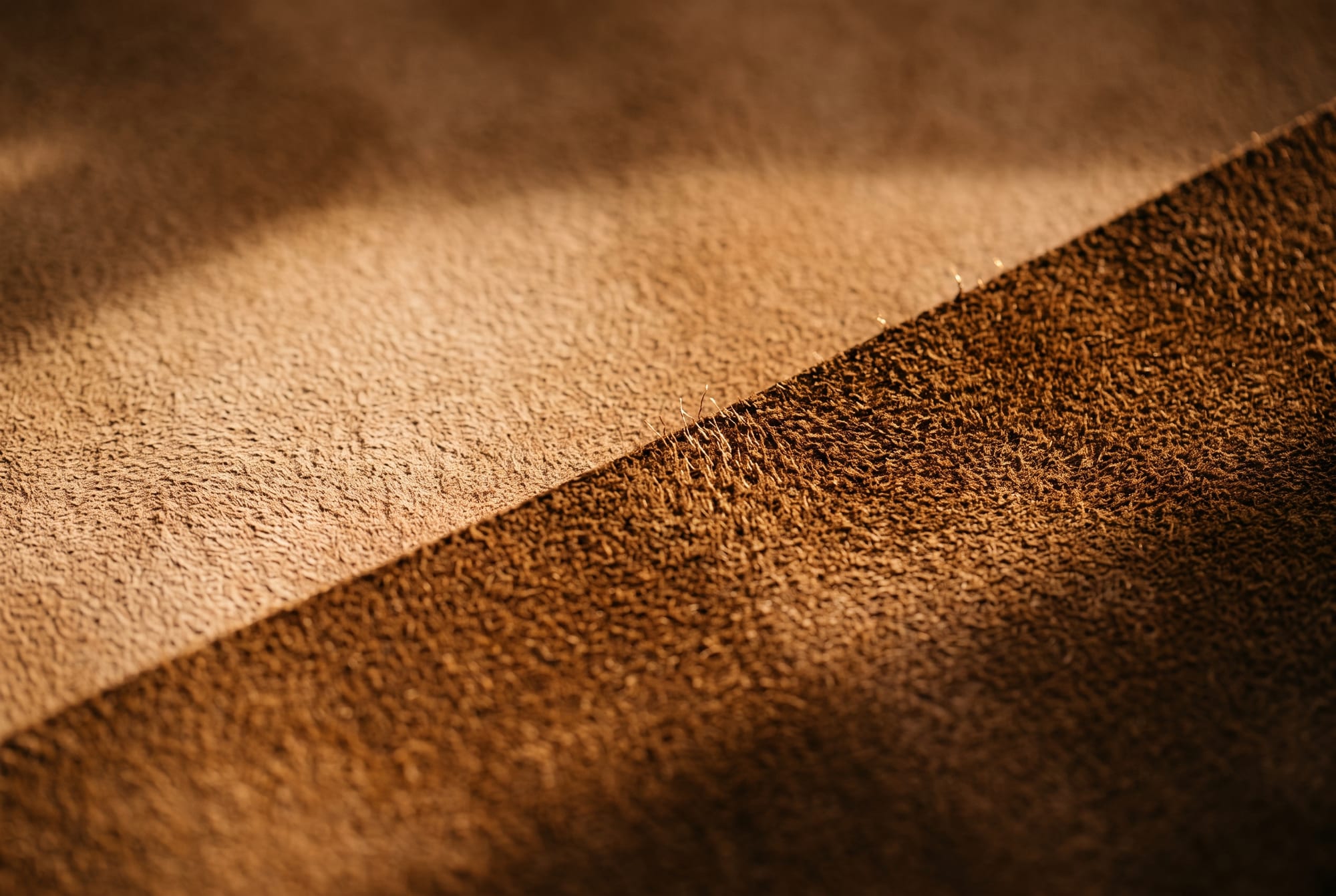
It also explains something people worry about unnecessarily: a suede bag that looks a different colour at home than it did in the shop, or that appears to change shade as you turn it. Nothing has gone wrong. You are seeing nap direction under different light.
The practical rule that follows: brush in one direction, across the whole panel, and keep to the same direction every time. Scrubbing back and forth produces exactly the patchy, blotchy look you were trying to remove. Pick the direction that looks best in the light of the room you live in, and be consistent about it.
The kit: four things, and not one of them is a cream
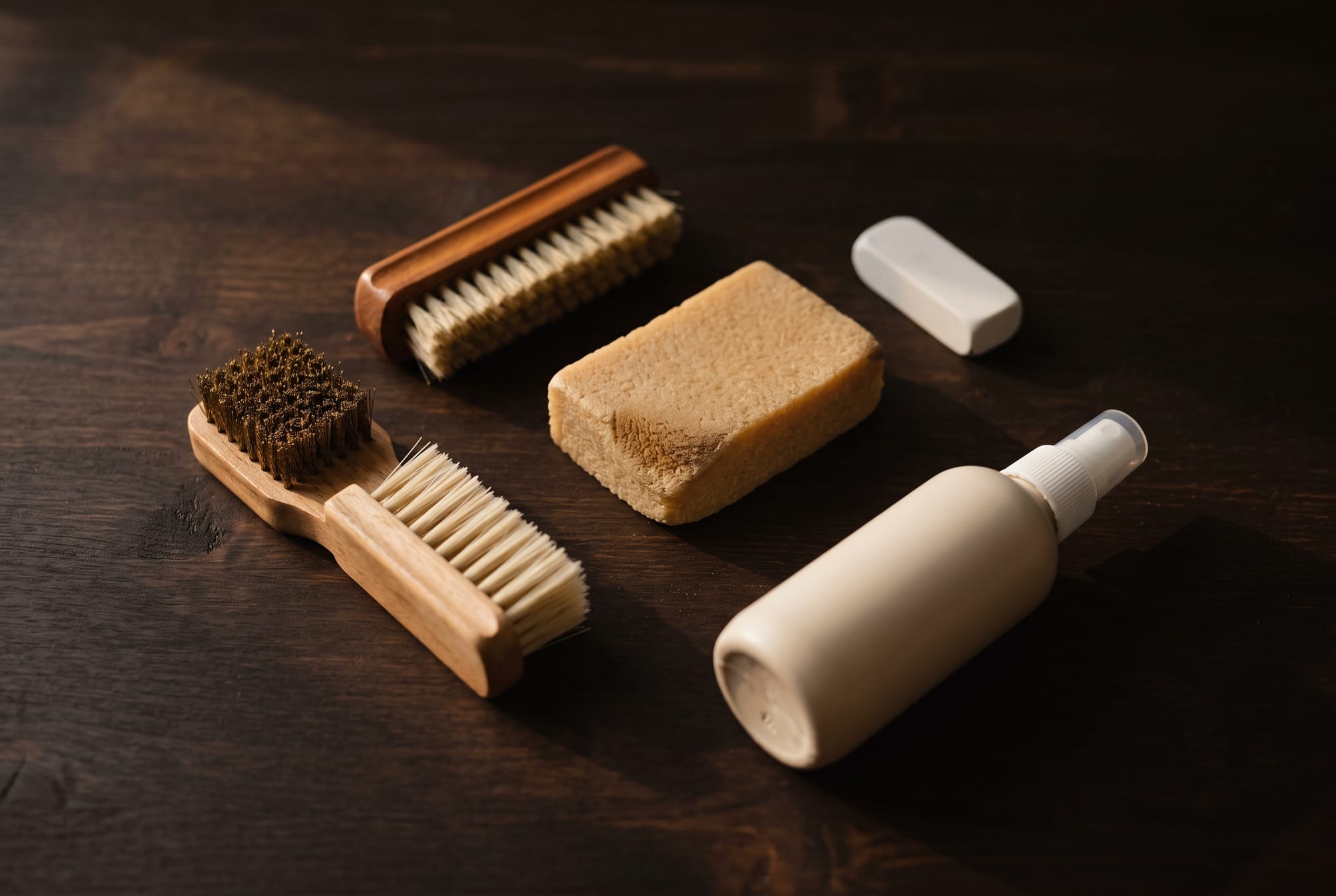
- A brush. Brass wire for suede; nylon or rubber for nubuck. If you are only buying one and you own both materials, buy the soft one.
- A crepe rubber block. Natural crepe, the same material as a crepe sole. It grips and lifts rather than smearing.
- A clean pencil eraser — white, soft, unused.
- A suede protector spray. The only spray we ever recommend for leather, for reasons given below.
All four together cost less than one bottle of the conditioner you should not be using.
The escalation ladder: always start at the top
Every rung below is more invasive than the one above it. Start at the top, and stop the moment something works. Most marks never make it past the first rung.
- Dry brushing. Short, light strokes in one direction. You are lifting fibre, not scrubbing dirt. Do the whole panel, not just the mark — otherwise you leave a brushed patch sitting in an unbrushed field, which looks worse than what you started with.
- The crepe block. Rub firmly over a shiny or grubby area. The rubber grabs what the brush could not. It also takes the protector spray off with the dirt, so re-spray afterwards.
- The eraser. For a small, discrete, hard mark — a scuff edge, a pen tick. Light pressure, small circles, then brush the crumbs away.
- Steam, then brush. For crushed nap: where something heavy has sat on it, or it was folded in a bag. Hold it ten seconds well above a kettle spout — above the visible plume, never in it — then brush immediately, while it is warm. Steam relaxes the fibre, the brush stands it up, and it cools in the new position.
- Damp the whole panel. For water rings. The counter-intuitive one, and it gets its own section below.
- Cornflour, overnight. Fresh grease only. Heap it on the mark, leave it twelve hours, brush it out in the morning — the powder wicks mobile oil up out of the fibre. It only works while the oil is still mobile. Old grease does not come out of suede. I would rather tell you that now than sell you three attempts at it.
How to clean suede boots at home, step by step
The autumn ritual, in the order that actually works. Before anything else, one instruction that matters more than the rest of the list put together:
Let mud dry completely before you touch it. Wet mud brushed into suede becomes part of the suede. Dry mud is a crust that flakes off and takes nothing with it. Wait a day.
- Dry the boots fully, stuffed with paper to hold their shape, at room temperature and away from any heat source.
- Knock the loose dirt off over a bin.
- Brush the whole boot, one direction, light strokes.
- Crepe block anything still showing.
- Eraser on discrete marks that survived the block.
- Final brush, whole boot, that same one direction.
- Re-spray, and let it dry before wearing.
Fifteen minutes, twice a season, and a pair of suede boots will see out a decade.
Rain, water rings, and the fix that runs backwards
Can suede get wet? Yes. It will not be destroyed, whatever the internet tells you — people have walked suede through northern winters for a century. We went through the whole material family in the guide to which leathers can get wet; here are the two rules that matter most for nap.
Never brush it while it is damp. Not “try to avoid” — never. Wet fibres are limp, a brush drags them into tangles, and they dry set in exactly that position: matted, shiny, and effectively permanent. You can do this to a boot in thirty seconds. Dry it first, every single time.
Dry it slowly, stuffed to shape, away from heat. Same rule as any other wet leather, and for the same reason — heat sets fibre hard and there is no coming back from it.
Then there is the ring. It is worth understanding why it forms, because the explanation contains the cure. As a wet patch evaporates it retreats toward its own edge, carrying loose dye particles and fine dust along with it, and deposits all of that in a line where the water finally stopped. The ring is not damage to the leather. It is a tide line: everything the water was carrying, parked at the boundary.
You cannot remove a tide line by drying it harder. You remove it by removing the edge — damp the whole panel evenly, corner to corner, so there is no boundary left for anything to collect at. Then dry it slowly and brush it out.
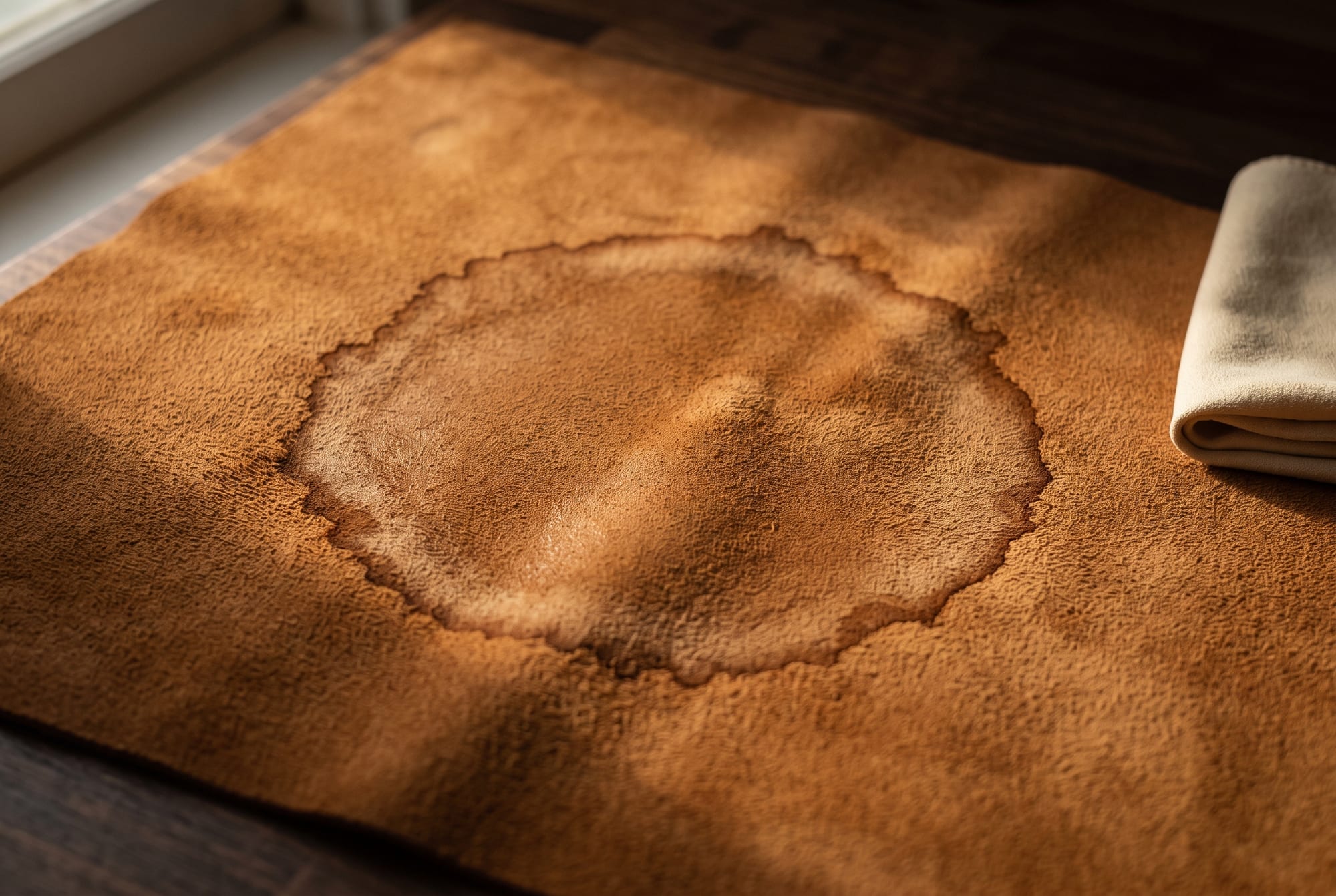
The honest limit: this evens the tone rather than reversing it. On a pale suede that has bled a lot of dye, the panel may end up slightly darker overall than it began. Darker and even beats lighter and ringed — but you should know that before you start, not afterwards.
Nubuck is not simply short suede
The ladder above applies to both materials. But nubuck is grain fibre and suede is corium fibre, and three things follow from that.
The brush. Nubuck's nap is the broken top of the grain layer: extremely fine, extremely short, packed dense. A brass wire brush — correct for suede's long corium fibre — will go straight through it and abrade the leather underneath, leaving a bald shiny patch that no amount of brushing brings back. Nubuck takes nylon or rubber, and a lighter hand.
How it marks. Nubuck shows finger-marks and shine faster than suede, because with a short nap even slight flattening exposes the base immediately, where suede's longer fibre hides it. The consolation is that nubuck also recovers better: short fibres are springy, and a soft brush genuinely does reset them.
How it takes water. Nubuck spots more visibly for the same reason. It is denser, so water sits and spreads near the surface instead of wicking away evenly, and the rings it leaves are sharper. Nubuck needs the whole-panel treatment more often than suede does.
There is a buying point buried in this. Nubuck is made from the grain side — the strong, expensive part of the hide. Suede is frequently made from the split, the layer left over once the grain has been taken off for something else. When two items cost the same and one is nubuck and one is suede, the nubuck is usually the better hide. It is not a law, but it is a good starting assumption.
Protector spray: the one time we tell you to use one
Everywhere else on this site we argue against spraying things onto leather. Here we are for it, and the reason is consistent rather than contradictory: on nap there is no grain layer to seal, so the spray is not being put between you and a finish. The nap is the finish, and the spray goes onto the individual fibres.
What it does: raises surface tension so water beads and rolls off before it can wick in, and leaves a thin barrier on each fibre so that oils bead too.
What it does not do: waterproof anything. It buys you the walk from the car to the front door. It will not survive an afternoon in real rain, and any product claiming otherwise is selling you something.
How often: at the start of the season, and again after every proper clean. This is the part almost everyone misses — brushing and crepe-rubbing strip the spray off along with the dirt, so re-spraying is the last step of cleaning rather than a separate annual event.
Test it on a hidden area first, every time, with every new can. The tongue of a boot or the inside of a flap will do. Some sprays darken pale suede, and you want to discover that somewhere nobody looks.
Why we do not make suede — and when you should buy it anyway
The hides we work with — Pueblo, Crazy Horse and their cousins — are smooth, hand-stitched and uncoated, built to be fed and repaired for decades. Nap cannot be fed, and it cannot be re-dyed by hand at a bench; refinishing suede means spraying it, which is a different trade in a different room.
But the real reason is this, and it is the sentence I would want you to carry away from the whole article:
A smooth hide gets better at the exact point where it is handled most. Suede gets worse at the exact same point. Friction polishing an exposed surface is what patina is — and friction is also what flattens nap. Identical wear, opposite outcome.
The corner of a full-grain bag where your hand always goes darkens, and glows, and becomes the best part of the object. The corner of a suede bag where your hand always goes goes flat, then shiny, then bald. Both hides are responding honestly to being used. Only one of those responses is the thing we are in business to produce.
None of which makes suede a bad material. It is lighter, it drapes where a firm vegetable-tanned hide simply will not, it is warmer to the hand, and a suede jacket is something full-grain can never be. Buy it deliberately, for the things it is genuinely good at. Then look after it the way it actually wants to be looked after: brush it, keep it dry, spray it, and keep every jar in your cupboard well away from it.
If you have a suede or nubuck piece you are unsure about, send us a photograph — info@pazleather.com — and say which one you think it is. We will tell you what we would do with it, including “leave it alone”, which is the right answer more often than people expect.
Further reading
- Can suede, patent or vegan leather get wet? Every material, answered
- Olive oil, Vaseline, baby wipes: what not to put on leather
- Aniline, semi-aniline, pigmented: what a leather’s finish actually decides
- Leather grades explained: full-grain, top-grain, “genuine” and bonded
- How to care for handmade leather: the complete guide
- How to fix scratches on leather, by depth and finish
- Glossary: nubuck
- Glossary: grain & corium