Guide · 3 October 2026 · by Pınar
Leather and sunlight: why it darkens and fades at the same time
Most care advice says the same three words about sunlight — avoid direct sun — and then stops, which is not much use if the piece is a table runner. Light is doing two opposite things to your leather simultaneously, and once you know which is which, the question stops being how to keep leather out of the light and becomes how to let it in evenly.
A bag spends most of its life in the dark. It is in a cupboard, in a crook of an arm, under a desk. When we write about caring for leather, we are almost always writing about an object that sees daylight in short bursts.
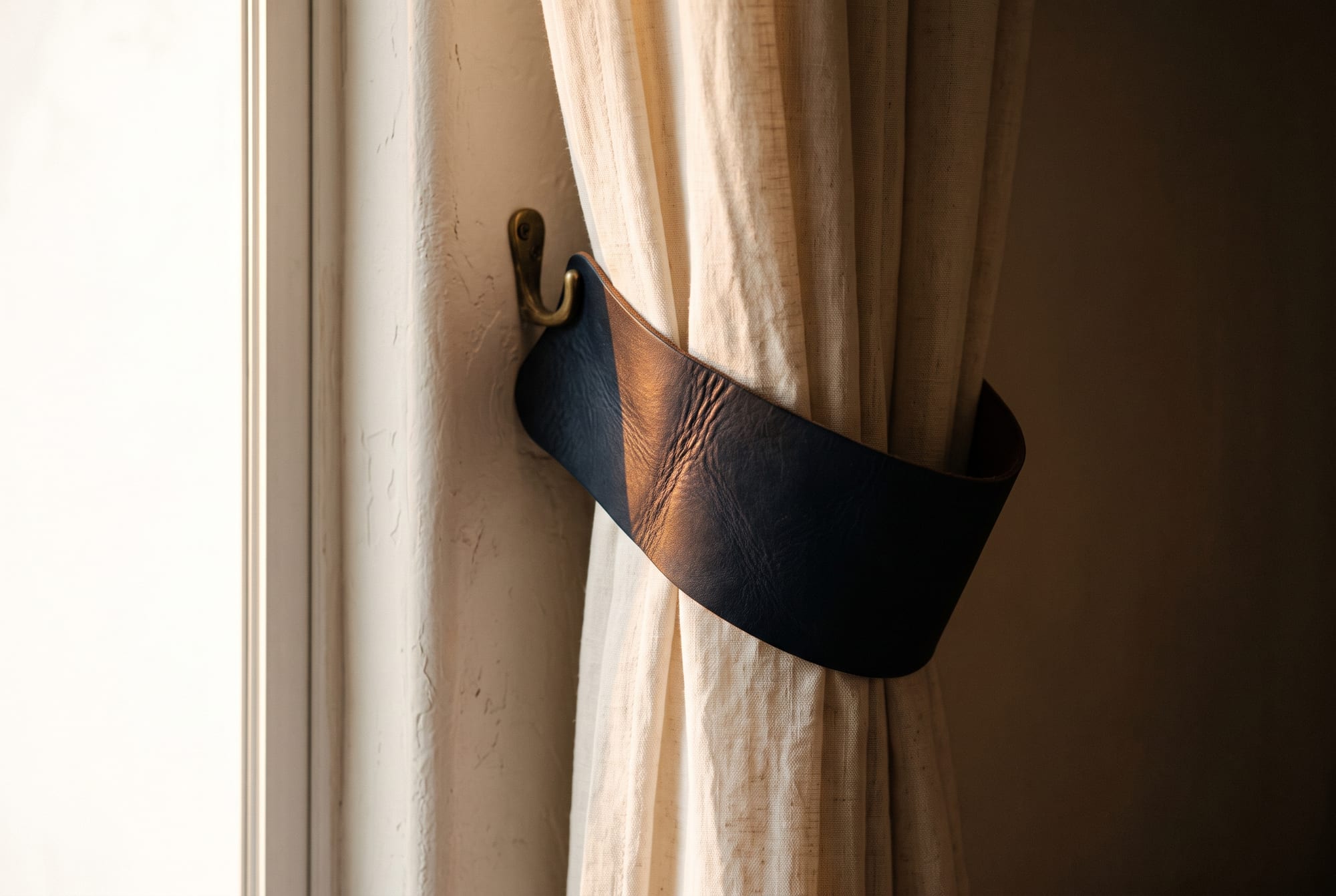
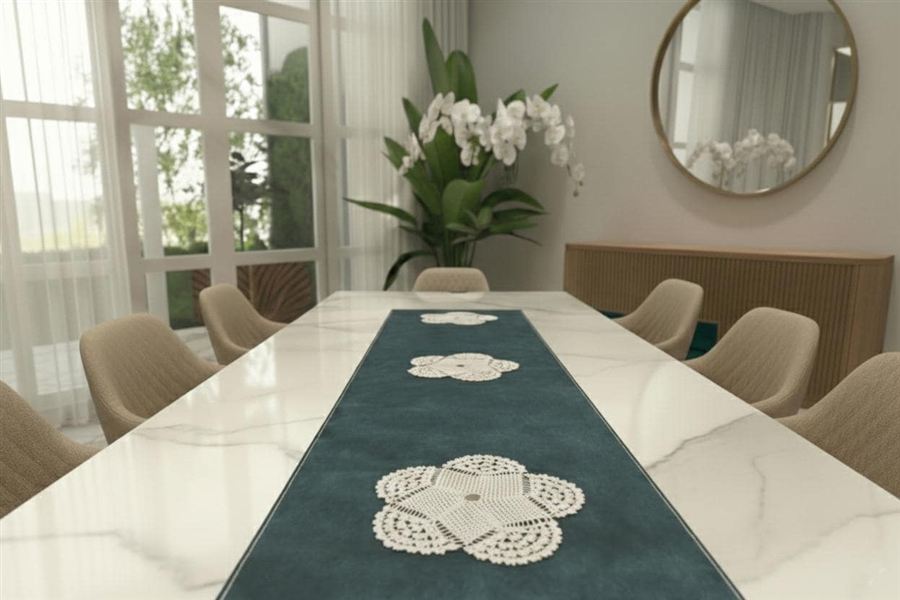
Half of what we make does not live like that at all. A table runner lies on a dining table for years. A placemat sits where the morning comes in. A pair of curtain tiebacks is held against the glass, in one position, one face out, permanently. For those pieces, “keep it out of direct sunlight” is not advice, it is a contradiction of the object's purpose.
So this is the long version, and it begins with the thing almost nobody mentions: sunlight does not have one effect on leather. It has two, they run in opposite directions, and they are happening to two different parts of the material at the same time.
Two reactions, one piece of leather
The hide itself gets darker.
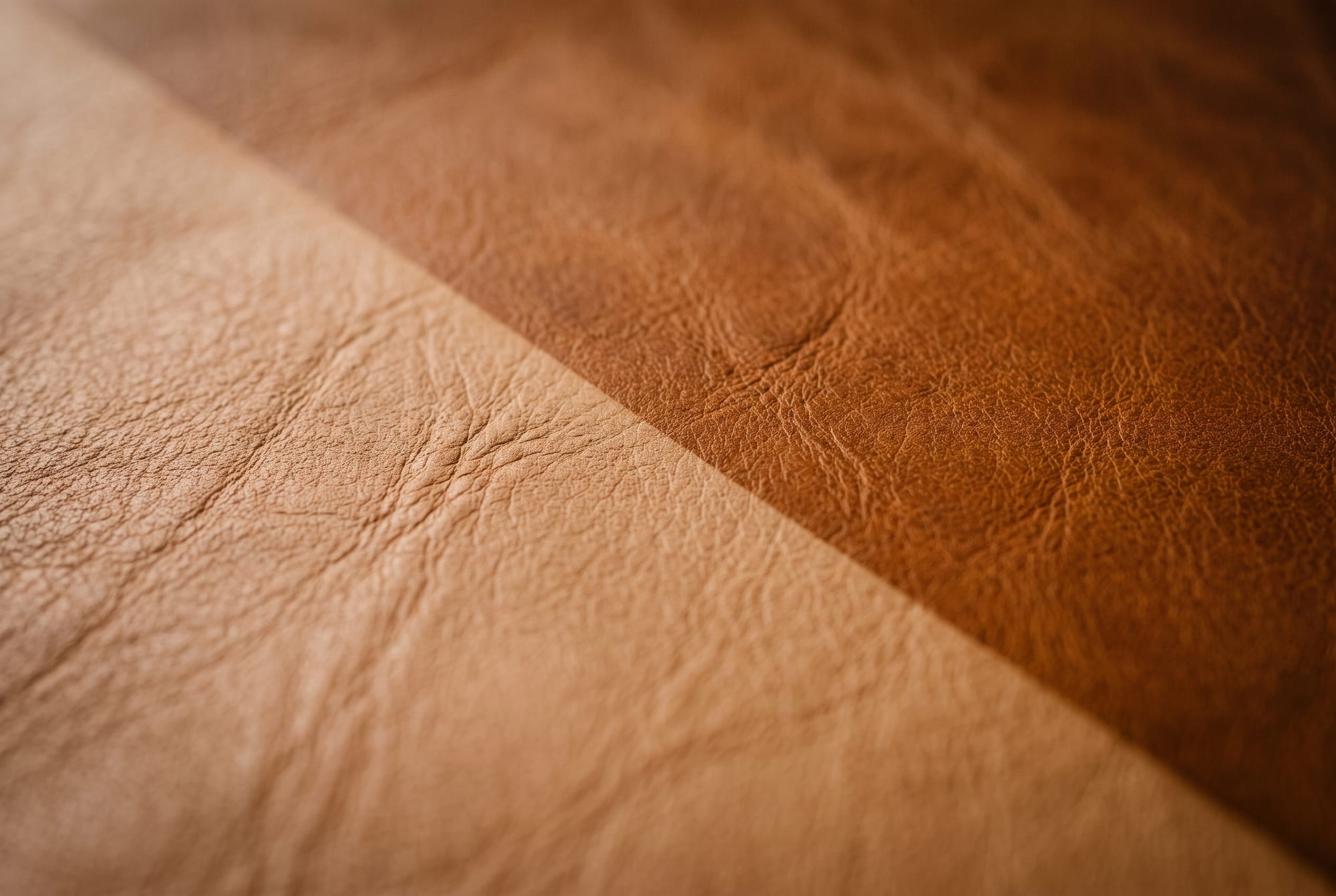
Vegetable-tanned leather is full of tannins — that is what vegetable tanning means, plant tannin bonded into the fibre — and tannins oxidise in light. They deepen from pale biscuit through honey towards a warm reddish brown. The oils in the leather oxidise along with them and add their own warmth. This reaction is so reliable that leatherworkers use it deliberately: leave a piece of undyed veg-tan on a sunny windowsill for a fortnight, turning it, and you can take it from raw oatmeal to a rich tan on purpose. It is called sun-tanning, and it is the same chemistry that gives a well-used natural wallet its colour, just accelerated.
The dye gets lighter.
Dye molecules hold their colour because of a particular arrangement of chemical bonds, and ultraviolet light carries enough energy to break those bonds apart. A broken dye molecule does not change colour; it stops producing colour altogether. Enough of them go and the shade thins out. This is fading, it is irreversible in the strictest sense — the thing that was doing the colouring is no longer there — and it has nothing to do with the hide underneath, which is busy going browner.
Which of the two you notice depends entirely on what is on top. Light does not fade leather. It fades dye, and it tans hide, and it does both to the same panel at once.
Put those together and you can predict what a given piece will do. On a natural or undyed piece there is no dye to lose, so you see only the darkening, and it generally looks wonderful — this is the one case where strong light is doing you a favour. On a dyed piece the two reactions fight, and the dye usually loses first, which is why sun-faded leather so rarely goes pale. It goes muddy. The colour you chose thins away and what emerges underneath is not white or grey, it is the hide's own oxidised brown. A faded red reads rusty. A faded tan reads dull and slightly grey-brown. The colour did not disappear; it was replaced by the leather's own.
The shape matters more than the shade
Here is the part that changed how I place things at home, and it is the single most useful idea in this article.
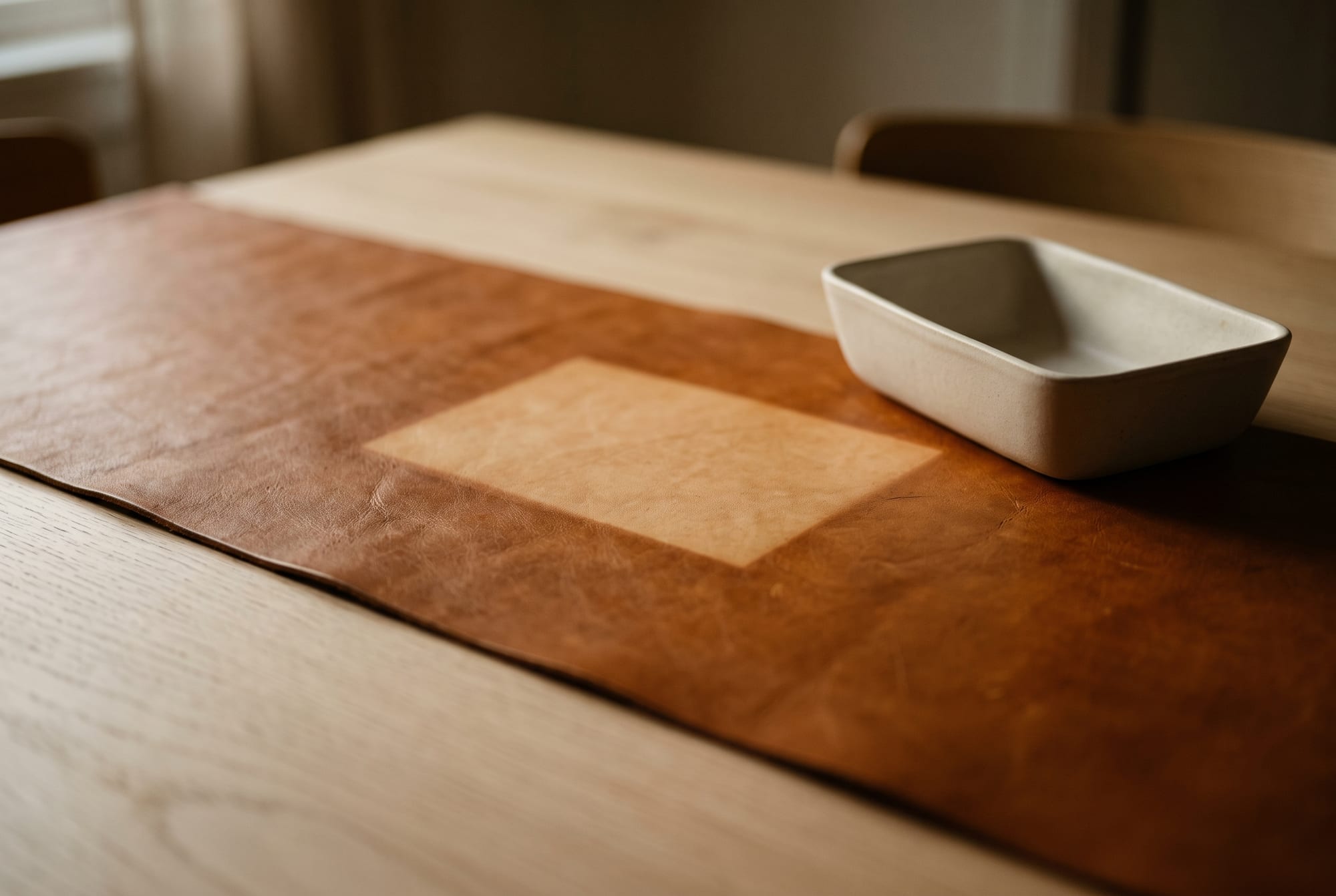
Nobody is upset by a leather piece that has gone two shades deeper over three years. That is the thing we all say we want when we talk about patina. What upsets people — what gets photographed and sent to us — is a rectangle. A pale panel exactly the size of a fruit bowl. A dark band precisely where the folded edge of a curtain sat. A runner that is one colour at the window end and another at the wall end, with a visible transition.
The colour change was never the problem. The boundary is the problem.
Even change is patina. Boundaried change is damage. They can be chemically identical — the difference is entirely whether something was sitting on top while it happened.
Your eye is far more sensitive to edges than to absolute tone. A gradient across a metre of leather is nearly invisible, and a hard line two millimetres wide is the first thing you see in the room. This is why a sunlit piece with nothing on it ages beautifully, and a sunlit piece with a candlestick on it acquires a permanent record of the candlestick. The light did not pick on the covered part. It worked on everything it could reach, and the object you left there kept a little archive of the day you put it down.
Which reframes the whole problem. If you cannot keep a table runner out of the light — and you cannot, it lives on a table — then your goal is not to reduce the light. It is to stop anything from masking it for months at a time.
A windowsill is a heat problem as well
There are three separate things coming through that window, and lumping them together is why so much advice is vague.
Ultraviolet breaks dye bonds, as above, and over years also works on the collagen and the fat-liquor in the hide itself, which slowly costs the leather flexibility. Visible light fades dye too, more slowly — so a north-facing room with no direct sun is gentler, not exempt. And heat is the one that gets forgotten, which is unfortunate because in a domestic setting it often does the most harm.
A dark leather surface in a sunbeam gets genuinely hot. Heat drives moisture out of the hide and mobilises the oils that keep the fibres sliding — the oils migrate towards the warm surface and then oxidise there. The result is a piece that is not just discoloured but dry, and dry leather is leather that cracks where it folds. On a flat runner that may never matter. On a tieback that is knotted around a curtain in the same place every day, it matters a great deal, because that is a permanent fold being baked.
And there is a nasty wrinkle about glass. Ordinary window glass blocks most short-wave UVB but passes a good deal of longer-wave UVA, and it traps heat very efficiently. So a spot directly behind glass is not the mild environment it feels like on a cool October morning. It is a low-UVB, high-UVA, high-temperature environment — which is close to the worst combination available for a leather object, and considerably harsher than the same spot would be outdoors in moving air.
One warning that follows from this, because the two halves of our Journal meet here: a sunlit piece will read as dry, and dryness invites conditioning. Be careful. The honest answer is a thin application if the fold test says it genuinely needs it, and nothing otherwise — a warm, oily surface is exactly the situation in which surplus oil migrates straight back out and blooms on the surface. Heat does not help you feed leather. It helps the leather hand the food back.
Where things can actually live
This is less a rule than a way of looking at a room. Light in a house is not uniform, and most of the good placements are only a metre away from the bad ones.
So what can you actually undo?
Honestly, very little on the colour side, and I would rather say so plainly than sell you a remedy.
Faded dye is gone. The molecules that were producing the colour have been broken, and there is no product that reassembles them. Anything claiming to restore a sun-faded colour is a pigment being laid on top — which is a refinish, not a repair, and it means accepting a coated surface on a hide that was chosen for being uncoated. Sometimes that is the right call on a much-loved old piece. It is not a reversal.
But there is one genuinely useful move, and it is counterintuitive enough that almost nobody suggests it:
To fix a pale patch, do not give the piece less light. Give the patch more.
If a rectangle is lighter than its surroundings, the surroundings have moved on and the rectangle has not. Both halves still respond to light. So take the bowl off, turn the runner around, and let the sheltered area catch up with the exposed one. On natural and lightly dyed veg-tan this works remarkably well, because the dominant reaction there is the hide darkening rather than dye fading — and that reaction is still available to the covered part. It is slow, it wants months rather than weeks, and it will not be perfect. It will turn a hard edge into a soft one, and a soft one into nothing much, which is all you actually need.
The reverse case — a patch that is darker than its surroundings, which happens where a folded tieback or a stacked edge shaded part of a dyed piece — is harder, because there you are waiting for the exposed area to stop fading, and it will not. Even that one improves with rotation, just less.
For the dryness side, treat it as dryness: check the fold, condition thinly if and only if it asks, and move the piece out of the hot spot. That part is genuinely fixable.
Living with a sunlit room
The whole protocol, such as it is, fits in four habits. None of them involves buying anything.
- Turn things around. Twice a year, end-for-end: runners, placemats, tiebacks, armrest covers. Put it in the same mental drawer as changing the clocks. This is the single highest-value habit in this article and it takes four seconds per object.
- Move whatever sits on top. The bowl, the tray, the candlestick, the stack of books. Not far — just not the same square for a whole season. If an object genuinely has to live in one place, accept that its outline will eventually be part of the piece, and choose the placement with that in mind.
- Think about light when you choose a colour, not after. If a piece is going to spend its life on a sunny table, natural, cognac and the deep browns will reward it. A red or a bright clear shade in that position is a beautiful object with a shorter colour life, and reds are the least light-fast family there is. Worth knowing before you commit, rather than being surprised in the second summer.
- Watch the heat, not just the brightness. If a surface is warm to the back of your hand at four in the afternoon, that is the spot to worry about — more than a bright but cool north-facing shelf. A sheer curtain costs little and cuts both heat and UV substantially, without making the room dark.
What I have stopped doing is apologising for the change. We make things from a material that responds to its surroundings; that is the entire reason to choose it over something stable and synthetic. A runner that has deepened across three autumns on the same table is doing the thing it was supposed to do. The failure mode is not that leather changed. It is that it changed in the shape of something else.
Patina is light and oil and hands, spread over the whole surface. Sun damage is the same light, concentrated by the thing you left in the way. Same agent, different distribution — and distribution is the only part of it you control.
If you have a piece with a boundary on it and you are not sure whether rotation will close it up, photograph it in indirect daylight — the whole piece flat, and a close-up across the line at a low angle — and send it to info@pazleather.com. Whether it is faded dye or a shaded hide makes all the difference to what happens next, and it is usually obvious from a good photograph.
Further reading
- What patina actually means, and how long it takes
- Leather in the home: where it works and where it does not
- The leather colour guide: choosing a shade that ages well
- Burgundy leather: the hardest colour to get right
- How to style a leather table runner
- Over-conditioned leather: limp, sticky, dark — and what comes back
- Leather winter care: dry heat and the cracking season
- How to store a leather bag for a season or a decade