Guide · 16 October 2026 · by Zafer
Fake crazy horse leather: why every real-leather test passes it
Ask the internet how to spot fake leather and you get the same four tests: burn a corner, smell it, look at the back, put a drop of water on it. Run all four on a convincing fake crazy horse bag and it will pass every one of them — because it is leather. “Crazy horse” names a finish, not a hide, so the counterfeit is almost never plastic. It is the wrong hide wearing a wax costume, and only two tests see through it.
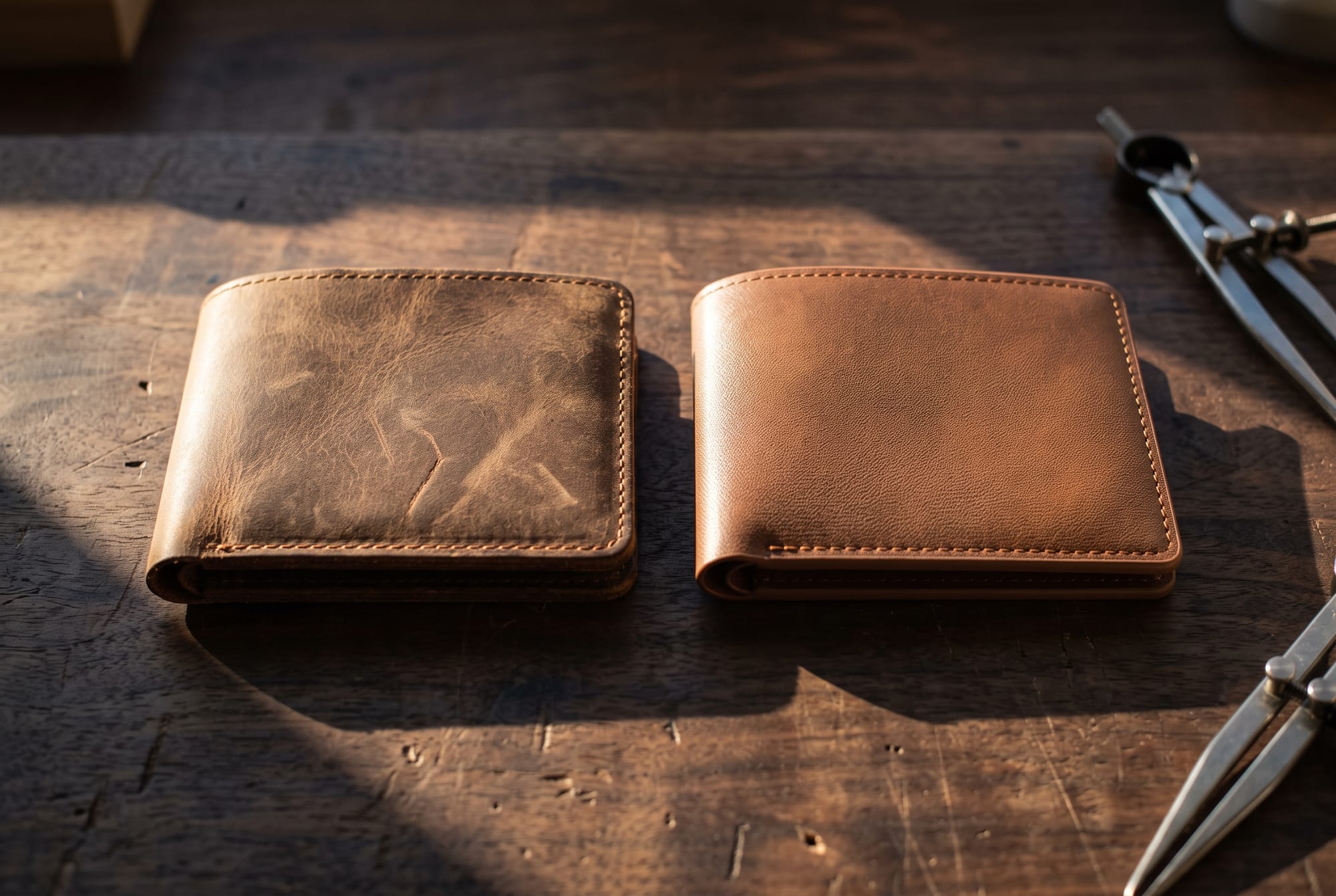
A message arrives with two photographs and one question. The bag is a “vintage crazy horse leather” messenger, bought online for roughly what we would pay for the hide alone. The owner has done his homework before writing. He burned a sliver from inside the strap and it charred and smelled of burnt hair. He has run a thumb over the back and it is fibrous. He has put his nose to it, and it smells of leather.
He is right about every one of those observations. It is leather.
It is also not crazy horse, and within a year it will not look like the photographs that sold it to him.
Crazy horse is a finish, which is exactly why the fake is made of leather
Nearly everything that gets faked in this trade is faked with plastic, and the whole folk library of tests was built to catch plastic. The flame test works — in a narrower way than people believe, but it works. The flesh side works. The smell works.
Crazy horse is a different kind of problem, and the reason sits in the words. Full-grain, top-grain and split name a layer of the hide. Vegetable and chrome name a chemistry. Crazy horse names neither. It describes a treatment: a hide loaded heavily with waxes and oils, so that bending or pressing it shoves the wax sideways, the colour goes lighter where the wax left, and then the wax flows back and the mark closes again. That behaviour is pull-up, and it is the whole point of the material.
Read that description again and notice what it does not specify: which layer of which hide went under the wax. There is no standard behind the term, no certifying body, and nobody to complain to. A seller can write “crazy horse” on anything that has been waxed, and a great many of them write it on things that have not.
The cheap way to make something that looks like crazy horse is not to reach for plastic. It is to take the least valuable leather in the building, press a distressed grain into it, spray on a mottled two-tone colour, and wax over the top.
So the counterfeit arrives with a genuine hide underneath it. Every test that asks is there leather here comes back yes, honestly, every time. The tests are not failing. They are answering a question that stopped being the useful one the moment the label named a finish instead of a grade.
Six tests, and only three of them are looking at the right thing
Here is the whole field laid out: the real material, the imitation that fools people, and the crude imitation that fools nobody who has handled leather. The crude one is worth including only because it is what everybody pictures when they hear “fake” — and picturing it is what leaves the middle column free to walk past.
The test that works: make the wax move
If you only ever learn one check for this material, learn this one. It takes four seconds and it is the only test that interrogates the thing the label actually promised.
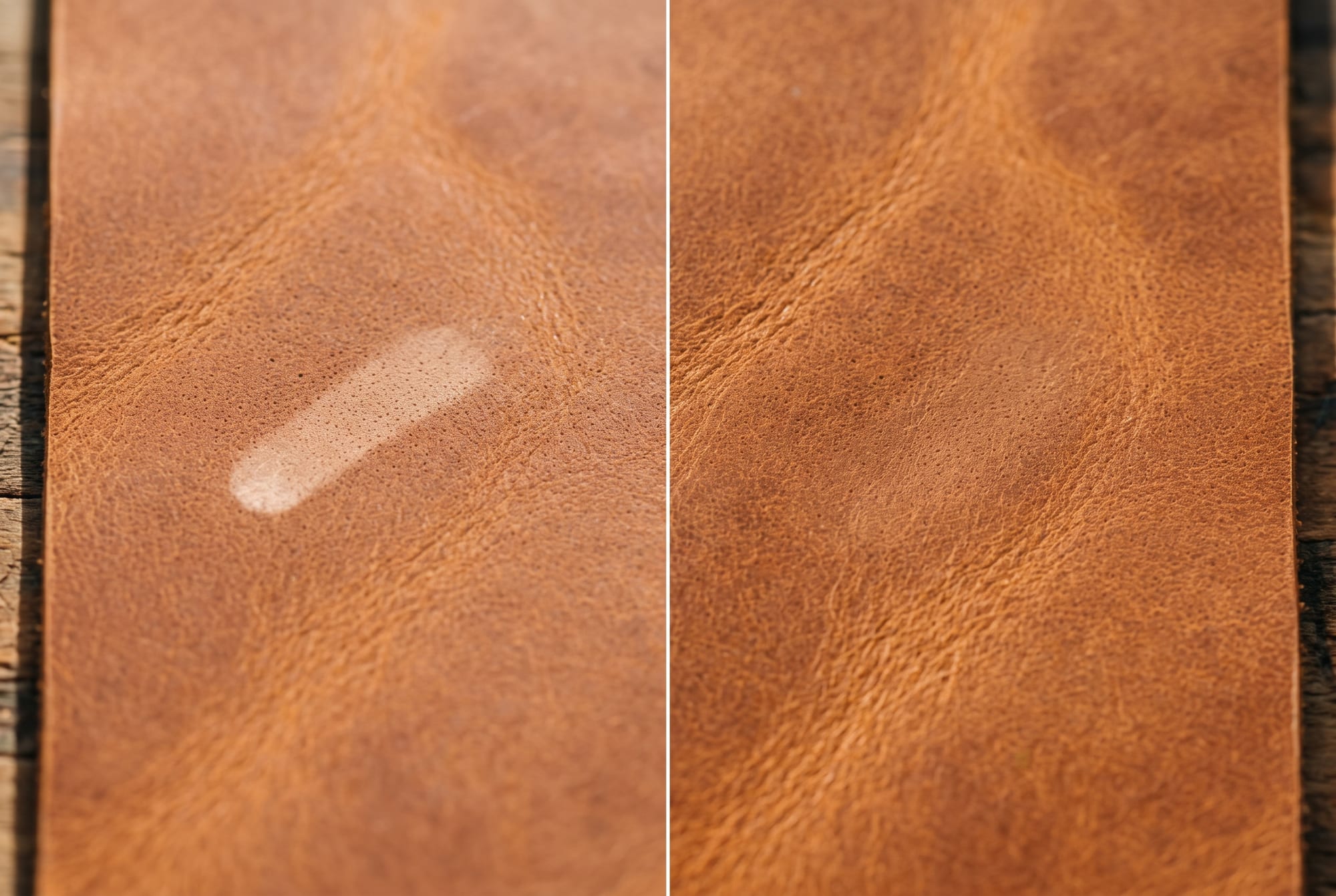
Press a thumbnail firmly across a hidden area — the inside of a flap, under a strap, the back of a card pocket — in one short stroke. On genuine waxed pull-up, a pale line appears instantly behind your nail. Then put a warm thumb on it and rub for ten seconds. The line goes.
That sequence is the material describing its own construction. The wax and oil are not a coat on top; they are inside the fibre structure near the surface. Compress the leather and the fibres on the outside of the bend spread apart, the wax is squeezed out of that zone, and with less wax to darken it the colour reads lighter. Warmth and pressure let the wax flow back, and the mark closes. Nothing was damaged. Something moved, and then it moved back.
Severity is not the test. Recovery is. The question is never “did it go lighter” — it is “did it come back”.
That distinction matters, because a lightly waxed but entirely honest full-grain hide will pull up only faintly, and people reject good leather on the strength of a shy result. Meanwhile a printed surface can show a very dramatic line indeed — it is just a scratch through a coating, and a scratch does not heal. Judge the return, not the drama.
The grain that repeats, and why the fake looks better
The second test costs nothing and can be done from a listing photograph, which makes it the one to use before money changes hands.
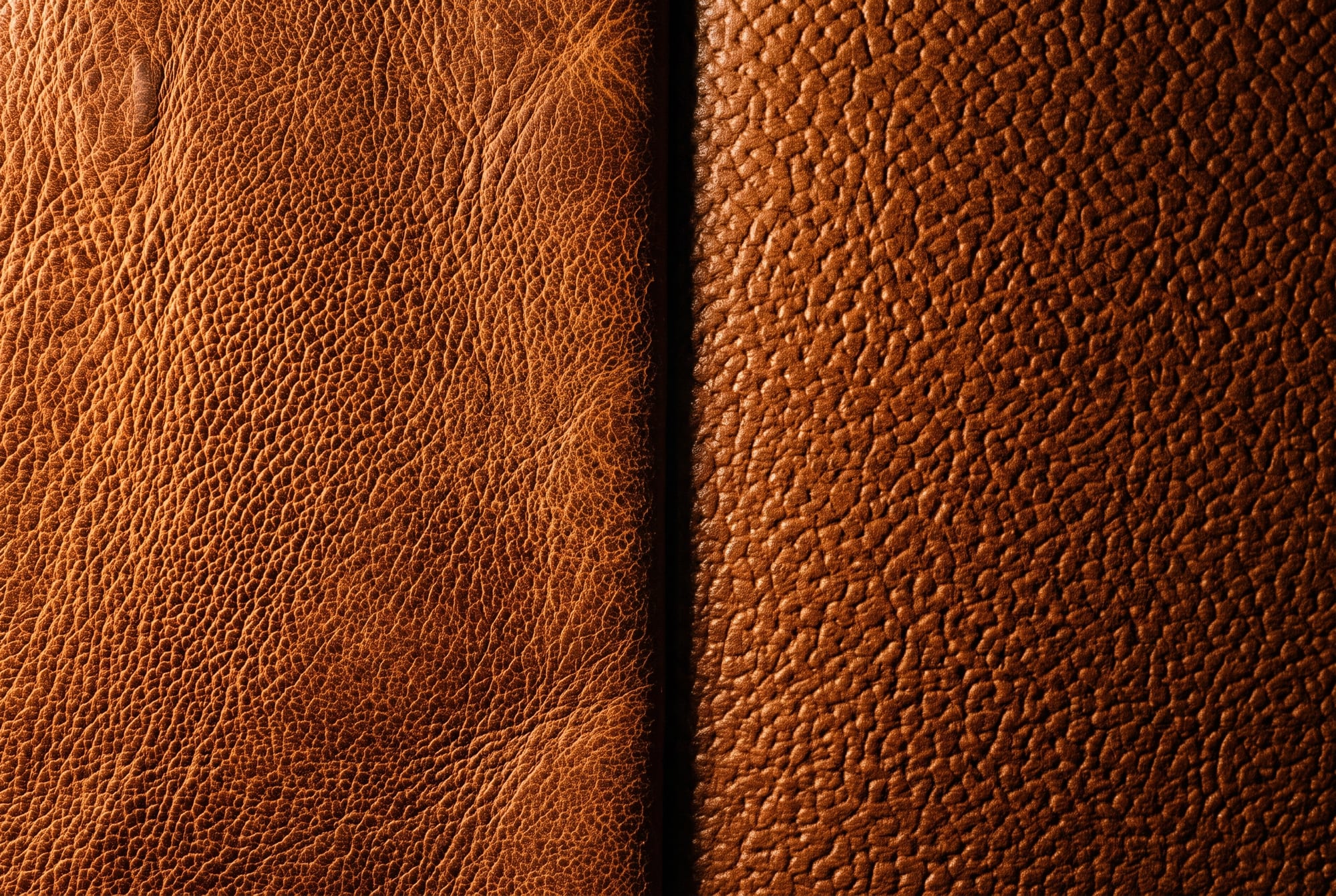
A full-grain hide keeps the animal’s own surface. Pores crowd together in one place and thin out in another. There are growth lines, healed scratches, the odd insect bite, and a visible difference between the dense leather off the back and the looser leather from the belly. Those marks are the hide’s biography, and no two square centimetres of it are the same.
A printed grain comes from an engraved plate, and a plate is a finite object — a few tens of centimetres across. Run it down a whole hide and the pattern has to repeat. So: take the listing photograph, zoom in, and hunt for the same little constellation of pores appearing twice. On an embossed grain you will find it, usually faster than you expect.
There is a second version of this test which needs no zooming at all. Look at two different panels of the same bag — the front and the gusset, say. A real hide gives you two panels that do not quite match, because they were cut from different parts of an animal. A printed hide gives you perfect agreement everywhere.
The imitation is more consistent than the real thing. That is the tell, and it is also why it photographs so well.
This is worth saying plainly, because it inverts what most buyers assume they are looking for. Evenness reads as quality control. In this material it reads as a machine.
What the two look like in the second year
The tests matter because the paths diverge, and they diverge sooner than most people are braced for.
Genuine waxed pull-up gets better. The wax redistributes, the surface evens out and deepens, the scuffs stop registering as events because they close as fast as they appear, and the places your hands go darken first. By year two it looks like something that has been used rather than something that has been damaged.
The printed, pigmented version has a different clock. The wax on top is a surface load with nothing holding it in place, so it leaves the corners and the handle first — months, not years, on a bag in daily use. Underneath it is a pigment film sitting on a buffed and corrected surface, and a film on a flexing panel does what films do. Real leather does not peel; coatings do, and this is exactly the construction that produces the cracking and lifting people photograph in year four.
So the honest summary is not that one is leather and one is not. It is that one was sold to you as a material that improves, and it is a material that degrades.
Where the name is merely loose, rather than dishonest
Not every imprecise use of the term is a swindle, and it is worth separating the three things you will meet.
- A brand’s own named leather. Some makers use “crazy horse” as the trade name of one specific hide inside their own range — specified, consistent, bought to a standard. That is a product name, and it tells you something real about that maker’s material. It says nothing at all about a marketplace listing using the same two words as a description.
- Honest waxed pull-up under a borrowed name. A great deal of good oil-waxed and pull-up leather gets called crazy horse because that is the phrase buyers search for. This is loose naming rather than fraud, and the material can be excellent. The thumbnail test will tell you.
- “Crazy horse PU” and “crazy horse leatherette”. Sold openly as synthetic with a crazy-horse look, and priced accordingly. There is nothing to catch here — the listing already told you. Whether it is a reasonable buy is a separate question with a more interesting answer than people expect.
The category that costs people money is none of these. It is the listing that names a finish, implies a grade, shows a photograph of consistency, and lets the burn test do the rest of the work.
Three questions to ask before you pay
“What grade is the hide?”
Not the finish, not the tannage, not the country — the grade. A seller who works with the material will answer in one word. If the answer is “genuine leather”, or a paragraph about craftsmanship, or nothing, then the words “crazy horse” are doing no work in that listing. The finish was never the thing you were buying; it was the grade underneath it.
“Can you send a photograph of a thumbnail press?”
Ask for one frame immediately after, and one frame a minute later, on a hidden part. It is a small request and a reasonable one, and in practice the reply is the answer: makers who have the material find this fun, and resellers who do not have it go quiet or send a stock image.
“Can you photograph two different panels?”
The front and the side, in the same light. You are looking for two panels that do not quite match. If they match perfectly, you have your answer without ever touching the bag.
Everything in our own workshop that we call Crazy Horse is full-grain, vegetable-tanned, and cut and saddle-stitched here in Istanbul — and the reason I will happily put a thumbnail across any of it in front of you is that the test has only one possible outcome. That is the whole argument, and it fits in four seconds.
Further reading
- What is crazy horse leather? Meet the hide that scars on purpose
- The leather burn test: what it actually proves, and what it cannot
- Aniline, semi-aniline, pigmented: what the finish decides
- Why is my leather peeling? Real leather doesn’t — coatings do
- Full-grain, top-grain, “genuine”: what leather labels really mean
- Why “real leather” doesn’t mean good leather