Guide · 3 August 2026 · by Pınar
Vegan leather vs. real leather: an honest answer from a leather maker
We cut leather for a living — which is exactly why you should hear us give the other side a fair hearing first.
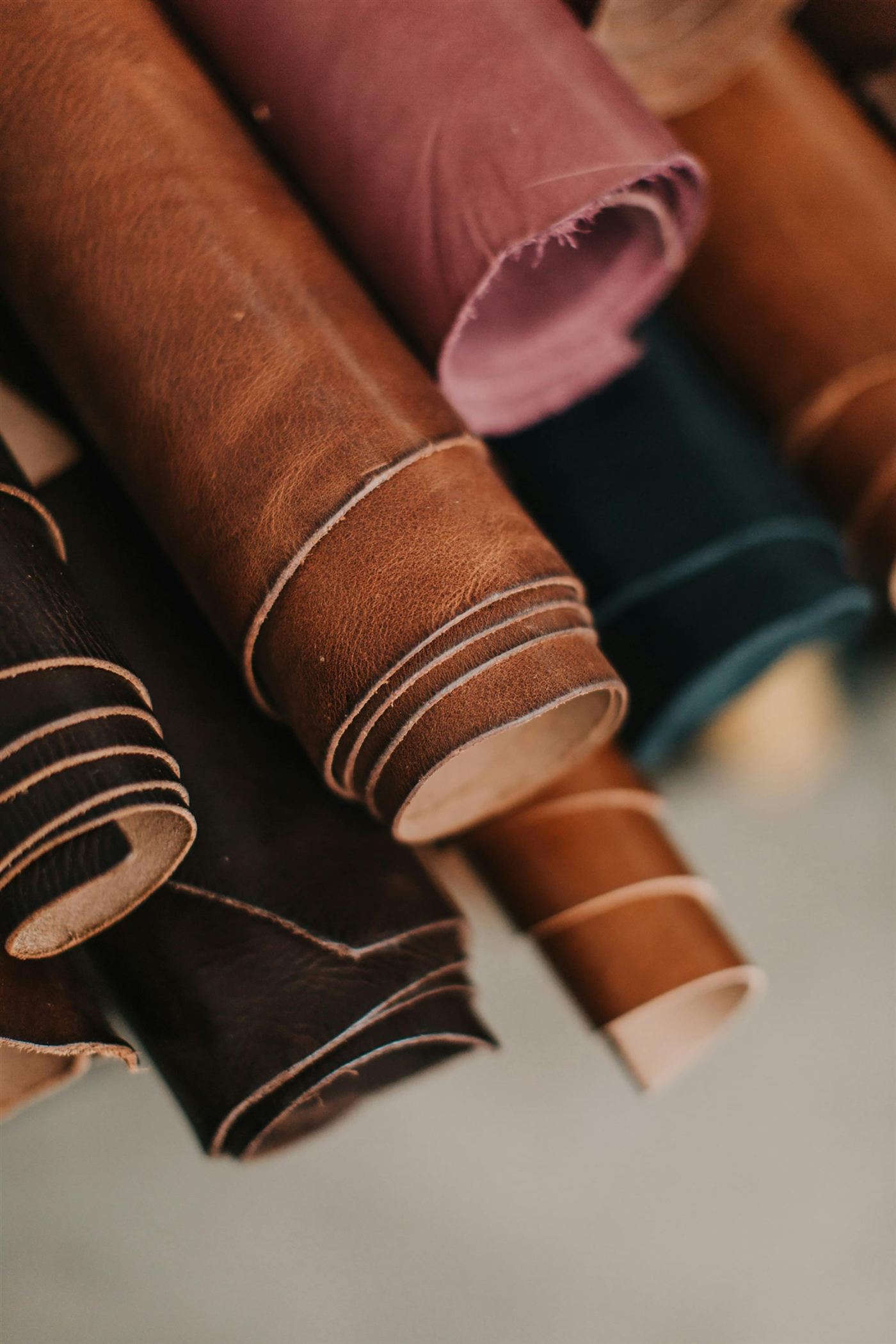
At every craft fair, someone picks up one of our pieces, hesitates, and asks the question of the decade: “But isn’t vegan leather better now?” They expect us to get defensive. We’d rather get honest — because the honest answer is more interesting than either side’s marketing.
First: what is “vegan leather,” actually?
About 90% of what sells as vegan leather is polyurethane (PU) — a layer of plastic embossed with fake grain, bonded to a fabric backing. The newer generation sounds greener: cactus, apple peel, mushroom, pineapple. Read the technical sheets, though, and most still rely on plastic binders for 30–60% of the material. There are genuinely exciting exceptions in development, but what’s on shelves today is, mostly, well-dressed plastic.
Where vegan leather honestly wins
Fairness first. If your ethics exclude animal materials entirely, no durability argument matters — and we respect that position; it’s coherent and honestly held. Vegan leather also wins on upfront price, on colour consistency (plastic doesn’t have scars or grain variation), on weight, and on water resistance out of the box. For a trend piece you’ll enjoy for two seasons and retire, it is arguably the rational buy.
Where it falls apart — literally
Materials age in one of two directions: they compound or they decay. Full-grain leather compounds — your hands, the sun and the years deepen its colour into patina, and a thirty-year-old bag is routinely more beautiful than a new one. PU decays: the plastic layer dries, stiffens, then peels in flakes — usually between years two and five — and no conditioner, repair or goodwill can reverse it. A peeling bag isn’t repairable; it’s finished.
Real leather gets better until you lose it. Vegan leather gets worse until you bin it.
The math nobody does: cost per year, waste per decade
Here is the frame we wish every comparison article used. Take a decade of daily carrying:
- One full-grain bag, well made: bought once, conditioned twice a year, repaired if needed. Ten years later it’s at its best. Cost per year falls every year; landfill contribution: zero so far.
- PU bags at a typical 2–4 year lifespan: three to five purchases over the decade, three to four bags in landfill — where, being plastic, they will sit for centuries.
Run the numbers and the “expensive” option is usually the cheaper one, and the “animal-free” option quietly becomes the petroleum option. That’s not a gotcha — it’s just arithmetic that fashion marketing skips.
The environmental caveat we won’t hide
Leather has real environmental costs too: tanning consumes water, and chrome tanning (most fast-fashion leather) uses heavy-metal salts. Two choices change the equation. First, hides are a by-product of the food industry — the animal is not raised for leather, and an unused hide is simply waste. Second, vegetable tanning replaces chromium with oak and mimosa bark, at the cost of months instead of a day. Slow tanning plus decades of use is the most defensible version of leather there is — and it’s the only version we buy.
A one-question test for choosing
Skip the ideology and ask: “When this fails, will it be repaired — or replaced?” If the honest answer is replaced, buy the cheaper thing, whichever material it is, and enjoy it guilt-free. If the answer is repaired — if you want an object that joins your life rather than passing through it — then buy full-grain, vegetable-tanned, and stitched so it can be opened and fixed. (Here’s what to check before buying, whichever way you go.)
Our position, in one paragraph
We make things from full-grain, vegetable-tanned leather — by-product hides, tanned with bark, saddle-stitched so any seam can be repaired, shipped with a flower seed in the box. Not because leather is sacred, but because our whole philosophy is anti-disposable: the greenest object, whatever it’s made of, is the one you never throw away. If a future plant-based material can honestly promise thirty years and a patina, we’ll be the first to order a hide of it.