Guide · 30 September 2026 · by Zafer
Natural marks on leather: where each one came from, and which ones are actually faults
The commonest message we get after a piece ships is a photograph taken far too close, with one sentence under it: is this supposed to be here? Almost always, yes. But “don’t worry, it’s natural” is a poor answer, so here is the long one — what made each mark, where on the animal it comes from, and the short list of things that genuinely are faults.
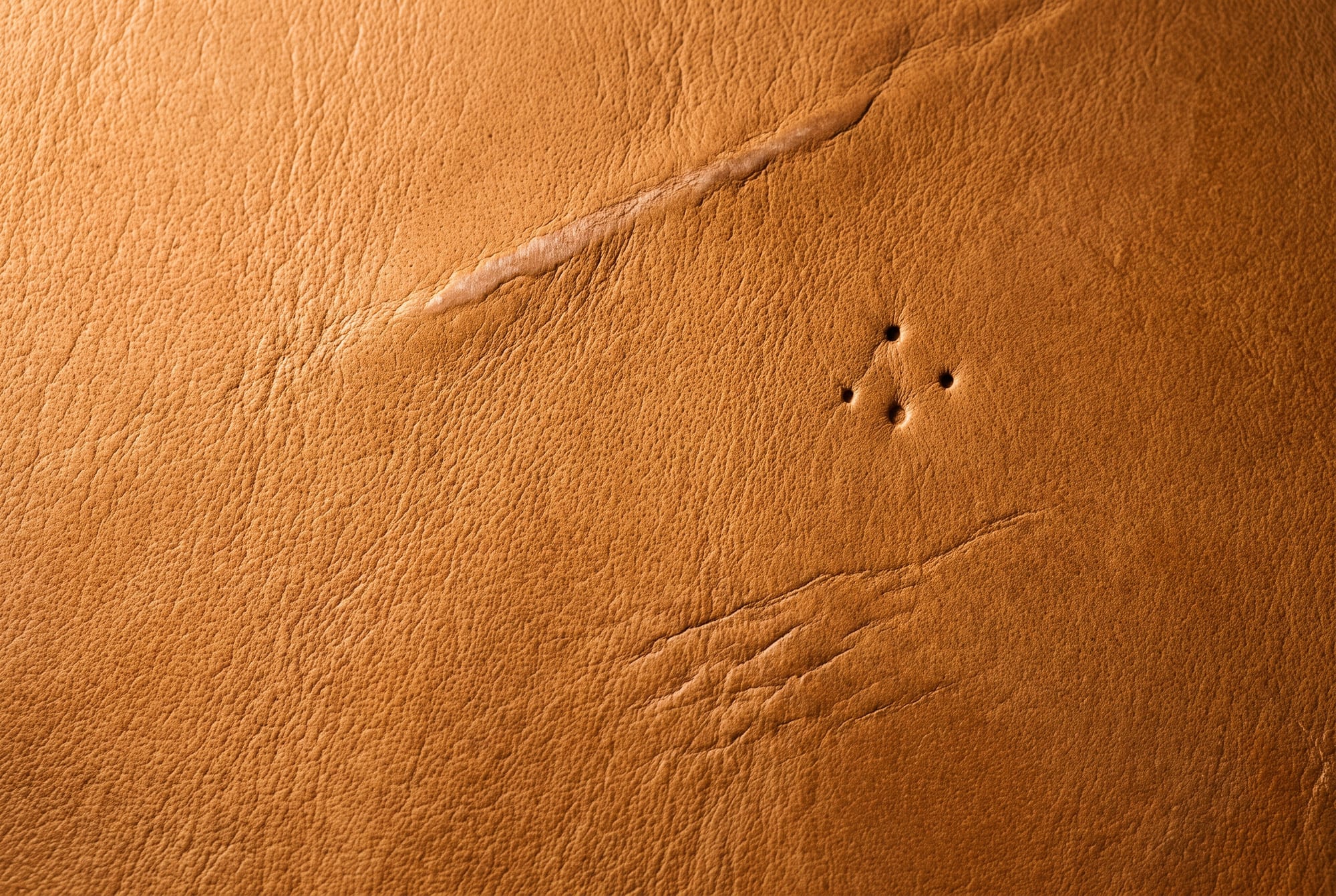
There is a particular kind of quiet that follows a parcel arriving. The piece comes out of the wrap, gets turned over twice under a kitchen light, and then somebody notices a line. A faint ridge across one corner. A cluster of small dots. A patch that has taken the dye half a shade deeper than everything around it.
And the reasonable thought is: this one has a flaw in it.
I want to give you the honest version of what that mark is, because the reassuring version — it’s natural, it makes each piece unique — is true and completely useless. It tells you nothing about whether the piece will last, and it is exactly what somebody would say if they were covering for a genuine defect.
So: the mark is on your bag because nobody removed it. There is a well-established industrial process for removing it, it is used on most of the leather in the world, and it is the only step in this entire story that would have made your leather measurably weaker. That is the whole article, but the details are worth having.
A hide is a map, not a sheet of material
Start with the thing that is easy to forget once leather arrives in a shop looking like fabric: it was the outside of an animal, and the outside of an animal is not uniform.
The fibre structure changes depending on where you are standing on it. Along the spine and over the hindquarters — the region a tannery calls the bend or butt — the collagen fibres are at their tightest and most densely interwoven, and the hide is at its thickest. That is the leather you want under a belt, a strap, a handle, or anything with a buckle hole in it. It is also the most expensive part of the hide by a wide margin, for exactly that reason.
Walk outwards and it loosens. The shoulder is firm but more open, and it carries the deepest natural creasing. The neck is creased further still. And the belly — the strips along each flank — is the loosest and thinnest leather on the animal. Belly is soft, and people who are new to leather often like the feel of it, which is a trap: that softness is not suppleness, it is the absence of structure. A strap cut from belly will stretch, and it will keep stretching, and no amount of care will bring it back.
Two pieces cut from one hide, in the same colour, by the same hands, on the same afternoon, are not quite the same material. That is not a quality-control failure. That is an animal.
A field guide to the marks
Here is what you are most likely to be looking at, roughly in order of how often it causes alarm.
Growth wrinkles. A fan of parallel creases, usually running across a piece rather than along it, deepest on neck and shoulder leather. They are the record of an animal spending several years lowering its head to eat and lifting it again. They look structural and are not: the fibre beneath them is intact, and they show most clearly on vegetable-tanned hides precisely because nothing has been done to flatten them.
Healed scars. A raised line, sometimes pale, sometimes a shade darker than its surroundings. Barbed wire, a thorn hedge, an argument with another animal. The healed tissue is not weak — it is scar tissue, which is what skin does instead of leaving a hole — but it is denser and less porous than the leather around it, so it drinks dye and conditioner at a different rate. That is why a scar often reads as a change in sheen rather than a change in shape. It is also visible from the flesh side, which is a useful thing to know: a mark that exists on both sides of the leather is a real event in a real animal, not a pattern that was pressed on afterwards.
Insect marks. Small round pits, sometimes singly, sometimes in a loose constellation. Biting flies account for most of them. The famous one is the warble fly, whose larvae migrate through the animal over months and surface near the backbone — which is to say they ruin the single most valuable region of the hide, and a tannery will tell you about it at length. Britain eradicated warble fly by around 1990 after a decade-long programme, and it is absent or rare across much of Western Europe now, but it persists in other parts of the world, and hides move around the world. Where the larva pierced the skin and the wound then healed, you get a scar rather than a hole. A hole is a different matter, and we will come back to it.
Stretch striations. Fine, irregular, roughly parallel lines, mostly on belly and flank, from rapid growth or from carrying a calf. They look almost exactly like the human equivalent, for the same reason.
Brand marks. The one mark on this list that costs somebody real money. A hot iron destroys the grain outright, and burnt tissue does not tan or take dye like its neighbours ever again. Branding is usually placed on the hindquarter or flank — not because ranchers are thinking about leather, but it happens to be a slightly less catastrophic place for it to land. In some traditions a visible brand is prized. In a wallet panel it is a cutting problem.
Shade movement. Not a mark at all, strictly, but it generates as many questions as all of the above put together. Dye is taken up by fibre, and fibre density varies across the hide, so an aniline-dyed panel will be a fraction deeper here and a fraction lighter there. You are seeing the hide’s own structure through the colour. The only way to get a flat, even, machine-consistent shade is to stop dyeing the leather and start painting it, which is a different product with different properties.
So which ones are faults?
This is the part that actually matters, and it needs a test rather than a list of reassurances. The test is one question:
Has the grain layer been broken, or has it merely been marked?
The grain is the top stratum of the hide, perhaps a fraction of a millimetre deep, where the collagen fibres are packed far tighter than anywhere below. It is the layer doing most of the work: abrasion resistance, water resistance, the ability to take a bend a hundred thousand times and come back. Everything in the field guide above happens to the grain and leaves it whole. Here is what does not.
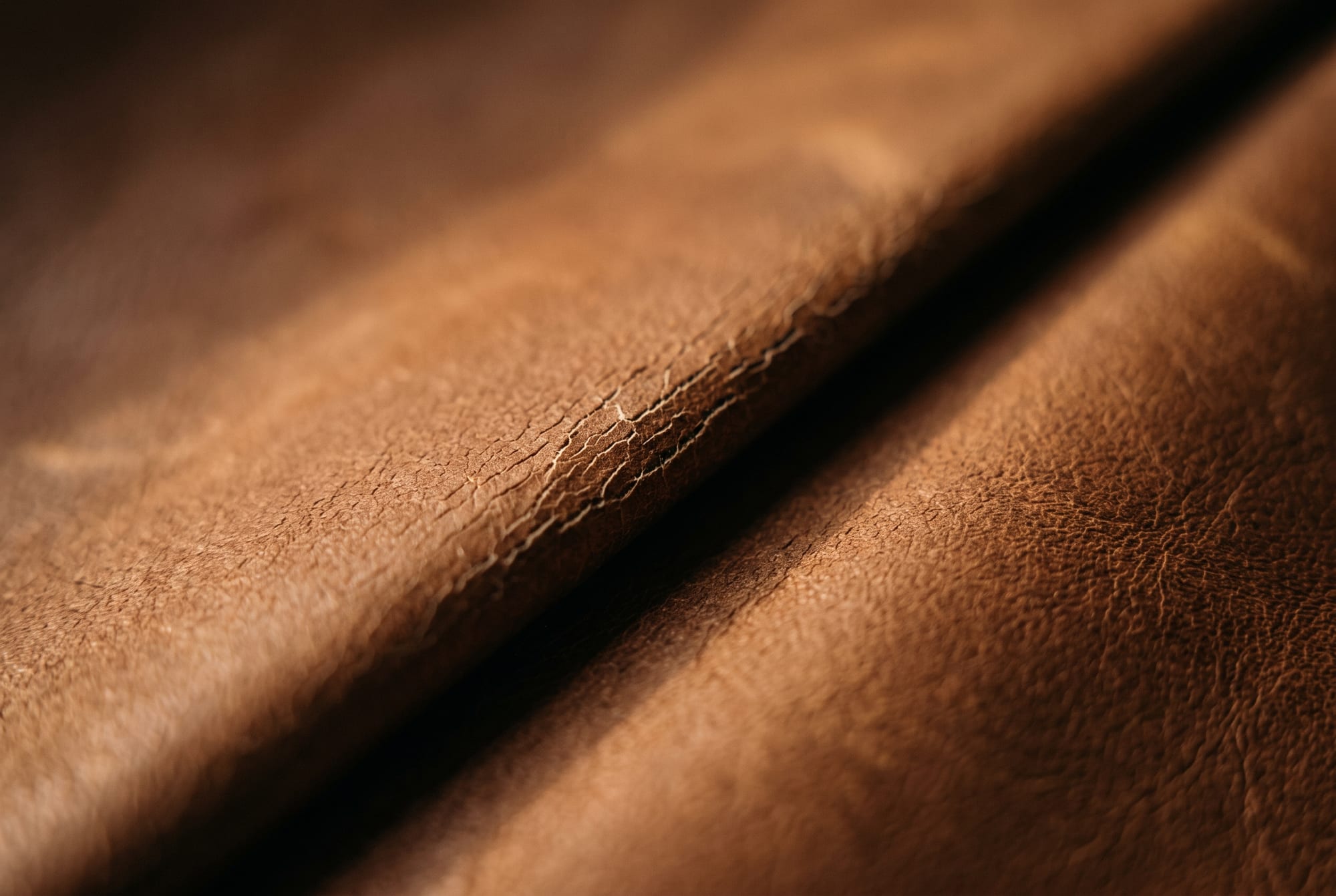
- Cracking. Fine lines that open up when you flex the piece, nearly always at a fold. This is not a mark, it is dryness damage, and it is progressive — which is a winter problem far more often than people realise. A crack in the middle of a flat panel is an accident. A line of them along a fold is a history.
- Loose or flaking surface. If the top layer is lifting, powdering, or coming away in small plates, you are not looking at hide at all — you are looking at a coating failing, which is the single most common way “leather” falls apart. Real grain does not peel. It wears.
- A hole, or a genuinely thin spot. An open warble hole, a deep old cut, a place where the grain is so reduced that light gets an opinion about it. These exist on plenty of hides, and the correct response is to cut around them. Finding one in a finished piece means it was not cut around.
- A mark in the wrong place. This is the real fault, and it belongs to the maker, not the animal. A scar sitting precisely where a strap folds, or exactly where a buckle hole has to be punched, or across the one panel that takes the whole weight of a bag — the mark is fine, the placement is not. Judging a maker on whether there are marks is pointless. Judging one on where the marks are is the most informative thirty seconds you can spend on a piece.
What the flawless ones cost
Which brings us to the middle column, because it explains almost everything about why mass-market leather looks the way it does.
To make a hide uniform, you sand the surface. That removes the scars, the wrinkles, the bites and the striations, and it also removes the layer those marks were sitting in — the tightest-packed collagen in the whole hide. What is left is more open and more absorbent, so it gets sealed with a pigment coating, and because a sealed surface looks like plastic, a grain pattern is embossed into it. The result is corrected grain: perfectly consistent, available in unlimited quantity, and wearing a picture of a surface it no longer has.
That coating is also the thing that eventually lifts, cracks along fold lines and flakes — which is why the one failure mode people associate most strongly with “cheap leather” is a failure of the correction, not of the hide. We have written the longer version of what finishes do and cost elsewhere.
Uniformity is not a higher standard. It is a different product, and it is bought by giving up the strongest part of the material.
None of which means marked hides are free. Tanneries sort their output by how much clean, unmarked area each hide yields — commonly into something like an A / B / C ladder, though there is no single industry standard and every tannery draws its own lines. As a rough sense of the shape of it, a typical run might come out somewhere around a fifth top grade, half middle grade, a fifth lower, and the remainder fit only for small parts and offcuts. Those proportions move with breed, region, climate and how the cattle were kept, so treat them as a shape rather than a rule.
The crucial point about that ladder is what it does not measure. A lower grade is not weaker leather, badly tanned leather, or leather that will not last. It is leather with more marks in more places, which means a smaller usable area and more offcuts. You are grading a yield, not a strength.
What actually happens at the bench
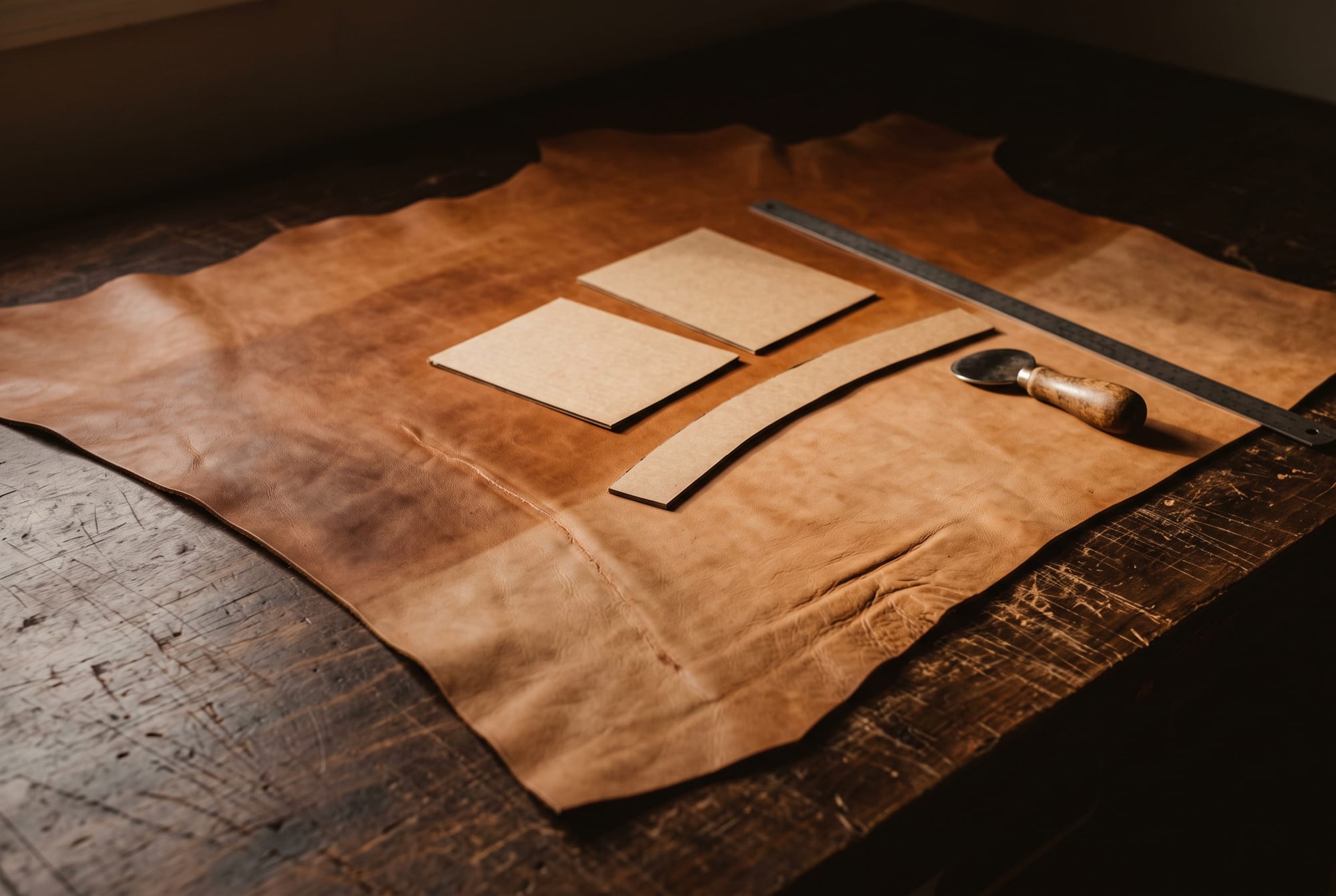
A hide arrives, gets unrolled across the bench, and is looked at for a long time before anything sharp comes near it. Marks decide the order of operations.
Anything that must not stretch comes out of the bend first — straps, handles, belts, anything that will be pulled on for ten years. Then the large panels, from the shoulder and the remaining back. Then the small parts, from whatever is left, which is where the bellies finally earn their place. This is also, incidentally, where thickness decisions get made, because the hide is not one thickness either.
And each mark gets a decision. Put it on the inside, where it will never be seen. Put it deliberately on a face, if it is a good one. Or cut around it, and accept that the area is gone.
That third option is the answer to a question people ask a lot, usually politely: surely a marked hide is cheaper, so shouldn’t a piece with a scar on it cost less? It works the other way round. Marks do not reduce the price of the finished object, they reduce how much of the hide becomes finished objects at all. A heavily marked side takes longer to lay out, produces more offcuts, and yields fewer pieces. The visible scar on your bag is the one that got used. It is the invisible ones, the ones that ended up in the waste bin, that you paid for.
The same logic explains why the front and back of a hand-cut bag are rarely identical twins. They can be cut close, from adjacent areas, and a maker who cares will do exactly that. But a maker who insists on a perfect match will burn through a hide finding it — which is a real part of why handmade costs what it does.
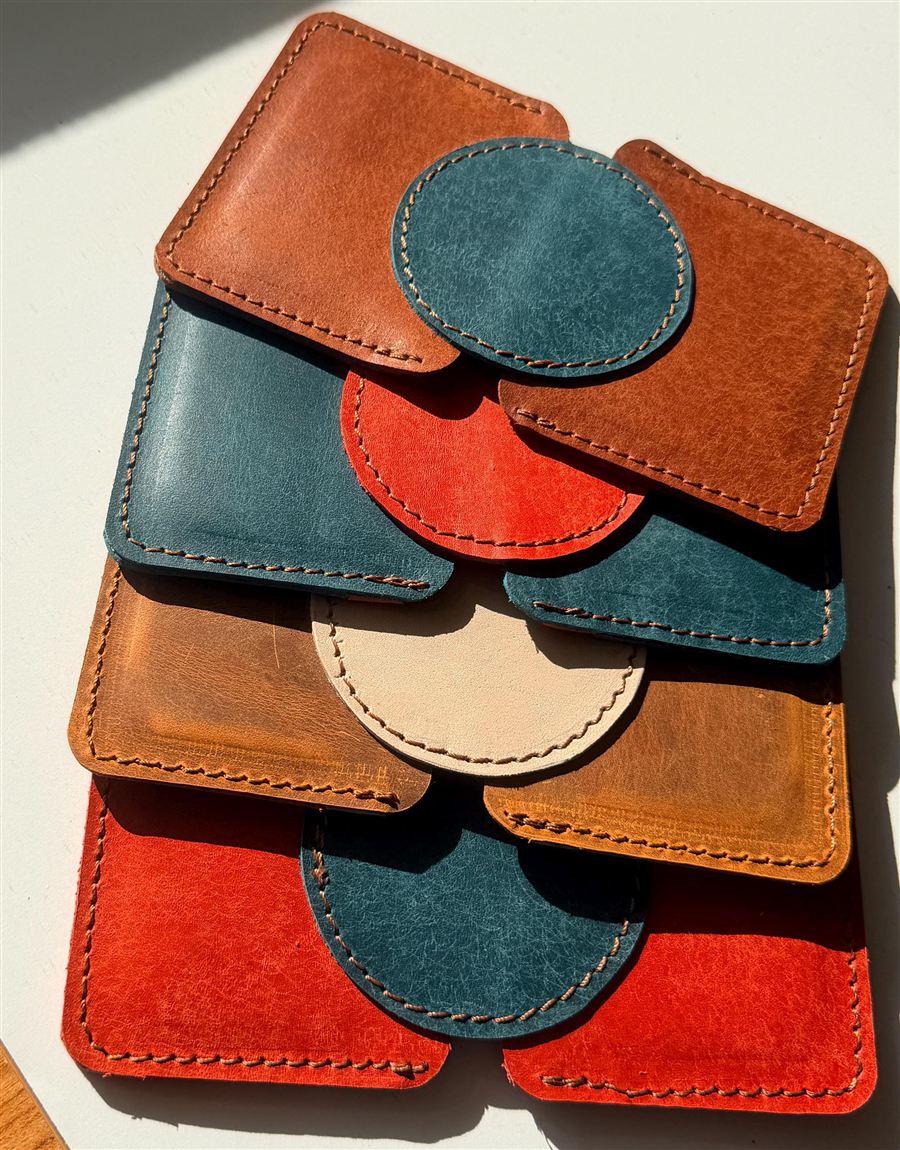
What to do about the mark on your piece
Nothing. That is not a dodge; it is the actual advice, and there is a specific mistake it is meant to prevent.
The instinct, when one small area looks different, is to treat that one small area. Work a bit of conditioner into the scar, rub the patch that looks light, give the dots a little cream. Do not. Spot-treating is how a faint mark becomes a permanent dark halo — conditioner darkens leather as it goes in, and a hide does not redistribute it sideways to even things out. You will have swapped a mark the animal made for a mark you made, and yours will be rounder and more obviously artificial. If you are conditioning, condition the whole piece, thinly, and far less often than you think.
Then leave it, because time is on your side here in a way that is genuinely unusual. Almost every mark on the field-guide list is at its most conspicuous on day one. What makes it visible is contrast against an unused, evenly-coloured surface — and that surface is about to stop being even. Handling deposits oils, light deepens the tone, the places you touch most darken first, and the whole panel starts moving towards the tone of the mark. Twelve months in, the scar that worried you is one line of character among many. It has not gone anywhere. Everything around it has caught up.
The reverse is also true, and it is the sentence worth keeping. A corrected hide is at its best on the first day, and the coating on it has nowhere to go but down. A marked hide is at its worst on the first day.
A flawless surface starts perfect and gets worse. An honest one starts marked and gets better. The only real decision is which direction you want the next ten years to run.
So — is it supposed to be there? If it is a wrinkle, a scar, a pit, a striation or a shade change: yes, and it is evidence that nobody sanded your leather. If it is a crack, a flake, a hole, or a mark sitting exactly where the piece has to bend: no, and you should say so. Those are two very different photographs, and now you can tell which one you are holding.
Further reading
- What full-grain leather actually is, and how to recognise it
- Leather grades explained: full-grain, top-grain, genuine, bonded
- Aniline, semi-aniline, pigmented: what the finish decides
- Leather thickness: why the same hide is not one material
- What patina actually means, and how long it takes
- Why “real leather” does not mean good leather
- Why leather peels — and why real grain never does
- Glossary: corrected grain