Guide · 17 September 2026 · by Zafer
Aniline, semi-aniline, pigmented: what a leather's finish actually decides
Two hides can both be full-grain. Both vegetable-tanned. Both cut from the same part of the same animal. One will darken in your hands over ten years and the other will look exactly as it does today until the day it cracks. The difference is the finish — and it is the one line a listing almost never prints.

A customer wrote to us last month with a photograph of a bag she had bought elsewhere and a single question: why has it not changed at all? She had read about patina, she had been careful with it, she had oiled it twice. Three years in, it was identical to the day it arrived — except for a small white graze near the corner that would not rub out.
Nothing was wrong with her care. The bag was doing exactly what it was built to do. It was pigmented leather, and pigmented leather does not change, because the part of it you touch is not really leather.
Three questions, and most people ask two
By now the two big leather arguments are well rehearsed. Grade — full-grain, top-grain, “genuine”, bonded — tells you which layer of the hide you are holding. Tannage — vegetable, chrome, combination — tells you how it was stopped from rotting, and sets its character: firm and slow-darkening, or soft and stable.
There is a third question, and it is the one that decides what the object is like to own. What is sitting on the surface?
What “aniline” actually means
The word sounds like a chemical you should be worried about. It is really just a historical accident. When the first synthetic dyes arrived in the nineteenth century they were made from aniline, a coal-tar derivative, and the trade started calling leather coloured that way aniline leather. Most modern dyes are no longer aniline-based at all, but the name stuck to the method rather than the chemistry.
So forget the etymology and keep one distinction, because everything else in this article follows from it:
A dye is transparent and goes into the leather. A pigment is opaque and sits on top of it. Aniline leather is coloured with dye and nothing else. Pigmented leather is, in the most literal sense, painted.
Drum-dyeing an aniline hide means tumbling it in dye until the colour has soaked through the thickness. Cut the piece in half afterwards and the core is the same colour as the face. Nothing has been added to the surface, so the surface you touch is the animal's own grain, with its pores, its growth marks, the healed scratch it got against a fence in its second summer.
That is the whole appeal and the whole liability. There is nothing between you and the hide — which is why it takes on patina, and equally why it takes on a coffee ring.
The spectrum, coat by coat
It is not two categories but a slope, and each step down it trades character for predictability.
- Aniline. Dye only. Maximum character, maximum vulnerability. Every hide is visibly a different hide, which is a problem if you are a factory needing four hundred identical handbags and a virtue if you are buying one object.
- Waxed and oiled aniline — the pull-up leathers. Still aniline: no pigment. Waxes and oils are stuffed into the fibre instead, so the colour lightens where the hide is stretched over a curve and darkens back when you rub it. Crazy Horse and Pueblo both live here.
- Semi-aniline. Aniline-dyed first, then given a thin coat carrying a small amount of pigment. You still see grain through it. The point is evenness — it hides the variation between hides and buys some resistance to spills. A reasonable compromise, and honestly labelled it is nothing to object to.
- Pigmented (sold as “protected” or just “finished” leather). An opaque polymer layer, coloured with pigment, sprayed over the top and sealed. The colour you see is not in the leather; it is on it. Wipes clean, resists sunlight, does not spot. Also does not breathe, does not darken, does not develop anything.
- Corrected-grain pigmented. The bottom of the slope. The natural surface is sanded off to remove scars and insect marks, the raw nap is filled, then pigmented, then embossed with a plate that prints an artificial pore pattern. You are looking at a photograph of leather, pressed into leather.
Note what is not on that list: nubuck and suede. Both are unfinished in the coating sense — nubuck is the grain side buffed to a nap, suede is the flesh split. They behave like aniline, only more so. Everything below about spotting applies to them twice over.
One drop of water, four answers
Here is the part worth carrying into a shop. You cannot see a finish reliably — a good pigmented leather can look convincing under shop lighting, and a matte aniline can look cheap. But you can test it, with one drop of water from a fingertip, in less time than it takes to read the price tag.

A caveat I would rather give you than have you discover: on genuinely unfinished vegetable-tanned leather that drop will leave a mark, and it may take a few weeks of handling to blend away. That is real, and it is why you do it somewhere hidden. If a shop assistant winces, that itself is information — they know what the hide is.
What the finish decides that you will actually notice
Put the diagrams away and think about the object in your hand for the next ten years.
Whether it ages, or merely wears. This is the big one. Patina is dye, oil, sunlight and skin working on an exposed surface. A coating stops all four. A pigmented bag has no mechanism for improving; it only has a mechanism for degrading. Everything that happens to it from the day you buy it is subtraction.
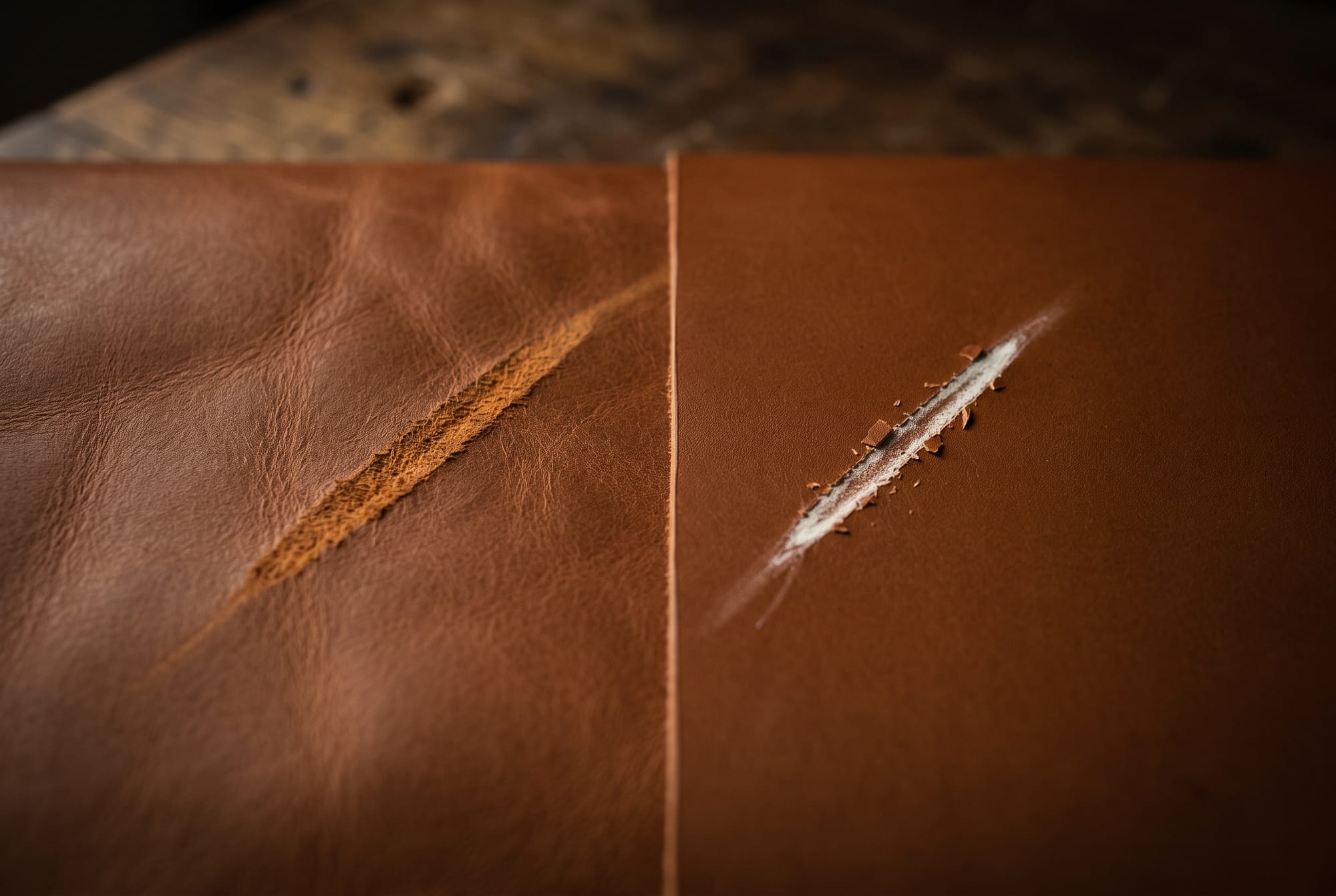
What a scratch does. On aniline leather a graze displaces oils and fibre — run a warm thumb over it and most of it closes, which is exactly how scratch repair works. On pigmented leather the scratch is a break in a plastic film, and a break in a film shows the pale filler underneath. No amount of thumb will bring that back, because nothing has moved; something is missing.
Whether it can ever be repaired. An aniline hide can be cleaned, fed, re-dyed by hand, blended into its neighbours. A pigmented panel has to be stripped and re-sprayed, which is refinishing, not repair — a job for a specialist with a spray booth and, on a bag, usually worth more than the bag.
Whether it will eventually peel. Only coatings peel. That is the entire content of the peeling question: a hide does not delaminate from itself, but a film applied to a hide will eventually let go, starting wherever the leather flexes most.
How it behaves in heat and against skin. Uncoated leather is breathable, which is why a veg-tan watch strap or a bag against a summer shirt is comfortable. A sealed surface is not, and in real heat you feel it.
And what it costs to look after. Aniline wants feeding and gets better for it. Pigmented wants wiping and gets nothing for it — conditioner on a sealed hide mostly sits on the surface, which is one more entry on the list of things that do nothing useful to leather.
Reading a finish in twenty seconds
In rough order of how quickly they settle the question:
- The water drop. As above. Soaks in and darkens within seconds: aniline. Sits for a minute then slowly goes in: semi-aniline. Beads indefinitely and wipes off dry: pigmented.
- Look at a cut edge. On a dyed hide the colour runs through the thickness. On a pigmented one you see a thin coloured skin over a pale, obviously different core — the same reason makers read the edge first.
- Check the pores for repetition. Real grain never repeats. Embossed grain does, on a cycle a few centimetres wide, because it came off a plate. Find the repeat and you have found corrected grain.
- Press your thumbnail in gently, in a hidden spot. Aniline takes the mark and lets it fade. A thick coating gives a shiny burnished dent, or crazes.
- Smell it. Uncoated veg-tan smells sweet and woody. A heavy finish smells faintly of solvent or of nothing at all — there is a whole article in that.
- Look at four of the same product. If all four are indistinguishable, they are coated. Four aniline hides cannot match.
Pigmented is not a swindle
I want to be fair here, because the honest position is not that one finish is good and the others are frauds.
A pigmented hide on a sofa in a house with two children and a dog is a completely rational choice. It will take orange juice, felt-tip and a wet dog, and it will wipe down. Aniline in the same room would be a slow tragedy. Car interiors are pigmented for the same reason — nobody wants a dashboard-sunned steering wheel that spots in the rain. The coating is a piece of engineering, and it is doing a job.
The swindle is never the finish. It is selling a coated hide on the promises of an uncoated one — photographing patina, writing “develops a rich character over time”, and delivering something sealed shut on the day it left the factory.
Which is where this rejoins the “real leather” problem. Every word in that description can be technically true. It can genuinely be full-grain, genuinely be leather, genuinely be well made. And it will still never do the thing the photographs implied, because the finish decided that before it ever reached the cutting table.
What we use, and why
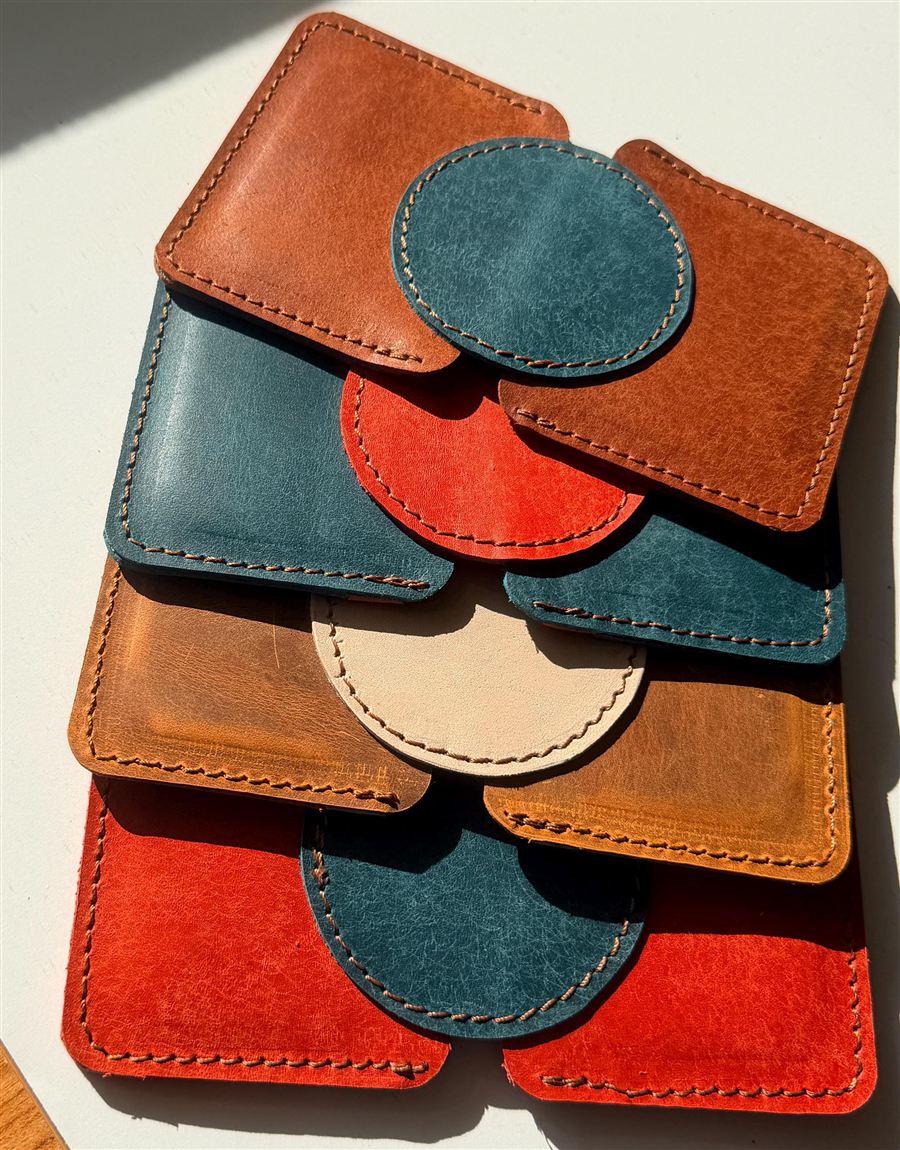
Everything we make is aniline, and most of it is the waxed, oiled end of aniline — Pueblo and Crazy Horse. That is not a boast about being the best kind of leather; it is a consequence of what we are trying to make. Objects that are hand-stitched, meant to be repaired, and meant to look better at ten years than at one require a surface that can register the ten years. A coating would make our work pointless. It would also, to be blunt, hide our mistakes, which is a good argument against it.
It also means our leather asks something of you. It will spot in rain, it will darken where your hand goes, it will pick up the shape of whatever it lives against. Everything in the care guide is written for this kind of hide and would be wasted effort on a sealed one.
So: ask the third question. If the seller knows the answer immediately, you are dealing with someone who has thought about the material. If the answer is “it's real leather”, you have learned something too — just not about the leather.
If you are weighing up something you have found elsewhere and cannot tell what you are looking at, send us a photograph of a cut edge and a close-up of the grain — info@pazleather.com. We will tell you honestly, including when it is a good buy.
Further reading
- Suede and nubuck care: why everything that feeds smooth leather ruins nap
- The leather desk pad: what size to buy, and what it becomes in five years
- Why is my leather peeling? Real leather doesn’t — coatings do
- Leather grades explained: full-grain, top-grain, “genuine” and bonded
- Vegetable-tanned vs chrome-tanned: what the tannage decides
- Why “real leather” doesn’t mean good leather
- Can suede, patent or vegan leather get wet? Every material, answered
- Glossary: aniline
- Glossary: corrected grain