
Guide · 18 October 2026 · by Zafer
Why a leather sofa always cracks on the arm first
Look at any leather sofa that has been in a family for a decade and the damage is never spread evenly across it. The seat is fine. The back is nearly new. The arm is finished. That is not bad luck or a weak panel — it is three entirely different loads arriving at the same curve, and the curve in question happens to be the tightest one on the whole piece.
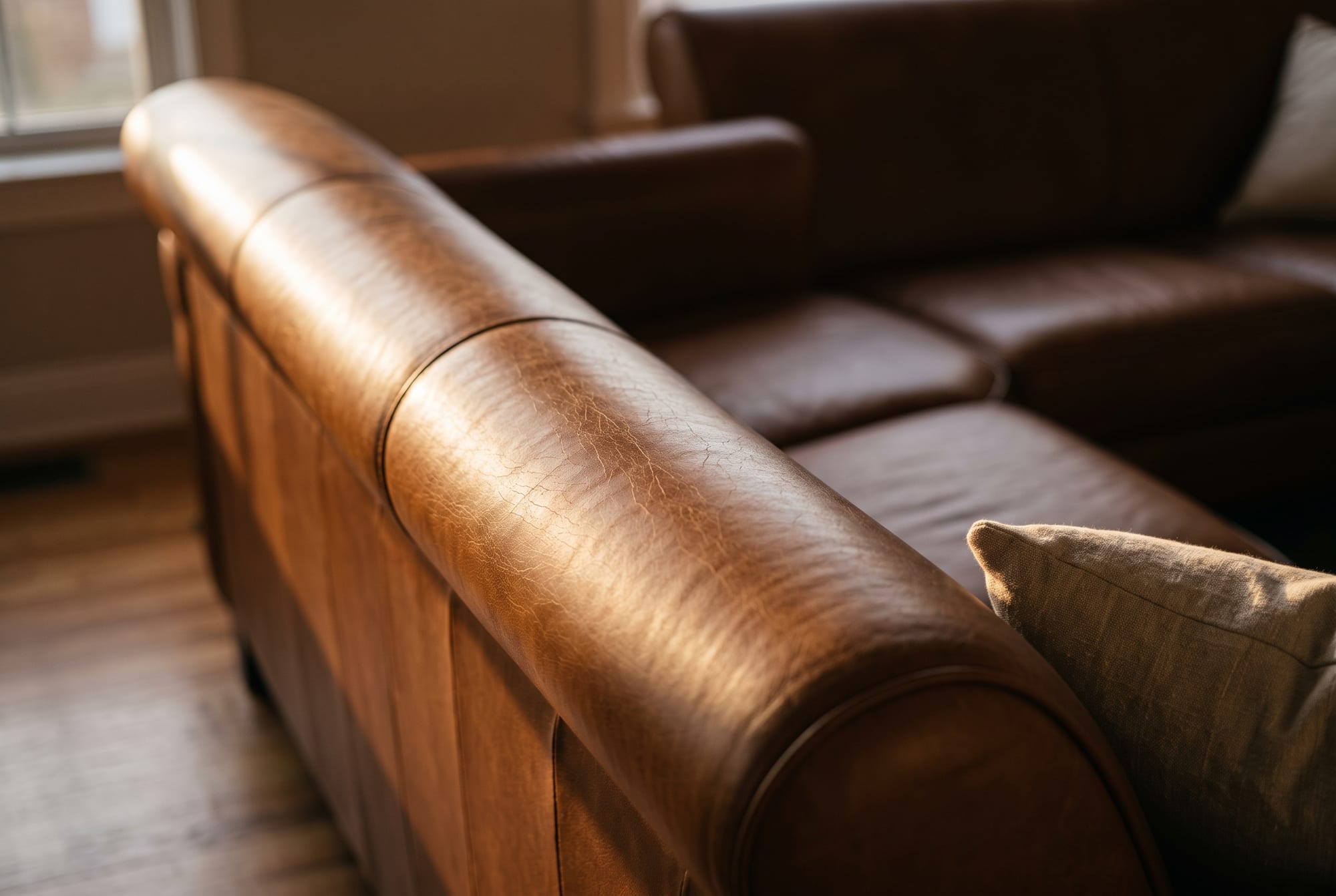
People bring us photographs of sofa arms more often than photographs of anything else in a house, and the message underneath them is almost always the same sentence: we have looked after it, so why has it gone here?
The honest answer is that they probably did look after it, and that the arm was never going to be saved by cleaning. It is the one surface on a sofa where three unrelated kinds of damage are happening to the same square of leather at once, and it is also the one place where the leather is least able to cope with any of them.
Three loads, one curve
Spread across a whole sofa, none of these would matter much. The problem is that they all land in the same place.
Skin. The arm is the only part of a sofa that receives bare forearms, for hours, most evenings. Nothing else in a living room takes that much direct skin contact. Along with the natural oils come whatever else is on an arm that day: hand cream, sunscreen, hair product. Oils do not simply sit there. They soften a finish, and a softened finish holds dust instead of shedding it, and held dust is an abrasive. It is the heaviest sebum load of anything we make, which is why the step everyone skips — cleaning before conditioning matters more here than anywhere else in a house. Feeding a dirty arm grinds the dirt in.
Friction. Everyone who sits down and stands up again drags something across the arm: a sleeve, a hip, a pocket. Denim is the worst of them, because the weave is coarse and the rivets are not, and the same arc gets travelled several times a day for years. This is ordinary abrasion, but it is extraordinarily repetitive abrasion in one narrow band.
Geometry, which is the one nobody counts. Look at a sofa in profile. The seat is a broad, gentle curve. The back is nearly flat. The arm is the tightest radius on the entire piece — and that matters, because every time weight goes onto it the outer surface of that curve is pulled into tension, and tension concentrates where the curve is sharpest.
Every finish is a film, and films fail in tension before they fail anywhere else. The arm crown is simply where a sofa bends hardest.
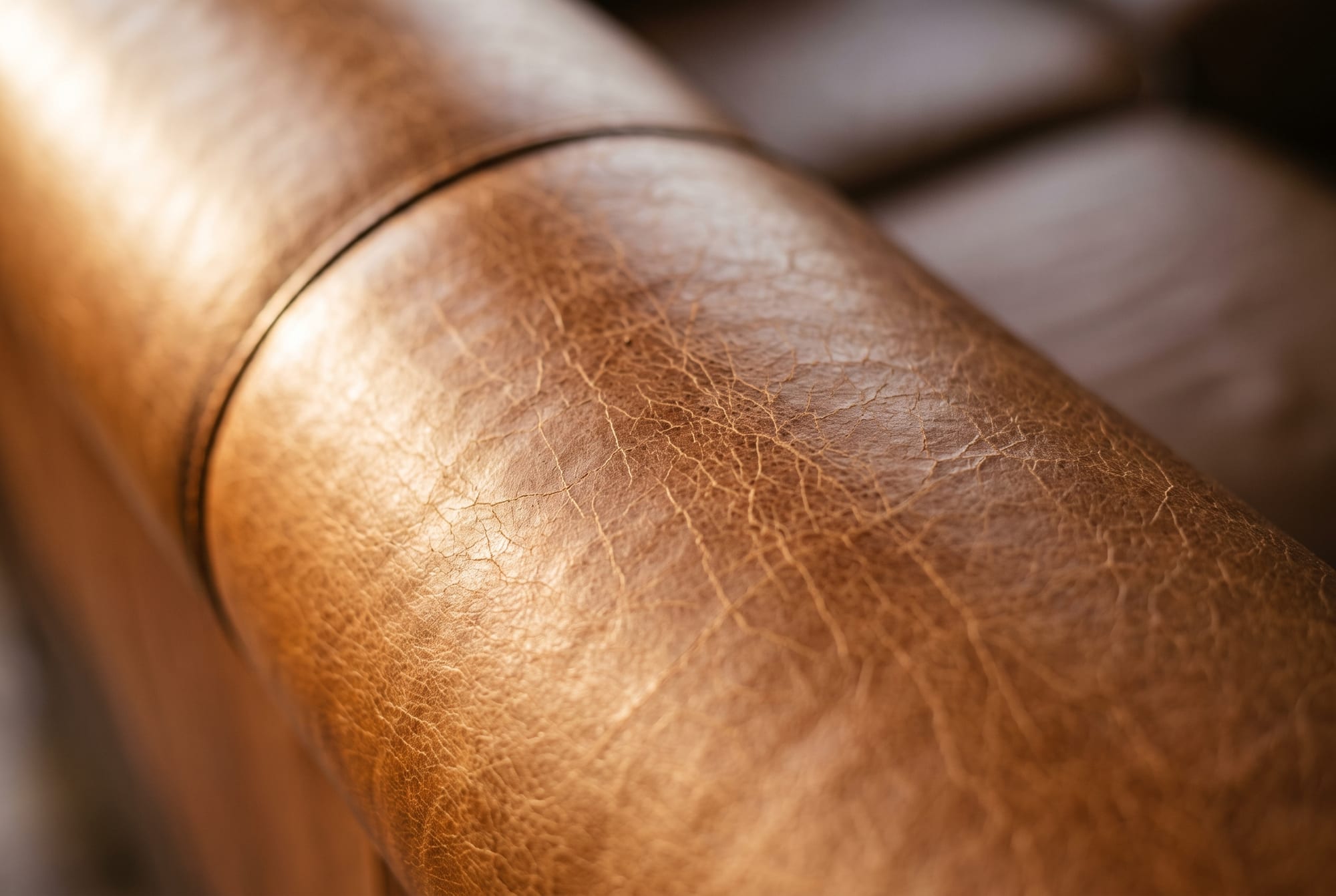
So the arm gets chemically softened, mechanically scrubbed, and repeatedly strained — and the first two make the third worse, because a softened, thinned finish has less left to resist with. That is the whole mechanism, and it explains the thing that puzzles people most: why the damage appears as a fine web along the top of the curve rather than as a scuff where you would expect one.
The order it fails in, and where the door closes
This is the part worth knowing before you buy anything, because the useful interventions all sit at the start and almost nothing works at the end.
It begins as crazing: a web of micro-cracks in the finish, invisible straight on and obvious in raking light. Then the cracks open, and because colour in most upholstery leather lives in the surface, the crack edges go pale — which is the moment it becomes visible from across the room. Then the opened finish lifts at the edges, and you are looking at peeling, which is always a coating failing rather than leather failing. Only at the end does the hide underneath actually split.
Conditioner does not fill a crack. It darkens it, which makes it easier to see, and people read that as the product making things worse.
That sentence is the single most common misunderstanding I deal with on this subject. Conditioning is a maintenance action for leather that is still sound: it keeps the fibre bundles lubricated so the hide stays supple. It has no mechanism for repairing a broken film, and applying more of it in the hope that it will produces a dark, tacky arm with the cracks still in it.
Which leaves a short and unglamorous honest list. Clean before you feed. Feed sparingly, twice a year. Keep the arm out of direct sun, because light is doing its own slower work on the same panel. And after that, the only remaining lever is to stop the loads reaching the surface at all.
What a leather panel actually does — and the part nobody warns you about
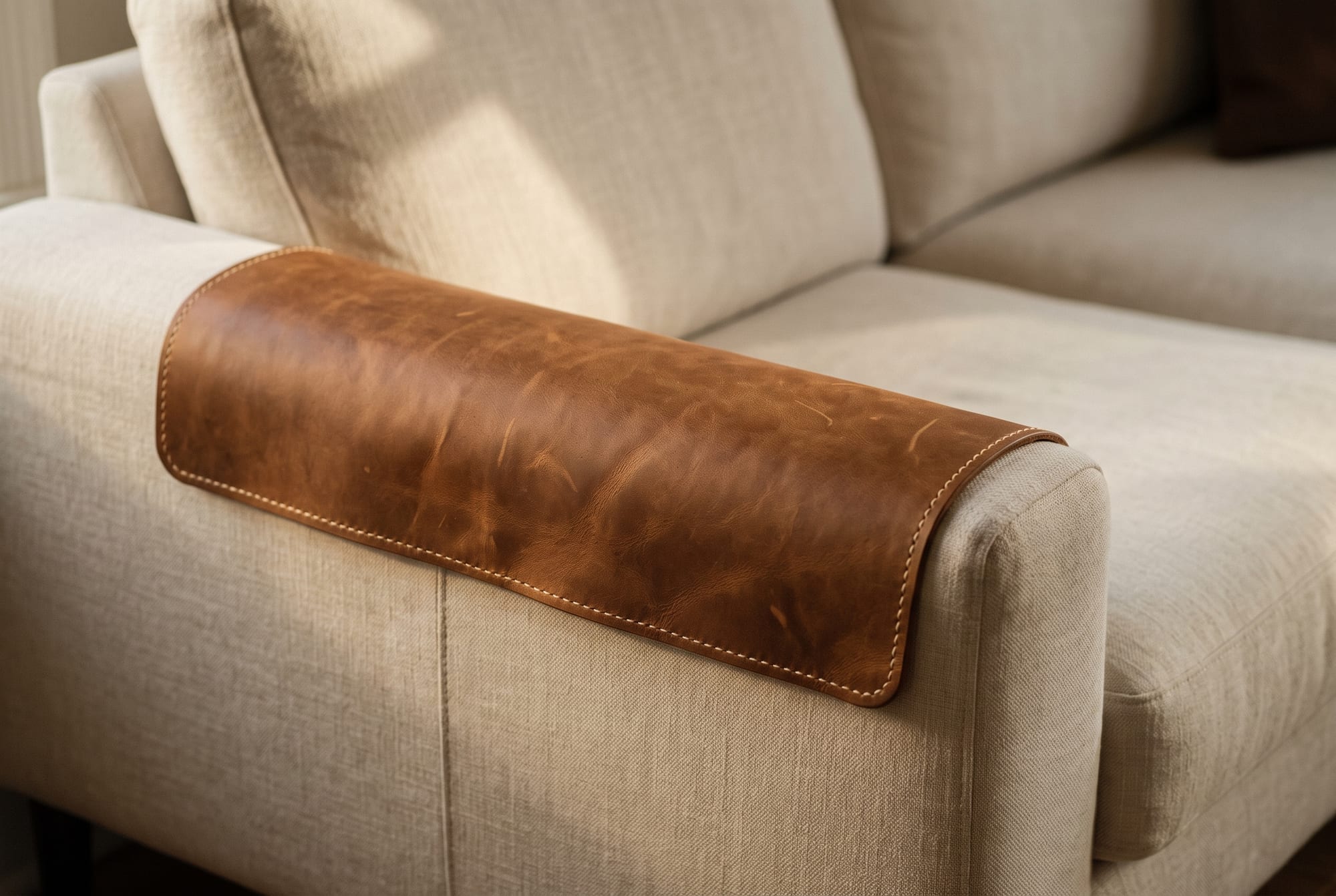
A panel over the arm intercepts all three loads at a surface that is not the sofa. Skin oils land on it, denim scrubs it, and because the panel sits across the curve rather than being stretched over it, the sofa’s own finish stops being the thing in tension at the top of the bend. That is the entire mechanism, and it is a good one.
Two things make leather a better choice there than cloth, and neither is aesthetic. A woven cover absorbs the oils and then holds them against the surface it was meant to protect, which is close to the opposite of the intention. And a loose cover slides — and a sliding cover is itself an abrasive, working the same band several times a day.
Now the honest part, which almost nobody selling these will tell you.
A protector does not stop an arm ageing. It stops one patch of an arm ageing — and the eye is far more sensitive to an edge than to a tone.
Leather under a panel is shielded from light and from hands, so it keeps the colour it had on the day you covered it, while everything around it carries on doing what leather does. Lift the panel in year five and there is a rectangle. This is the same lesson as a sunlit panel that faded unevenly: even change reads as patina, and limited change reads as damage.
So the rule that follows is about shape rather than product. Cover a whole form, not a patch. A panel that runs the full length of the arm and down to a natural seam leaves its edge where the eye already expects a line. A small mat parked in the middle of the arm leaves its edge in open ground, and that is the one you will regret. If you have already got a small one, move it every few months — a soft gradient is forgiving in a way that a sharp rectangle is not.
Two more practical notes from the bench. If the panel is new, richly dyed and the sofa is pale, do a wipe test for dye transfer before you leave the two pressed together for a year; a damp white cloth on a hidden corner answers it in ten seconds. And if the piece is a caddy that hangs over the arm rather than a flat panel, the strap is the thing to watch: it is a narrow contact line carrying a load, which is precisely the geometry that burnishes a surface. A wide strap spreads it. A thin cord concentrates it.
Three questions people actually ask
Will a warm phone or a charger damage the leather?
No, and this one is worth putting to rest because it comes up constantly with arm caddies. Dry leather is comfortable well beyond the temperatures a phone or a charging pad reaches; the figure that matters in a workshop is far higher, and it is wet leather, not warm leather, that is genuinely at risk from heat. What a phone can actually do to an arm is mechanical, not thermal: a hard corner, resting in one place, under its own weight. The fix is a pocket rather than a bare surface.
My sofa is cracking on the arm already. Is a panel pointless?
It is not pointless, but be clear with yourself about which job you are buying. Over an intact arm, a panel is prevention. Over a crazed one, it is concealment plus a slowing of what comes next — which is a perfectly reasonable thing to want, as long as nobody is expecting the leather underneath to recover. It will not.
Can I just condition the arm more often than the rest?
Yes, and you should, but with a correction to the instinct behind the question. “More often” should mean more frequent cleaning and the same sparing feeding, not more conditioner. The arm accumulates more of what needs removing than any other panel, and conditioning over the top of that drives it in. Clean the arm every time you clean anything; feed the whole sofa twice a year, thin, warmed in the hands.
Further reading
- How to decorate with leather: five surfaces and four pairings
- How to clean leather: the step everyone skips
- Why is my leather peeling? Real leather doesn’t — coatings do
- Over-conditioned leather: limp, sticky, dark
- Leather and sunlight: why it darkens and fades at the same time
- Dye transfer both ways: when one leather marks another