Guide · 10 September 2026 · by Pınar
Leather placemats: what size to buy, and what hot plates really do
Every autumn the design magazines rediscover the same thing — warm natural materials, layered surfaces, a table you actually want to sit at. And every autumn we get the same email, which is never about styling at all. It is four words long: will a hot plate ruin it?
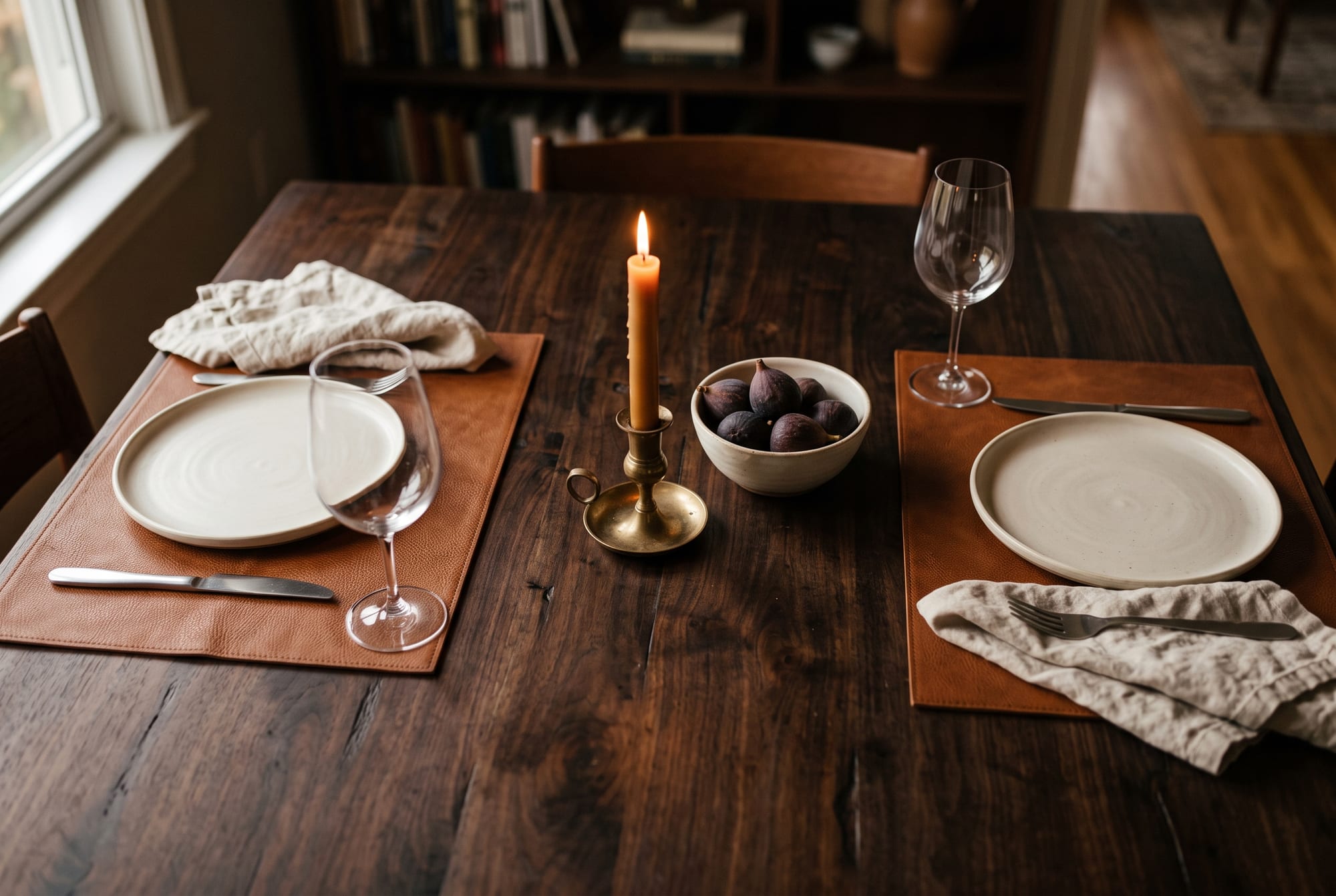
So let’s answer that one properly, along with the two questions nobody asks and then regrets: what size to buy, and what the mats will look like in five years. I trained as an interior architect before I ever cut a hide, and a dining table is one of the few surfaces in a home where a two-centimetre mistake is visible to everybody sitting at it.
A placemat is a boundary, not a decoration
A bare table has no plan. Everyone guesses where their territory ends, and the glasses drift, and there is always one person with three centimetres less elbow room than everyone else. Mats draw the plan. That is their first job and, honestly, most of their value: they turn a surface into a set of places.
The second job is the one particular to leather. Look at what is normally on a dining table — porcelain, glass, steel, stone, lacquered wood. Every one of those is cold and smooth to the hand. A hide is the only common table material that is warm to touch and matte to look at, which is why one leather surface changes a whole room and why two or three of them start to look like a scheme rather than an accident.
And the third job is the boring one that pays for the whole thing: it takes the ring, the drip, the scrape of a plate being pushed away — instead of the table doing so.
Three numbers
60 cm per person. This is the oldest number in dining and it has not moved: a cover — one person’s share of the table — wants 60 cm of width, and 70 is generous. It is also a brutally honest test of your table. A 180 cm table seats three a side, not four, no matter how many chairs you own. Squeezing in a fourth is why some tables never feel relaxed and nobody can say why.
45 × 30 cm. The standard rectangle, and it works. But look at the diagram: a normal 27 cm dinner plate almost fills its depth. If you serve on large plates, or you like a bread plate on the mat, go to 33–35 cm deep and the setting stops looking cramped. Round tables want round mats, about 38 cm across — rectangles on a circle fan out into a pinwheel and fight the table’s geometry.
3 cm back from the edge. Not flush. A mat pushed to the lip of a table reads as a chopping board and catches on sleeves; set back a few centimetres, it reads as a place. This is the smallest of the three numbers and the one people get wrong most often.
One more, for anyone who already owns a runner: a runner and mats can share a table, but only if one of them is clearly the stage and the other the frame. Mats sitting half-on and half-off a runner look like an accident. Either the runner goes down the spine with the mats outside it, or the mats sit squarely on a wide runner. Never in between.
The hot-plate question, answered honestly
Leather is collagen: a protein, with all a protein’s habits. Dry, a good hide shrugs off the temperature of any plate you would willingly hold, and only begins to stiffen and scorch somewhere around 100 °C. So the honest answer to will a hot plate ruin it? is: a dinner plate, no. That is the job.
The catch is water. Wet or steamy, vegetable-tanned leather starts to shrink irreversibly at roughly 75–80 °C — it puckers, hardens and curls, and no amount of conditioning brings the shape back. That is why the base of a teapot, which is both hot and wet with condensation, is genuinely more dangerous than a dry plate at the same temperature, and why a serving dish straight from the oven is simply out of the question. Use a trivet or a cork mat for those. They cost nothing and they are a different tool.
In practice, over years of tables, the damage we actually see is never thermal. It is a glass left sweating on the same spot all evening, a wine ring nobody wiped, and olive oil — which is the one substance that no amount of cleaning ever fully removes. Blot standing water while it is still a ring, and the mat will outlast the table.
Which leathers survive a dining table
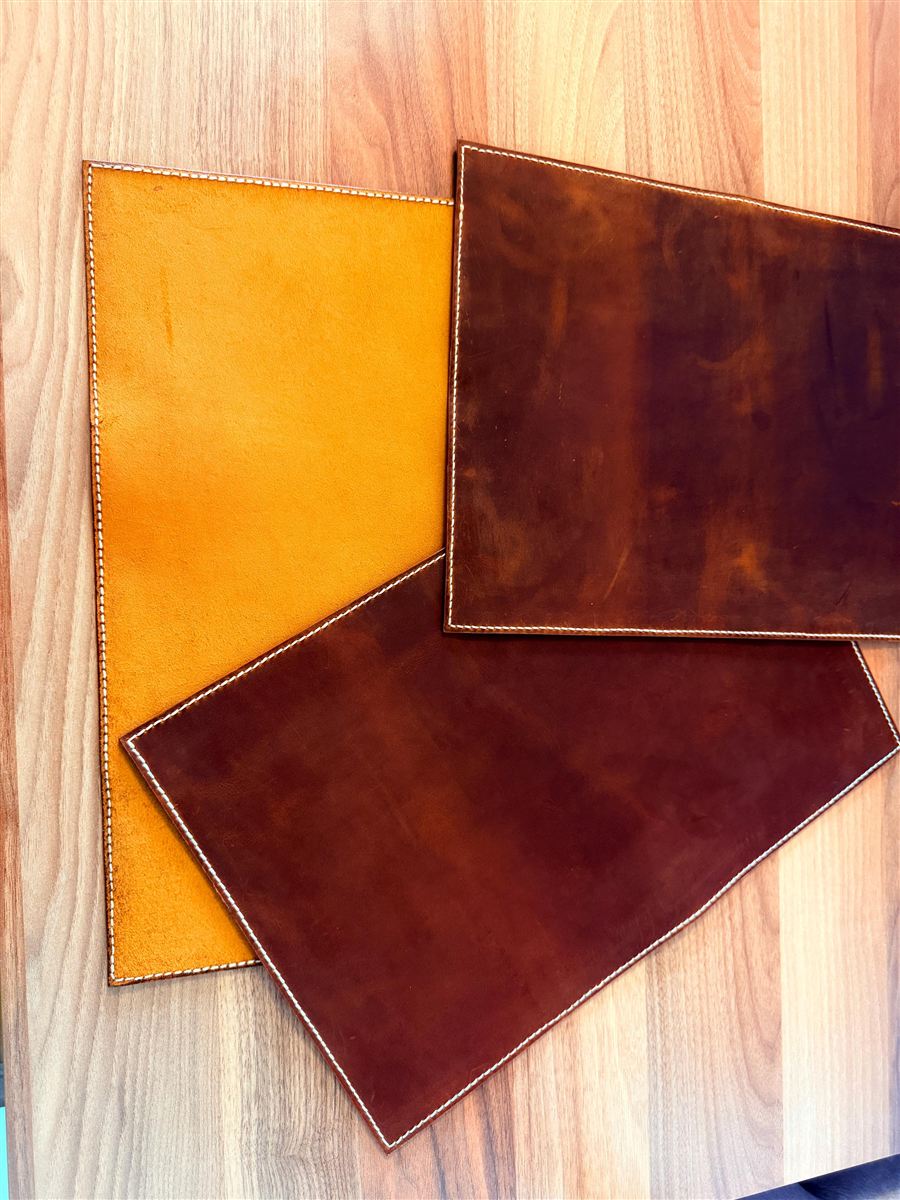
A table is a harder brief than a bag. The mat has to stay flat for a decade, get wiped constantly, and look better as it collects marks rather than worse. That rules a lot out.
- Firm, 2–3 mm, vegetable-tanned, full-grain. Thin garment leather curls at the corners within a season and never lies flat again. Weight is what keeps a mat honest.
- Crazy horse is the practical champion. It is a waxed pull-up hide, which means the wax moves: rub a fresh scratch with a thumb and the mark closes. On a surface that gets a knife dragged across it twice a week, that is not a luxury — it is the whole argument.
- Avoid anything pigmented or painted. A sprayed finish shows every scratch as a bright white line, and cannot be rubbed back — it can only chip further. This is the same film that eventually peels.
- Avoid suede and nubuck. Beautiful, and a sponge for every drop of oil that lands on them.
- Check the edges and the back. A stitched perimeter stops a mat delaminating at the corner where everyone picks it up; a smooth flesh side is kinder to a lacquered table than cork or woven fibre — provided you lift it rather than dragging grit underneath.
Five years of dinners
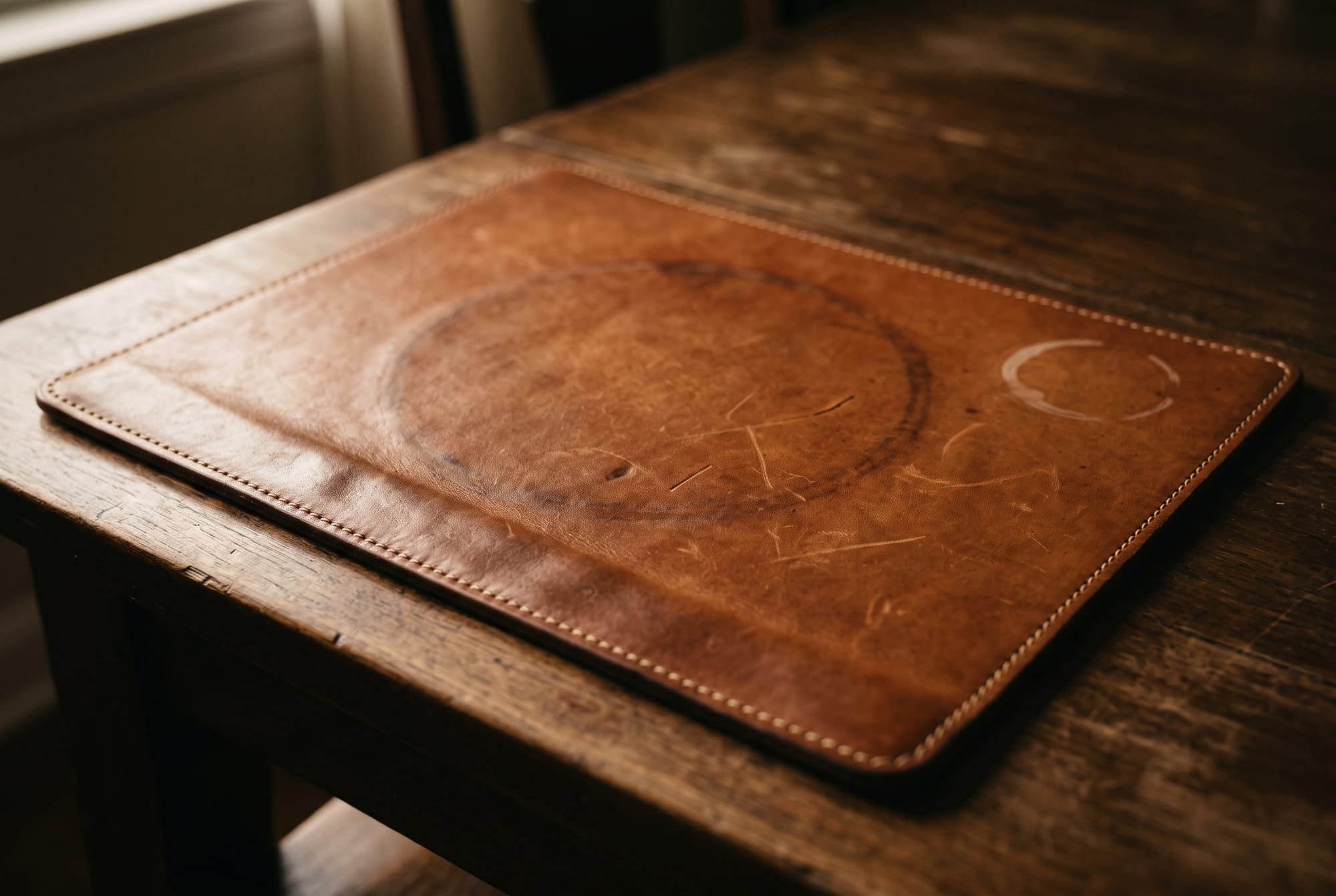
A fabric mat has one good year. It stains, it goes grey in the wash, and at some point you quietly replace the set. Leather does the opposite: the plate leaves a faint ring, the near edge polishes where forearms rest, and the whole panel deepens a shade or two — and every one of those is patina rather than damage.
Five years in, a set of mats is a record of how a family eats. Ours are the only things in our own house that are more interesting than the day they were made, and it is not close.
The care, meanwhile, is almost nothing:
- Brush the crumbs off dry. Every time. Most wear on a mat is grit being ground into the grain, not use.
- Wipe with a barely damp cloth, then dry it immediately with a second cloth. Never soak, never put one anywhere near a dishwasher.
- Dry flat and away from heat. A radiator is how a flat mat becomes a curved one.
- Condition once or twice a year — a fingertip of balm, worked in thin, exactly as you would treat a bag. No olive oil, ever.
- Store flat, or loosely rolled grain-side out. Never folded: a crease in a firm hide is permanent.
Linen mats are replaced. Leather mats are inherited. That is the entire difference, and it costs one wipe after dinner.
What to put around them
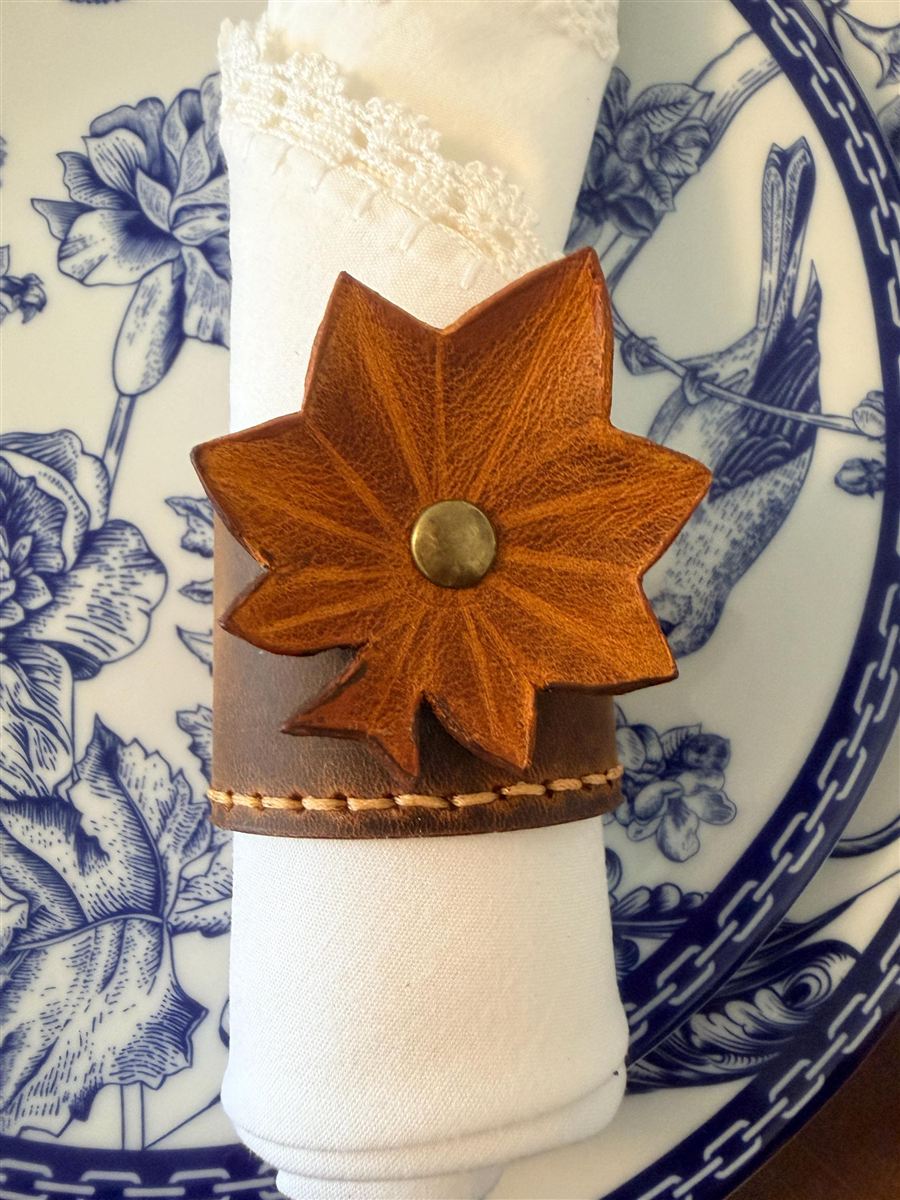
Leather is warm, matte and dark, so it wants company that is the opposite in at least one way. Cream or oatmeal linen napkins — the crumple is the point, so don’t press them flat. Matte ceramics rather than high-gloss porcelain; glaze against leather can look oddly clinical. Unlacquered brass, because it ages on the same schedule the mats do, and a candlestick that is going darker every year sits beside them like a relative. And one of the rules we keep returning to: never a matching set. Mats, a napkin cuff and a coaster are a scheme. Add a leather tray, a leather runner and leather coasters on top of that and it becomes a showroom.
For autumn specifically: the mats are already the warmest thing on the table, so let everything else go quiet. Bare wood, a low bowl of whatever is in season, one candle per two covers. The difference between a set table and a decorated one is usually about three objects.
If your table is an awkward size — narrow, round, or a family heirloom that nothing standard fits — send us the measurements at info@pazleather.com before you order anything. It is a far easier conversation to have before the leather is cut than after.
Further reading
- The leather desk pad: what size to buy, and what it becomes in five years
- How to style a leather table runner: an interior architect’s six rules
- How to decorate with leather: five surfaces and four pairings
- Crazy horse leather: the hide that heals its own scratches
- The leather care guide: what to do, and how often
- Glossary: pull-up
- Glossary: patina