Guide · 2 September 2026 · by Pınar
How to decorate with leather: five surfaces, four pairings
In all my years of interiors work, nobody who asked me for “a leather sofa” actually wanted a leather sofa. They wanted warmth they could touch. That is a much cheaper problem to solve.
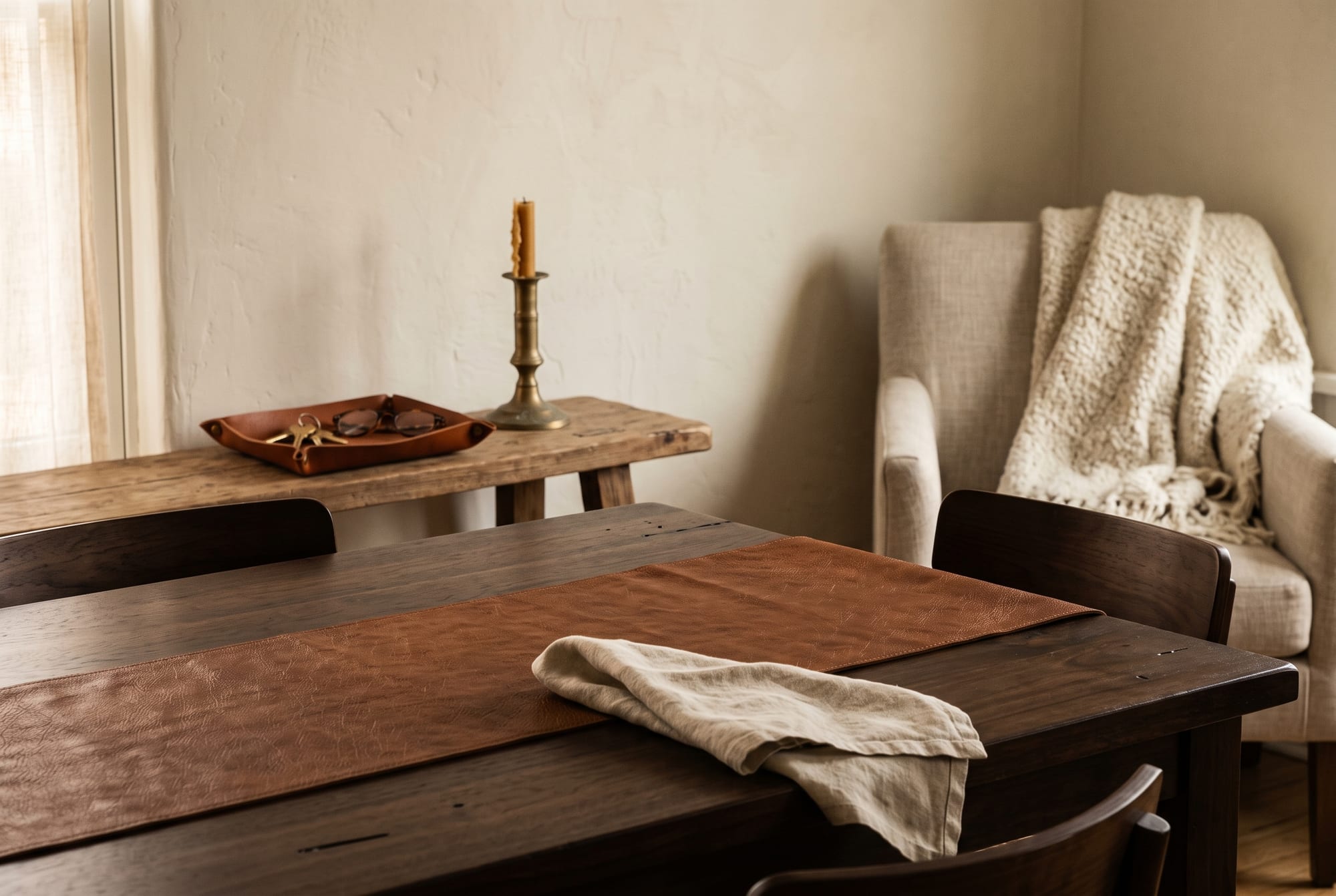
Clients would arrive with a folder of photographs — always the same photographs — and say: I want it to feel warm. Then they would point at a five-metre leather sofa in a room four metres wide, in a city where that sofa costs as much as the floor.
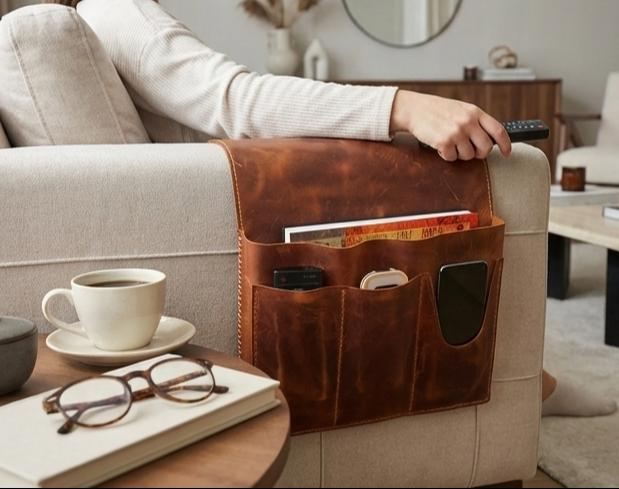
The sofa was never the answer. Warmth in a room is not delivered by the largest object in it; it is delivered by the surfaces your hands actually touch. Which is why the most effective leather in a home is almost always small, low and within reach: the strip down the middle of a table, the panel over the arm of a sofa, the bowl by the door where the keys land.
Why 2026 put leather back in the room
The trend forecasts for this autumn all say a version of the same thing: the cool, grey, hard-edged minimalism of the last decade is being replaced by warmth — walnut and espresso-stained oak, linen and wool, stone with visible veining, aged brass instead of chrome, and palettes moving through cinnamon, terracotta, muted ochre and deep chocolate. Leather sits naturally in that group, and designers are pairing it with exactly those materials.
But trends are a bad reason to buy anything. The durable reason is this: of every material in that warm-materials list, leather is the only one that records use as beauty rather than as damage. Oak scratches. Linen pills. Marble stains. A hide takes the same year of handling and comes out darker, softer and more particular — which is the whole argument for patina. A room with leather in it is a room that is allowed to be lived in.
The five surfaces
Not “rooms” — surfaces. Leather works where there is contact, and it looks accidental anywhere else.
Start with one. If it is a table, the six rules for a leather runner cover the sizing and the layering in detail. If it is a sofa, the arm is the honest starting point: it is where the wear already is, and a leather panel there is doing a job rather than making a statement.
The four pairings
A material never looks good or bad on its own; it looks good or bad next to something. Leather has four reliable partners, and each one works for a different reason.
The metals deserve a footnote, because it is where most rooms go wrong. Warm hides want warm metal — brass, bronze, antique gold — and the browner the leather, the more the brass reads as intentional. Cool hides (teal, grey, navy) want nickel or steel. The one combination I would avoid is bright chrome against a natural veg-tan: the leather looks dusty next to it. The burgundy guide goes further into the brass-versus-nickel question, because oxblood is the colour that makes it hardest.

How much is too much
Three appearances, small, and never as a set. That is the whole discipline.
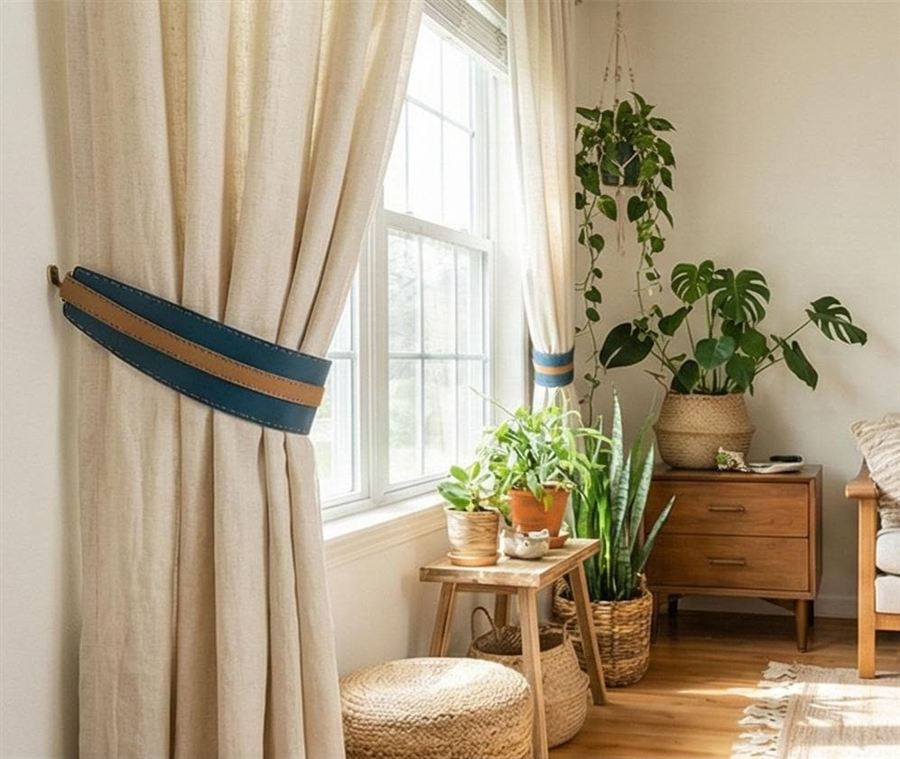
A room reads as collected when the same material turns up two or three times in different weights — a runner on the table, a bowl by the door, a tieback at the window — and as ordered from a catalogue when five matching pieces appear in the same finish on the same day. Buy the pieces one at a time, in slightly different tones, and let them arrive over a year. It is also, conveniently, how anyone can actually afford handmade.
The other half of the discipline: leather should never be the largest soft surface in a room unless it is the sofa. A big leather panel and a big leather cushion and a leather-topped table together stop being warmth and start being a waiting room.
Where not to put it
- On a sunlit windowsill. Direct sun for months fades the exposed side and dries the fibres. The tiebacks are near a window, not in the sun’s path — the difference matters more than it sounds.
- Above a radiator, or beside a wood stove. Heat is the one thing that genuinely damages a hide indoors.
- In a splash zone. Behind a kitchen tap, under a coffee machine, next to the hob: grease and steam are a combination that first aid can only partly rescue.
- Under a hot dish. A leather runner is a textile, not a trivet. Serving straight onto it will leave a dark permanent halo.
- Under a plant pot. Every plant pot leaks eventually, and water rings on veg-tan are a fact of life, not a stain.
- In a bathroom. Humidity, all day, forever — the same argument as storing leather in a sealed cupboard.
The five-year test
This is the question I would ask before buying any leather object for a home — or giving one as a gift: will it be handled? A hide that gets touched daily is on a path — darker at the contact points, softer at the folds, one shade richer overall. The same hide in a glass cabinet just gets dusty, and stiff, and eventually looks like a decision somebody made in 2026.
Which is why I always steer people towards the useful pieces first. The runner that gets crumbs on it. The caddy that holds the remote. The bowl that catches the keys at midnight. Those are the objects that will look better in your photographs in five years than they do in ours today.
A room that only looks good on the first day was decorated. A room that looks better on day one thousand was furnished.
If you are trying to place a piece and cannot decide — runner or placemats, brass or steel, cognac or oxblood against your floor — send a daylight photograph of the room to info@pazleather.com. I answer these myself, and after all the years of doing it on site, it is still the part I enjoy most.
Further reading
- The leather desk pad: what size to buy, and what it becomes in five years
- Leather placemats: what size to buy, and what hot plates really do
- How to style a leather table runner: six rules
- Burgundy leather: what autumn’s “new neutral” does on a real hide
- The leather colour guide: which colour ages best
- Quiet luxury is a material, not a logo
- The home collection: runners, placemats, caddies and catchalls