Guide · 5 September 2026 · by Zafer
Can suede, patent or vegan leather get wet? Every material, answered
The searches people type at midnight tell the story: can suede get wet? Patent? Lambskin? Each material gives a different answer, because each one has a different architecture. Here they all are.

We wrote the honest guide to leather and water for the leather we make: full-grain hide. But the questions that keep arriving are more specific — my suede boots got rained on; my lambskin bag has a water spot; is patent leather actually waterproof; what about vegan leather? Fair questions, different answers. Water doesn’t ask what your bag is made of. Your response should.
The one principle that covers everything
On any real hide, water itself is rarely the villain: it moves the leather’s oils around and the drying does the damage — heat cooks a wet hide stiff. What changes from material to material is only how much water gets in, and what the surface is made of. Sealed surfaces shrug water off but can’t be fed; open surfaces drink water but recover with care; napped surfaces hold it like a towel. Rank them, and every midnight question answers itself.
Suede and nubuck: the towel
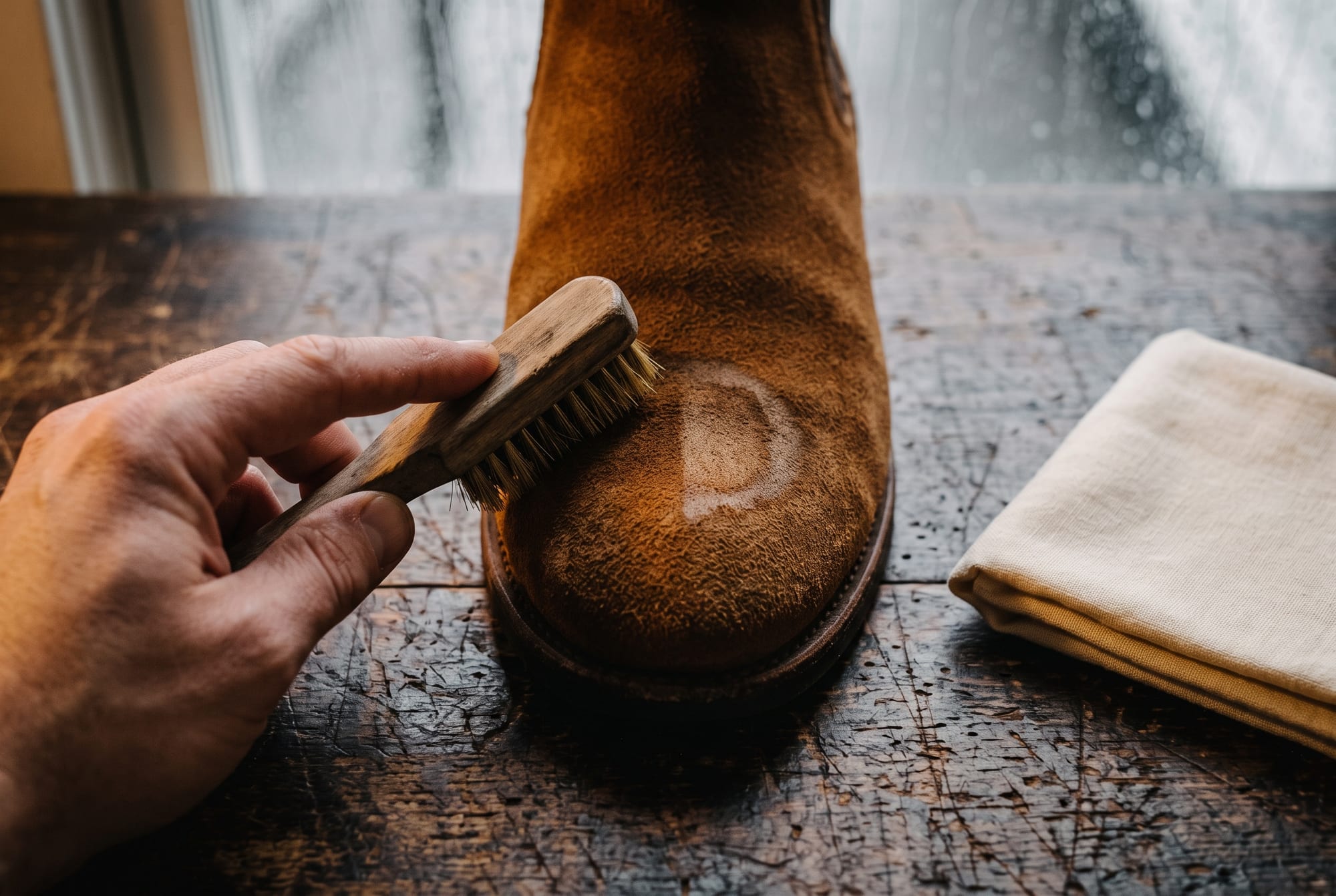
Can suede get wet? It can — it just shouldn’t make a habit of it. Nap is thousands of raised fibre ends, so water wicks straight in and dries into a visible ring. The protocol: blot (never rub — rubbing mats the nap), stuff to shape, dry slowly away from heat, then brush the nap back in one direction; a pass of steam lifts stubborn flat patches. Water rings usually brush out once fully dry; if not, a barely damp cloth over the whole panel evens the tone. And this is the one family where we recommend a protector spray — suede-specific, tested on a hidden corner first. Sprays don’t belong on smooth leather; we’ve explained why.
Patent leather: the raincoat that can’t breathe
Can patent leather get wet? Yes — it’s the best rain performer on the ladder. The mirror gloss is a sealed synthetic coat; drops sit on top and wipe away without a trace. Its weaknesses are everywhere else: water sneaks in at seams and edges (dry those promptly), heat and solvents dull or melt the gloss, and because nothing penetrates the coating, patent can never be conditioned — when it creases or clouds, there is no feeding it back. Wipe with a barely damp soft cloth, dry with a second one, done.
Lambskin: the delicate one
Can lambskin get wet? Briefly, with fast hands. Lambskin is thin, open-pored aniline hide — the same architecture as our veg-tan but finer, so it spots quicker and dries quicker. Blot immediately, then wipe a barely damp cloth over the entire panel so it dries evenly instead of in a ring, and let it dry flat, slowly. Once dry, a whisper of conditioner. What kills lambskin isn’t rain; it’s rubbing a wet spot, and radiators.
Vegan and “fake” leather: waterproof, with an asterisk
Can vegan leather get wet? The surface, yes — indefinitely. The bag, not forever. PU’s plastic face is genuinely waterproof, which is its honest selling point. The asterisk: PU is a coating on a fabric backing, and once the coating develops invisible cracks — which is how PU ages — water reaches the fabric, the fabric holds moisture, and the peeling that was coming anyway arrives early. So: wipe vegan leather dry rather than letting it air-dry wet, keep it away from heat, and know that no product exists that feeds it. It isn’t neglect; there’s simply nothing under the surface to feed.
Waxed full-grain: built for exactly this
Can Crazy Horse or Pueblo get wet? It was designed on the assumption that it would. The hot waxes flooded into the hide are the original waterproofing — centuries older than any spray. Drops bead and roll; what darkens, a warm thumb warms back once dry. This is why, if you live somewhere it rains sideways, waxed pull-up full-grain is the honest answer to “which leather should I buy?” — not a coating that can’t heal, but a hide that carries its own raincoat.

Whatever it’s made of: the soaked-bag protocol
If the drizzle became a downpour and the material is soaked through, the response is nearly universal — only the last step changes:
Salt water, snow slush and the sea are their own subject — salt keeps pulling moisture out long after it dries — and they’re covered in the water guide’s special cases.
Water is never the real question. The question is what the surface is made of — and whether anything under it can be fed afterwards.
Got a water mark that didn’t follow the script — a ring that won’t brush out, a bloom that came back? Photograph it in daylight and send it to info@pazleather.com with a word about the material. We’ll tell you the next move before you make a worse one.
Further reading
- Suede and nubuck care: why everything that feeds smooth leather ruins nap
- Aniline, semi-aniline, pigmented: what a leather’s finish actually decides
- How to store a leather bag: dust bags, mould and the wardrobe changeover
- Can leather get wet? The honest guide to leather and water
- Leather stain first aid: what to do in the first five minutes
- What is Crazy Horse leather? Meet the hide that scars on purpose
- Vegan leather vs real leather: an honest answer from a leather maker
- Leather FAQ: can water permanently damage leather?