Essay · 18 August 2026 · by Pınar
Leather and lace: why we join Turkish needle lace to full-grain hide
People ask which came first, the leather or the lace. The honest answer is a grandfather’s atelier and a designer’s drawer of oya — and an afternoon when the two ended up on the same table.

Every studio needs one idea that is entirely its own. Ours is the union of two materials that have almost nothing in common — a heavy, matte, animal hide and an airy, bright, thread-built lace — and the discovery that, set together, each makes the other look more like itself. This is the story of that signature: what the lace is, how it’s made, how we join it to leather, and why we think the contrast works.
What Turkish needle lace actually is
İğne oyası — needle lace — is an Anatolian technique that is centuries old and stubbornly simple in its tools: one sewing needle, one thread, and a pair of hands. No hook, no bobbins, no frame, no pattern paper. The lace is built knot by knot: a foundation loop is laid, and each row of tiny knotted loops is worked into the row before it, the tension of the maker’s fingers deciding whether the next loop curves outward into a petal or inward into a stem. Because every loop is a knot, the finished motif is not flat like most lace; it is sculptural, standing up from whatever it is fixed to, and it cannot unravel from a single pull the way a chain of crochet can.
For generations it edged the headscarves — yazma — of Anatolian women, and the motifs carried meaning: flowers, leaves, peppers, fruit, each with a message the village could read. Today it survives in the hands of women who learned it at home, as their mothers did. It is measured in hours, not minutes, and a palm-sized motif is a very long afternoon.
Why leather
Put a piece of cream lace on a white tablecloth and it disappears. Put the same piece on dark, full-grain leather and every knot casts a shadow. The contrast works on three levels at once. Value: pale thread on a deep hide is the highest contrast two natural materials can make without dye. Weight: lace is air; full-grain leather is the densest thing in the room, and each makes the other’s nature obvious. Time: both are slow crafts, both are built by hand, and — this is the part I love — both are built out of knots. A saddle stitch is a knot in every hole; needle lace is a knot in every loop. Two hands, working at the same speed, centuries apart.
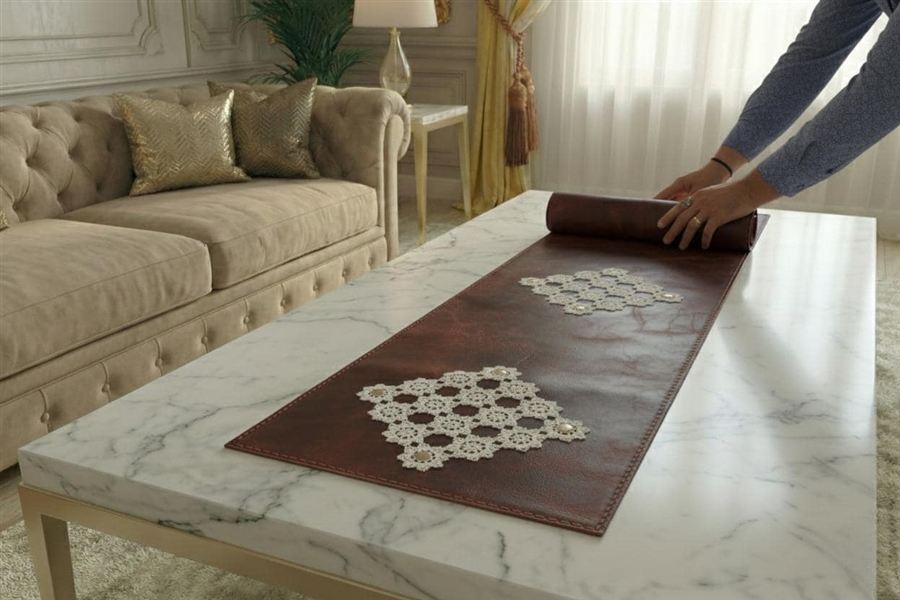
Lace is air. Full-grain leather is the densest thing in the room. Set together, each makes the other’s nature obvious.
How we join them — and why never with glue
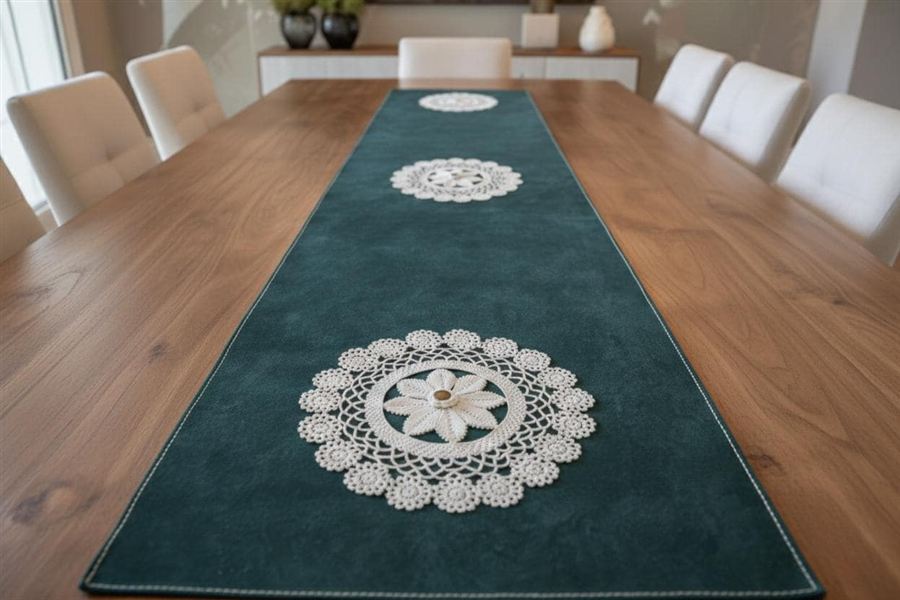
The motif is finished before it ever meets the leather. On the bench it’s positioned — the ends and the centre of a runner, where the eye lands first — and then stitched to the hide by hand through pre-pricked holes, with a fine waxed thread that disappears into the lace’s own edge. The knots sit on the back. Nothing is glued. Glue would stiffen the lace, stain the leather from behind over the years, and make the piece impossible to repair; a stitched join can be undone and redone in an hour if a motif is ever damaged. It is slower, and it is the only honest way to fix a textile to a hide that’s meant to outlive both of us.
Needle lace or machine lace? Turn it over
Because “lace” now mostly means a polyester ribbon from a roll, the question is fair. Three tells. Turn it over: machine lace has a flat, identical back with a visible ground mesh; needle lace looks almost the same from both sides, because knots have no wrong side. Look for the repeat: machine lace repeats perfectly every few centimetres; needle lace never quite does — petals differ by a knot, and that difference is the signature of a hand. Touch it: needle lace is dense and springy and stands up from the surface; machine lace lies flat and feels like fabric. On our runners every motif is different from its neighbour, which is why we call the pieces one of a kind and mean it literally.
Living with lace on leather
Less than you’d think. Dust the lace with a soft dry brush — a clean make-up brush is perfect. If a thread ever snags, don’t pull; tuck it under the motif and write to us. Condition the leather around the lace, not over it; wax dulls cotton. If the cream deepens to ivory over the years, that’s the thread ageing alongside the hide — never bleach it. And store the runner rolled with the lace inside, around a tube, never folded.
Why it matters to us
Zafer grew up in his grandfather’s atelier; I grew up in a house where the women made oya on the balcony in the evenings. Neither of those worlds needed the other. But when a piece of that lace ended up, one afternoon, on a scrap of dark leather on the bench, we both went quiet — and we’ve been making that quiet ever since. Every runner that leaves here carries two Anatolian crafts and two families’ worth of hands. That is what we mean when we say handmade.
A runner is a table’s jewellery. The lace is the stone; the leather is the setting.
Curious which motif would suit your table, or whether needle lace or crochet is the right one for a piece you’re imagining? Write to info@pazleather.com — we’ll send photographs of the motifs on the bench this week.