Guide · 28 August 2026 · by Pınar
How to style a leather table runner: an interior architect’s six rules
The leather runner is the one piece in our collection people hesitate over. “Leather — on a dining table?” Then they see one laid on a table, and the question changes to “which colour?”
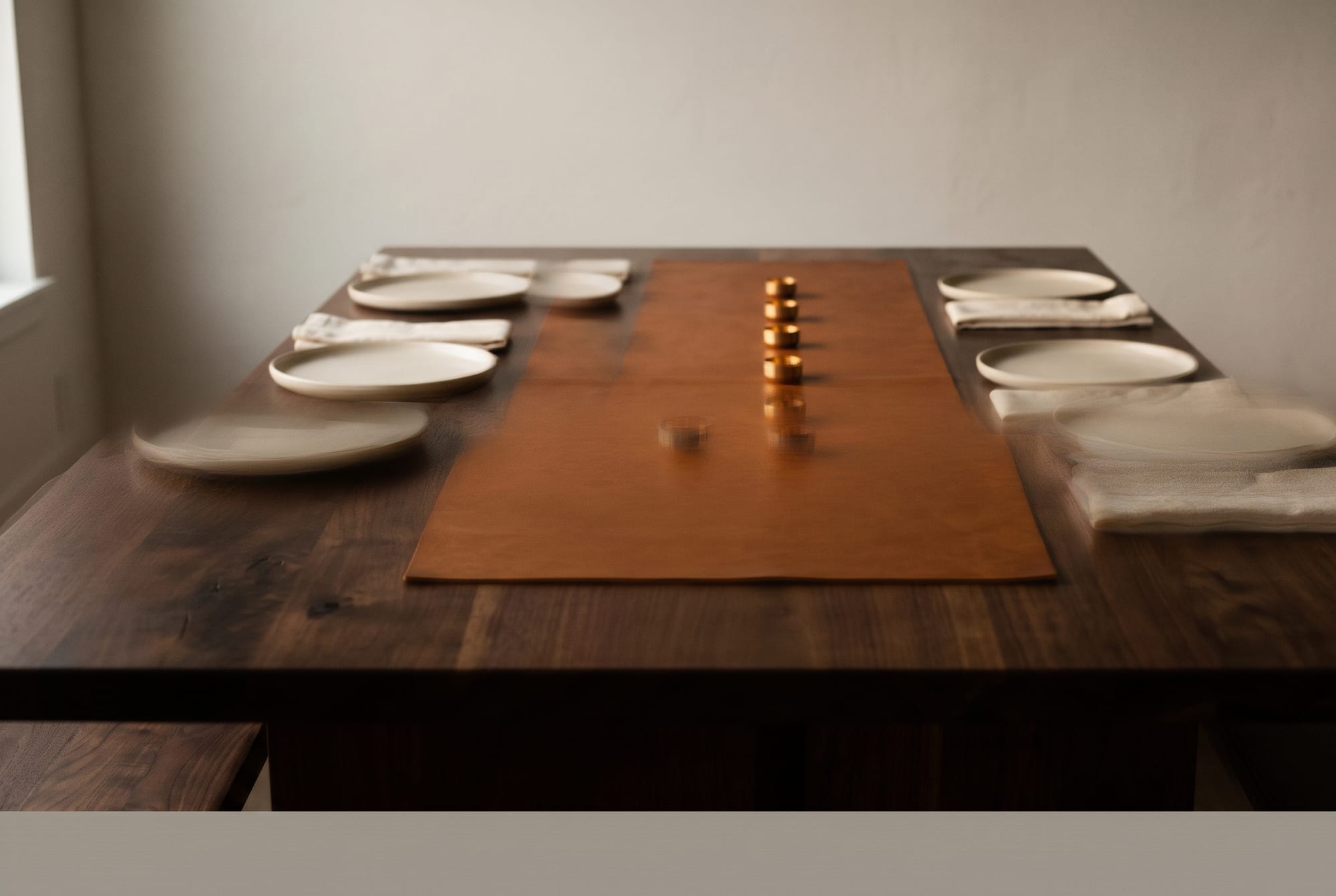
I spent twenty years as an interior architect before I spent my days beside a leather bench, and the runner is where the two halves of my life meet. A table is the largest horizontal surface in most homes and the one that gets looked at most — every meal, every morning coffee. Fabric runners soften it; a leather runner anchors it. It has weight, it has a matte warmth that stone and glass lack, it wipes clean, and unlike anything woven it gets better with use. These are the six rules I give every customer who asks “but how do I actually use it?”
Rule one: a third of the table, and never over the edge
Width first. A runner should be roughly one third of the table’s width — on a 90 cm table that’s a 30 cm runner. Narrower reads like a ribbon; wider reads like a tablecloth that gave up. Length is where leather breaks the fabric rule: a cloth runner is meant to drop 15–25 cm over each end, but leather should never fold over an edge. It’s stiff, it’s heavy, and a fold pressed into full-grain hide by gravity for a month becomes a crease that never fully leaves. So a leather runner sits inside the table — leave a hand’s width or two of bare wood at each end. That’s why ours are cut to 137 and 150 cm (54 and 59 inches): the right lengths for the six- and eight-seat tables most people own, with the ends clear.
Rule two: contrast in value, harmony in temperature
Wood and leather are both warm materials, so temperature is rarely the problem; value — light against dark — is what makes a runner read from across the room. A pale table wants a dark runner; a dark table wants a lighter one, or a colour that isn’t brown at all.
Rule three: the runner is the base layer, not a rival
Nothing goes under a leather runner. A tablecloth beneath it slides, clashes in texture and hides the wood the runner was chosen to frame. On top, keep one idea: matte ceramics rather than glossy, linen rather than polyester, wood and brass rather than chrome. Leather is horizontal and quiet, so let the vertical elements be few — a single line of candles or one low bowl. Two centrepieces on a runner is a buffet.
Rule four: put the lace where the eye lands
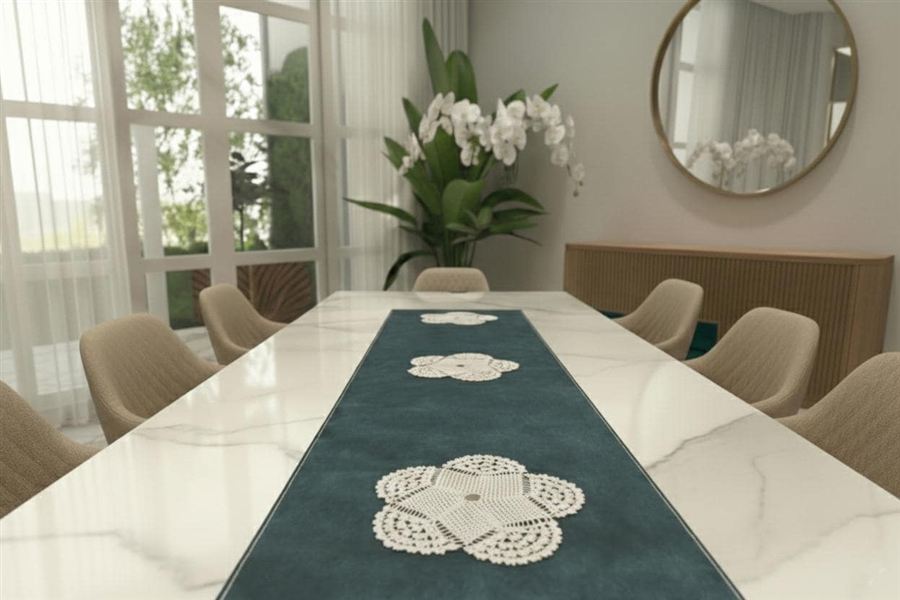
On our lace-joined pieces the needle-lace or crochet motifs sit at the two ends and, on the longer runners, at the centre — the three points the eye touches first when it enters a room. Between them the leather is deliberately clear, because that’s where bowls and serving dishes go. Don’t cover a motif with a plate; don’t place a candle on one. The lace is the jewellery of the table; the leather is the setting. We’ve written about why we join the two.
Rule five: placemats or runner?
Long rectangular table, six or more seats: runner — it draws the line the table already has. Round or square table: placemats, because a runner on a circle cuts it in half. Coffee table or sideboard: a short runner — our 137 cm piece was designed for exactly that low, long surface where a fabric runner would look like laundry. And for a table that’s used hard every day by children, placemats win on practicality: one spill, one mat.

Rule six: live with it, don’t protect it
A leather runner is not a museum piece. Hot dishes go on trivets (heat is the one real enemy, as on any leather); vases sit on a saucer; a spill gets blotted, not rubbed — and on waxed Crazy Horse most of it beads and wipes away. Dust with a dry cloth; condition twice a year, the same balm as a bag. When you store it, roll it, lace inside, around a cardboard tube — never fold it (rule one, again). And rotate it end-for-end every few months if one end sits in a sunny window, so it deepens evenly. It will deepen. That’s the point: in five years the runner will have a colour no shop can sell you, and the table will look like it was always meant to have it.
Fabric softens a table. Leather anchors it — and then, unlike anything woven, it starts getting better.
Send us a photo of your table — wood, light, size — at info@pazleather.com and we’ll tell you which colour and length we’d choose, and why. It’s the same conversation we have at the atelier every week.
Further reading
- Leather placemats: what size to buy, and what hot plates really do
- How to decorate with leather: five surfaces and four pairings
- Leather and lace: why we join Turkish needle lace to full-grain hide
- Burgundy leather: what autumn’s “new neutral” actually does on a real hide
- Which leather colour should you choose? What each one becomes in ten years
- What is Crazy Horse leather? Meet the hide that scars on purpose
- Shop: table runners & placemats