Guide · 29 October 2026 · by Pınar
Card holder or bifold? How to choose a leather wallet you will actually carry
Choose by what you actually carry and where it will live. Up to about six cards and little cash, in a front pocket: a card holder. Cards plus notes you like to keep flat: a slim bifold. More than that belongs in a bag, not a pocket.
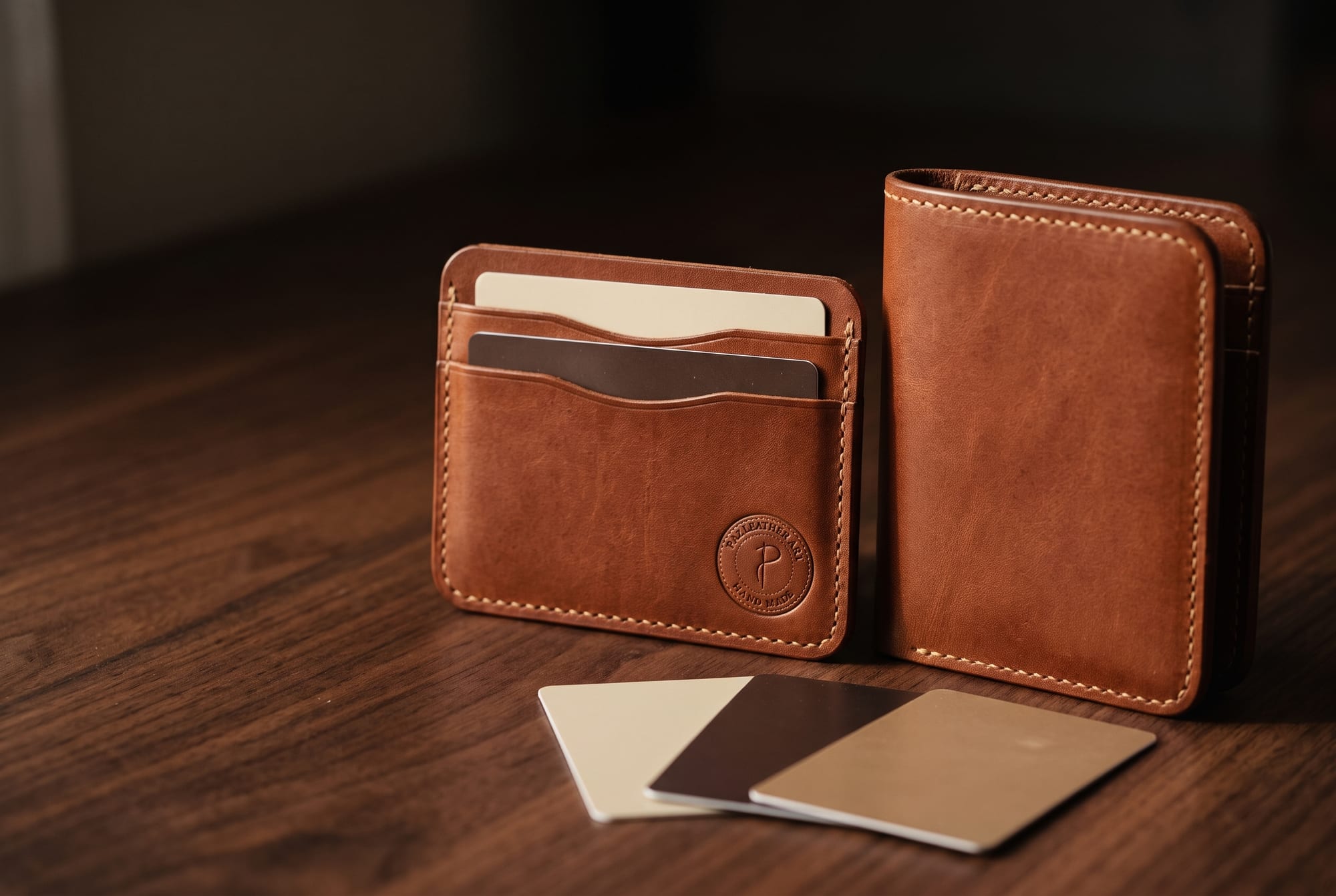
The short answer: if you use six cards or fewer in a normal week and carry little or no cash, choose a card holder and keep it in a front pocket. If you carry notes every day and want them flat, choose a slim bifold with no more than six to eight slots. If you need more than eight cards, receipts and coins, that is a long wallet, and it belongs in a bag rather than on your body.
| Card holder | Slim bifold | Long wallet | |
|---|---|---|---|
| Cards used weekly | 6 or fewer | 6–8 slots | More than 8 |
| Cash | Little or none | Notes, kept flat | Notes, receipts and coins |
| Where it lives | Front pocket | Inside or back pocket | A bag, not your body |
| Choose it if | You pay by card or phone | You carry cash every day | You carry everything |
That is the whole decision in three sentences. The rest of this piece is why, because the sentence people skip is the first one: use, in a normal week. Not own.
I draw our wallets, and the drawing always starts with a question I ask anyone who orders one: what is in your pocket right now? The answer is nearly always smaller than the wallet they came in with. Most wallets are bought for an imagined life, the trip abroad, the receipts you might need, the card for the shop you visit twice a year, and then carried in a real one. The format that suits you is the one drawn around the real one.
Start with what you actually touch in a week
Empty your wallet onto a table and make two piles: things you have used in the last seven days, and everything else. Be strict. The second pile is not carried; it is stored, in the one container nobody ever empties.
Cards
For most people the honest count is somewhere between three and six, and almost everybody guesses high before they look. That number matters more than it seems, because a leather card slot is not a pocket but a clamp. It stretches once, to the largest stack it has ever held, and then stays that size. We wrote a whole piece on why a card slot stretches only once, and the practical conclusion is simple: buy for the number you use plus one, and carry exactly that from the first day.
Notes
Cash habits decide the format more than cards do. If you carry a note or two for emergencies, a card holder with a centre pocket takes them folded and you will not notice them. If you pay in cash every day and want your notes flat and quick to count, you want a fold, and that means a bifold. Notes are kinder to a wallet than cards: they compress, and a few folded notes add far less to the thickness than the same number of cards.
Receipts and coins
Receipts are the most common reason a slim wallet stops being slim. If you need to keep them, keep them somewhere you empty: a bag, a desk tray, a folder at home. Coins do not fit cleanly into any format. A coin pocket on a bifold sits right at the fold, which is the one place a wallet least wants a lump. If you carry coins, a small separate pouch is the better design.
If your phone already pays
Then your real count may be two or three cards, and a card holder is the obvious answer. Phone cases with a card slot on the back do the same job for one or two cards, but they put your cards on the object you take out most often, which is the object you are most likely to put down somewhere. If you go that way, keep the second card somewhere else.

Then decide where it will live
The second question is the one people forget to ask, and it changes the answer as often as the first.
A front trouser pocket is the natural home of a card holder. It is the pocket you can feel from the inside, and a flat, unfolded object of about six millimetres disappears into it. A bifold fits a front pocket too, if it is slim and not overloaded.
A jacket’s inside pocket takes either format comfortably and is the kindest place for a bifold: nothing presses on it, and the fold is never squeezed.
A back pocket is where a bifold has traditionally lived, and it is where it causes the most trouble. Sitting on a wallet means sitting slightly tilted, on a block of leather and plastic, and many people find that uncomfortable over a long drive or a day at a desk. I am a designer rather than a doctor, so I will say only this: if it bothers you, the fix is the same whatever the cause. Take it out before you sit, or carry something thinner. A back pocket is also hard on the wallet: it takes the curve of your body, wears the dye on the high points and, on a pale pair of trousers, a new dark wallet may mark the lining for its first few weeks.
A bag changes everything, because a bag does not care about thickness. This is where a long wallet makes sense, with notes unfolded, room for receipts and a few travel documents. It is a good object, but it is not a pocket object, and buying one to carry in a pocket is how people end up disliking a perfectly good wallet.
Why every layer adds up
Here is the arithmetic that makes the choice for you, and it is the same arithmetic we use at the bench before anything is cut.
A payment card is 0.76 mm thick, fixed by standard. Everything else in a wallet is a decision. A card holder has no fold, so its leather is counted once: a body panel and the slot faces, skived thin. A bifold closes around its own contents, so every layer of leather is counted twice, once in each half, and the cards and notes sit in between. That is why a bifold carrying two more cards than a card holder ends up roughly twice as thick: it is not the cards that double, it is the leather.
It is also why the same carry can be slim in one wallet and clumsy in another. A lining under every panel, a stiffener, a fabric bill divider: each one is a fraction of a millimetre, and in a bifold each fraction is doubled. Our piece on leather thickness and why thicker is not better works through the numbers. Four layers of 1.2 mm leather cut straight to the edge make almost five millimetres at the seam; the same four layers thinned where they meet make a little over two and a half.
That thinning is called skiving, and it is most of how a hand-made wallet ends up thinner than the sum of its parts. We build ours with as few layers as the job allows: unlined, so the flesh side is slicked and finished rather than covered, the slot faces skived thin and tapered towards the mouth, and nothing glued in that is not leather doing a job. Then the stack is closed with a saddle stitch, two needles through every hole, so that a thread worn through at a corner years from now stays put instead of running along the seam.
A card holder also wears more gently. With no fold, the only part that can tire is the mouth of a slot, and a slot mouth that has been skived, folded or burnished rather than painted holds its shape for a very long time. A bifold’s weak point is the spine, which stretches every time it closes; the fatter the stack, the harder that curve has to work.

The hybrids, and who each one is for
Between the plain card holder and the classic bifold there are three formats worth knowing, because one of them is often the honest answer.
The card holder with a cash slot
A card holder with a centre pocket between the two faces. Cards go in the outer slots, a few notes folded once go in the middle. It is the right wallet for most people who say they “still need some cash”, because some cash usually means two or three notes, and a centre pocket takes those without adding a fold. Do not use the centre pocket as a fifth card slot: it is cut wider, and it will stretch to whatever you put in it first.
The slim bifold
A bifold drawn around four to eight cards rather than twelve, with a full-length note compartment and no coin pocket. It is the format for people who pay in cash daily and like their notes flat. Keep the slot count honest: eight in a bifold is a real eight; twelve is a wallet being asked to be a different object.
The long wallet
Notes unfolded, room for receipts, a boarding pass, sometimes a phone. It is a beautiful object for a bag and a poor one for a body. If you carry a bag every day and like to have everything in one place, it may be your best answer. If you do not, it is not a bigger bifold; it is a different object.
In the shop: two minutes, with your own cards
Whatever format you lean towards, the test is the same, and none of it needs any knowledge of leather.
- Bring your actual carry. The cards from the first pile, and the notes you normally have. Put them in.
- Close it and look at the open edge. A bifold that gapes with your own cards in it will not get better.
- Put it where it will live. Front pocket, jacket, bag. If it is a back pocket, sit down.
- Check the mouths and the spine. Skived and finished slot mouths, a stitch line that carries through the fold. The rest is in our sixty-second inspection for leather accessories.
If it is a gift
Choose the card holder. It has no size to guess, it carries very little taste risk, and the person you are giving it to already carries something that does the same job less well, so you are upgrading a habit rather than asking them to start one. That is the reasoning behind our guide on how to choose a leather gift, and the card holder sits squarely in its safe corner. A bifold is a slightly bigger gamble, because it is tied to how somebody pays, and you may not know whether they still carry cash.
On initials: if you know the person well, a small blind deboss in a corner is a lovely touch on something this easy to leave on a café table. If you are guessing, leave it plain. Our piece on monogramming leather explains why the corner, and why blind rather than foil on anything that is handled every day.
And whoever it is for, the same advice holds: break it in with the cards it will really carry. The first few weeks set the slots for good.
Quick answers
Is a card holder better than a wallet? It is better if you use six cards or fewer and carry little cash: it is thinner, has no fold to wear, and sits comfortably in a front pocket. If you carry notes every day and want them flat, a slim bifold is the better tool.
How many cards should a card holder hold? Three to six is the comfortable range. Count the cards you used last week, add one, and break the slots in with exactly that number.
Is it bad to keep a wallet in your back pocket? Many people find sitting on a thick wallet uncomfortable, and it wears the wallet unevenly. A thin format, or taking it out before you sit, avoids both.
Is a leather card holder a good gift? It is one of the safest: no size to guess, little taste risk, and it replaces something the person already carries every day.
Further reading
- How many cards should a leather wallet hold? Why a card slot stretches only once
- Leather thickness: what an ounce means, and why thicker is not better
- How to choose a leather gift: two questions, and neither is budget
- Saddle stitch vs machine stitch: the seam that decides how long it lives
- Burnished vs painted edges: why makers read the edge first
- Monogramming leather: blind deboss, foil, and whether to do it at all