Guide · 12 November 2026 · by Pınar
The leather glasses case: soft, hard, or neither
Almost every conversation about eyewear cases is about how much they protect the frame. The frame is rarely what gets ruined. It is the coating on the lens, it is ruined by grit rather than by pressure, and once you accept that, the inside of the case turns out to matter far more than the outside.
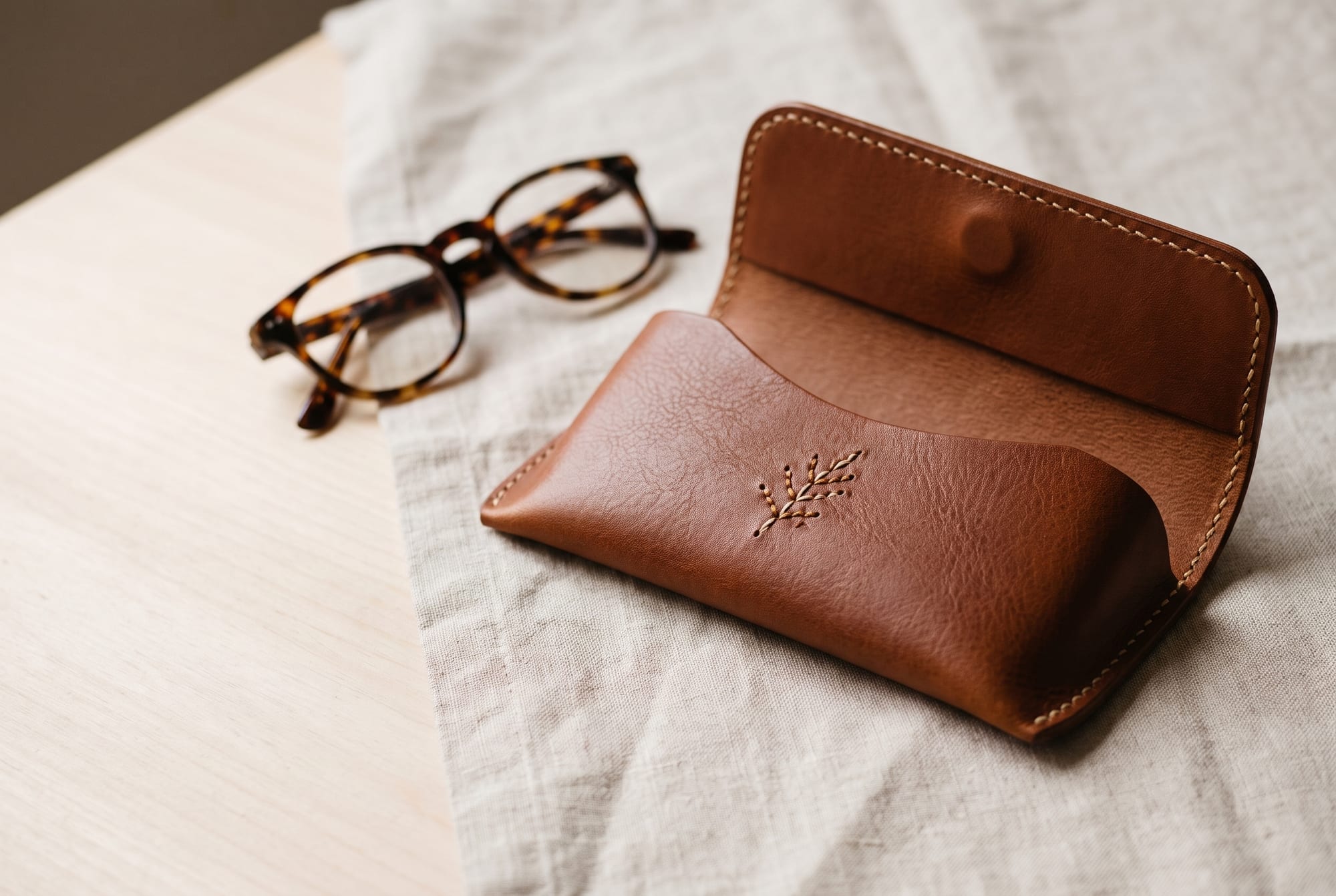
The short answer: choose the case by where it will live, not by how protective it looks. A soft leather slip is right for a case that goes into a coat pocket on its own; a fold-over case is right for a handbag with other things in it; a rigid case is only necessary if the glasses share a bag with keys. Whichever form you choose, the lining should be smooth finished leather rather than suede, because a napped lining holds grit against the lens, and the one habit that matters is shaking the case out every few weeks.
I designed our first eyewear case badly. It was a soft pouch, beautifully made, lined in a lovely soft suede, and I was very pleased with it until an optician explained to me, kindly, why it was the wrong object.
What you are actually protecting
A modern lens is not a piece of glass. It is a plastic or glass core with a stack of very thin coatings on it: anti-reflective layers, a hydrophobic top layer, sometimes a hard coat underneath. Those coatings are what give you clear vision at night and what make a smudge wipe off instead of smearing.
They are also thinner than a human hair and softer than the lens beneath them. A lens does not get scratched by being squashed; it gets scratched by a hard particle dragged across it. Sand, a crumb of grit from a pavement, a fragment of the sugar at the bottom of a handbag. One pass with a grain of sand under a cleaning cloth is worth years of ordinary handling.
The threat is not pressure. It is a hard particle, plus movement. Which means a case does its real work by keeping grit out and by not holding any itself.
This reorders everything. A rigid case with a gritty lining is worse than a soft pouch with a clean one. A plush velvet interior, which feels like the most protective option in a shop, is a trap: nap catches particles and holds them exactly where the lens sits, and you cannot see them to remove them.
It is the same argument I ended up making about what the inside of a jewellery roll should be made of, and for the same reason. Anywhere leather touches something delicate, a nap is a liability.
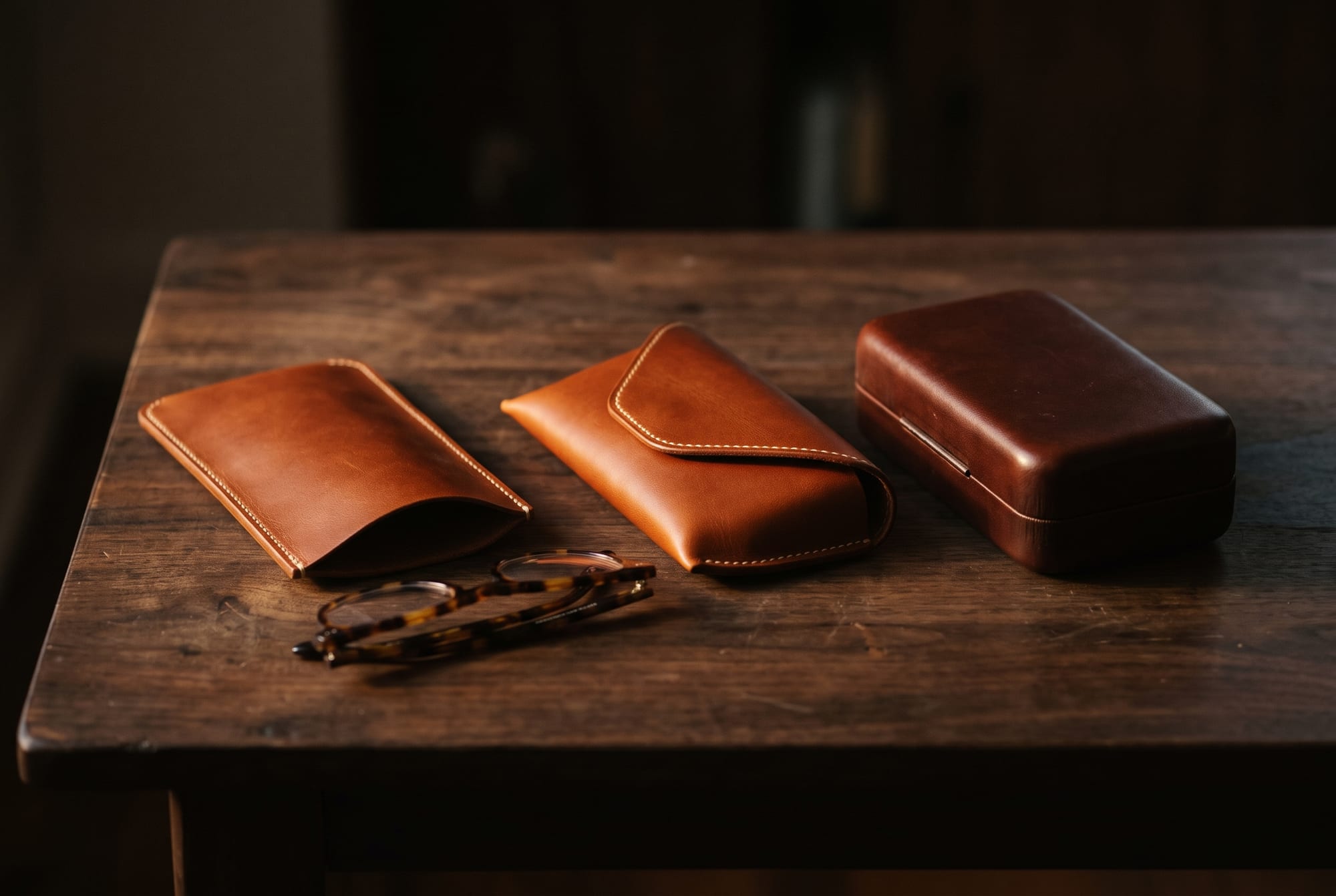
Three forms, four threats
With that established, the choice between case types becomes a practical matter rather than a matter of how serious you want to look.
I am aware this argues against the most expensive-looking option, and I want to be fair to it. If your glasses genuinely live loose in a rucksack with keys, a water bottle and a laptop charger, buy the rigid case — nothing else will survive that, and a crushed frame is worse than a scratched lens. It is the only one of the four columns where rigidity is the answer rather than a feeling.
The lining is the design decision
If you remember one thing from this piece, it should be this, because it is the opposite of what almost every case on the market does.
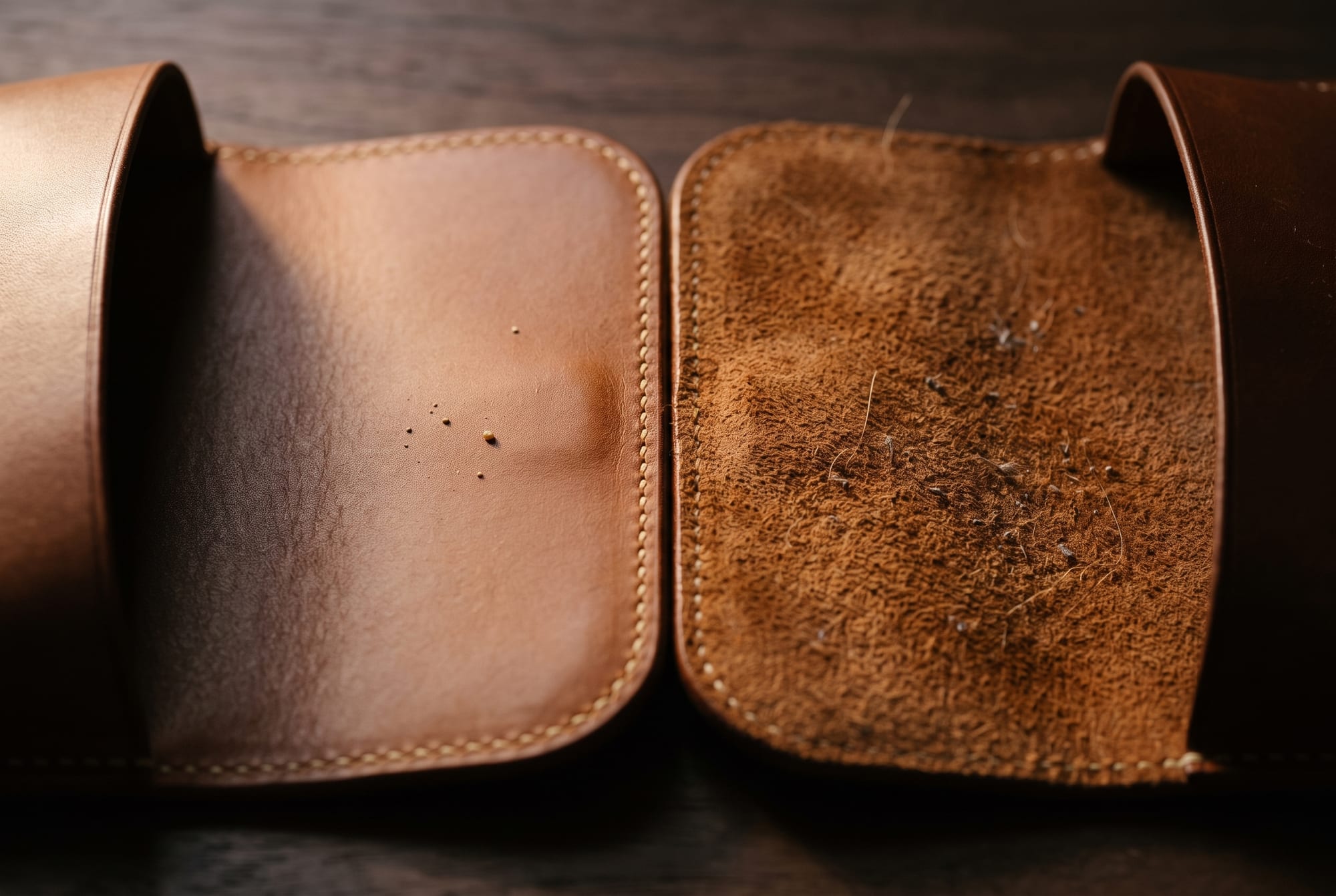
- Smooth finished leather, flesh side turned in or a second smooth layer. Grit sits on top of it and falls out when you tip the case up. You can see it, and you can wipe it with a fingertip.
- Not suede and not velvet. A nap feels protective and is the opposite. Fibres shed onto the lens, and particles bed down into the pile where neither shaking nor wiping reaches them. Those are the same properties that make suede a difficult material to look after in general, which the suede and nubuck guide goes into properly.
- No raw cut edge on the inside. An unfinished internal edge sheds dust of its own for the first months.
- Nothing hard where a lens rests. A rivet back, the end of a zip, or a metal clasp that can swing inwards are all small, hard and in exactly the wrong place. Magnets are fine: they do no harm to lenses or coatings, and a magnetic closure gives you a clean inside face with nothing protruding.
Whether a case should be lined at all is the one place I will allow a soft answer. An unlined case made from a hide with a tight, smooth flesh side is excellent, and simpler. An unlined case in a loose, fibrous hide sheds. The general trade-off is in lined versus unlined; for this object the test is to run a thumb over the inside face and see whether anything comes away on it.
The three measurements, and the one that gets forgotten
Eyewear varies more than almost any other object people buy cases for. A narrow pair of reading glasses and a wide pair of sunglasses differ by four centimetres in folded width, and a case that fits one will either not close on the other or let it slide about.
A case that is too tight is worse than one slightly too loose, and this is the part people do not expect: when you force a pair into a close case, the arms press forward against the back of the lenses. Over months that is a steady load on the hinge and a point of contact on the lens surface. Loose glasses rattle; tight glasses are being slowly worked on.
Why leather, and what it does over ten years
A case is a small object that gets opened and closed several times a day, which is a surprisingly demanding brief. Three things recommend leather for it, and one argues against.
In favour: a leather case has no seam ridge or moulding line to drag across a lens, which rigid plastic clamshells often do; it conforms slightly to the frame over the first weeks, so the fit improves rather than degrades; and it is quiet, which sounds trivial until you have spent a week with a hard case that clacks every time you put it down.
Against: leather is not waterproof and a case is often the thing in a bag that a bottle leaks onto. A soaked case will dry stiff and can mark, and the general rules in the piece on leather and water apply here too.
What it does over ten years is the part I actually care about. A case lives in a hand, in a pocket, against a thumb, several times a day — which is the ideal diet for a surface that records use. The fold goes glossy and dark. The place where a thumb pushes the flap open goes amber before anything else. Of all the small leather objects I have designed, an eyewear case is the one that most reliably ends up looking better than it did, because nothing about it is ever left in a drawer.
Ours, and what we would change about yours
Our eyewear case is a hand-stitched fold-over in a single piece of leather with embroidery across the front panel, closed with a magnet rather than a clasp so there is nothing hard inside. The embroidery is the part people ask about: it is worked into the leather by hand, in the same way we join needle lace to leather on the table pieces, with the thread passing through pricked holes rather than being glued or appliquéd on.
Two notes if you are choosing one as a gift, which most people are. First, a case is one of the safest leather presents there is, for a slightly unromantic reason: it lives inside a bag, so it does not have to match anything the person wears, which removes the usual problem described in the gift guide. Second, it takes a monogram better than almost any other small piece, because the front panel is flat, unloaded and always seen in the hand. The piece on monogramming has the sizing rule; on a case, smaller than you think is right.
What we would change about your current case, whatever it is: turn it upside down over a bin tonight and tap it. Most cases that have been in use for a year release a surprising amount of grit, and that grit is the only thing in this whole piece that is actually scratching your lenses.
Quick answers
- Hard or soft? Soft or fold-over, unless the glasses share a bag with keys or get sat on. Then hard.
- Is a microfibre pouch better for the lens? For wiping, yes, and you should still carry a cloth. As a case it offers no protection against grit entering, and it collects lint of its own.
- Can one case hold two pairs? Only if it is built for it, with a divider. Two pairs loose in one case is the single most reliable way to scratch both.
- Will a magnet affect my lenses? No. Magnets do nothing to glass, plastic or coatings. Keep them away from hotel key cards, not from glasses.
- How do I clean the inside? Tip it out, then wipe with a dry or barely damp cloth. Never put conditioner inside a case: it transfers to the lens and smears.
Further reading
- How to choose leather as a gift: two questions, and the pieces that answer both
- Monogramming leather: blind, foil or paint, and where it can go
- Lined or unlined leather: the three honest jobs a lining does
- Leather and Turkish needle lace: how we join them, and never with glue
- The leather jewellery roll: what it protects against, and how to pack one
- Quiet luxury in leather: the five tells that read without a logo