Guide · 9 October 2026 · by Pınar
The leather jewellery roll: what it actually protects against, and how to pack one
Almost everyone who buys a jewellery roll thinks they are buying a small, soft jewellery box. They are not. A box and a roll solve different problems, and once you know which problem the roll solves, both how to choose one and how to pack it stop being guesswork.
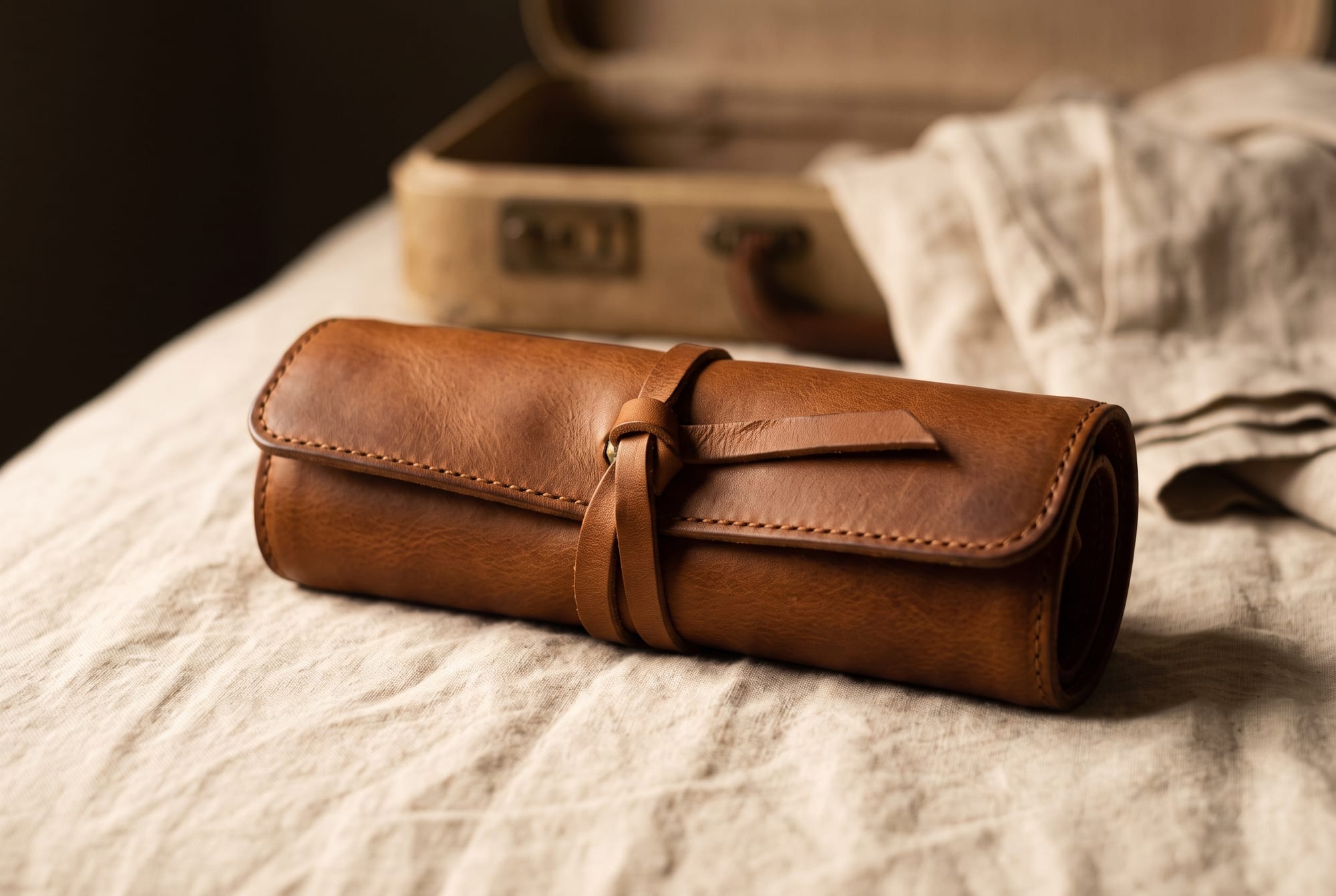
Think about how a single earring actually goes missing. It is hardly ever dropped and hardly ever stolen. It comes off late, it goes into the zipped pocket of a washbag because that is what is to hand, and it surfaces eleven days later — or it does not surface at all.
The pocket is the problem. Not the hotel, not the cleaner, not carelessness in any sense anyone could have corrected by trying harder. And that is the whole case for a roll, which has very little to do with what people imagine it has to do with.
A box protects jewellery. A roll protects a journey
A jewellery box answers the question where does this live. It is for one place, it has a lid and layers and compartments, it keeps dust off, and it absorbs the shock of a drawer being shut. It is furniture. Good ones are heavy on purpose.
A roll answers a different question entirely: how does this survive being moved. And the three things that go wrong in transit are not the three things a box is built for.
Jewellery in transit is damaged by tangling, abraded by its own neighbours, and lost to pockets. Impact is almost never the problem — a necklace is not fragile, it is just extremely good at tying itself in knots.
And here is the design observation that took me embarrassingly long to articulate, given that we make these:
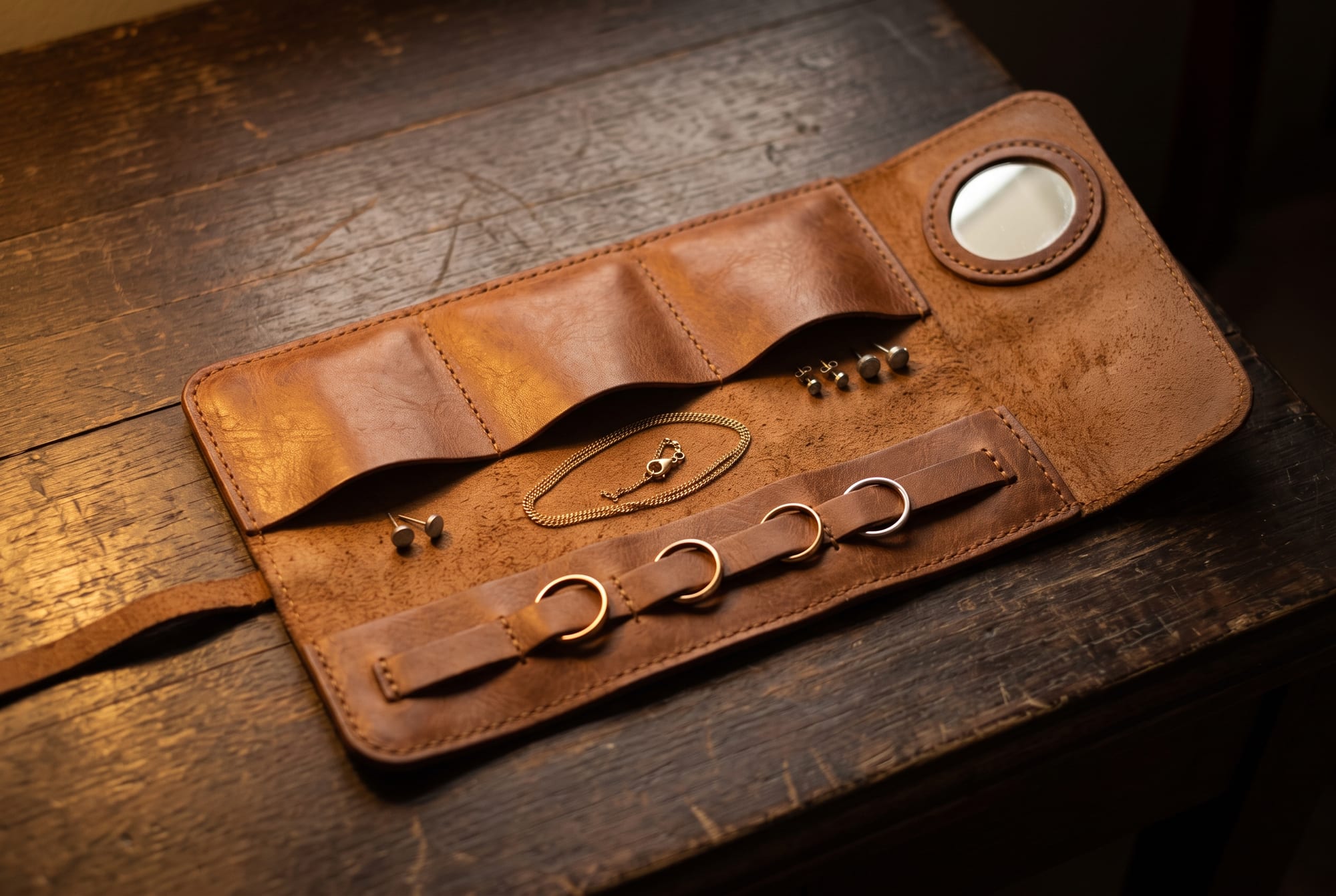
A roll works because when it is open, it has no inside. Everything you packed is in front of you, flat, all at once. You lose jewellery to opacity, not to thieves.
That is the real mechanism. A box with four lidded compartments and a tray that lifts out has four places where a single stud can sit unseen while you are checking out of a hotel at six in the morning. An unrolled roll has none. You look at it once, from above, and you know.
The damage nobody warns you about is hardness, not value
If you ask people how to pack jewellery they will say “keep the expensive things separate”. It sounds right and it is the wrong rule, because value and hardness are not the same axis at all.
Minerals are ranked on a scale of scratch hardness, and the distances on it are enormous. A sapphire sits near the top. Gold and silver sit near the bottom — genuinely near the bottom, softer than a copper coin, roughly as scratchable as a fingernail is by a knife. Which means the thing that quietly ruins a gold band is not a drop or a knock. It is a weekend spent pressed against a stone, moving a few millimetres back and forth every time a suitcase is lifted.
The rule is not separate the precious from the costume. It is separate the hard from the soft — and your most valuable stone is almost always the hardest object in the bag.
This reframes what a pocket is for. A pocket is not a ranking of importance. It is a hardness barrier. A diamond ring and a pair of silver hoops in the same pocket is a bad decision regardless of how carefully you fold them in; two pairs of silver hoops together is fine.
The tangle, and the one trick that ends it
A chain knots because it is free to move in more than one direction and because its own clasp can pass through its own links. Remove either freedom and knotting stops being possible.
So the trick, which is almost too simple to write down: do the clasp up before you pack it. A closed loop cannot thread itself through itself. Then lay it flat, in one gentle curve, in a pocket just long enough that it does not have to double back on itself. If a chain is fine and long, thread the free end through a pocket's seam gap, or through a short length of drinking straw, before you close the clasp — it cannot kink what it cannot cross.
Two chains in one pocket will still find each other. They always do. That is not a tangle problem, it is a counting problem.
How to choose one: six things, in the order that matters
This is the part listings are least helpful about, so it is worth being specific.
- Pocket depth before pocket count. This is the one people get wrong, because count is printed on a listing and depth is not. Six shallow pockets hold less than three deep ones, and a shallow pocket is actively dangerous — it is where a stud sits half in, half out, and leaves on its own. Look at the photographs for how far down a pocket actually goes relative to the fold.
- A ring bar, not a ring pocket. Rings in a pocket slide to the bottom, stack, and grind against each other for the length of the journey. A slotted bar or a split strap holds them separated and vertical, which is the only arrangement where they are not touching.
- A mirror decides whether you use it at all. This sounds like a nicety and it is not. Taking earrings off needs no mirror; putting them on does. A roll without one gets unpacked into the bathroom on the first morning, and from that moment it is no longer a roll, it is a bag of loose jewellery and a piece of leather.
- A tie closure over a snap. A tie is volume-adjustable: it closes round a nearly empty roll and round a full one. A snap is a fixed circumference, and an over-full snap roll puts a steady outward load on the prong plate behind the fastener — which, as the hardware guide explains, works its way through the leather long before the metal fails.
- Medium weight leather, and this is a real constraint. A roll has to curve tightly round its own contents and hold a fold without cracking at it. Too thin and it offers no protection between pocket and suitcase; too thick and it will not close round a full load, which is why the thickest hide on the table is usually the wrong one.
- Think about what touches the metal. Whatever lines the pockets is in contact with your jewellery for the whole trip, and it matters more than the outside face does. A smooth, soft interior is right; anything with a nap sheds fibres into a clasp. There is one honest caveat, below.
The honest caveat: travelling home, not permanent home
I would rather say this than have someone discover it.
Silver tarnishes by reacting with sulphur compounds in the air around it, and the materials a conservator keeps away from silver for long storage are a slightly surprising list: wool, felt — and leather. Vegetable-tanned leather is mildly acidic by nature, because the tannage fixes it that way. Over a fortnight in a suitcase this is irrelevant and I would not think about it for a second. Over three years in a drawer, a silver chain left in a leather pocket can come out duller than one left in a lidded box with a tarnish strip.
A roll is where jewellery travels. It is not where jewellery lives. If something only comes out twice a year, it belongs in an airtight bag, not in beautiful leather.
Gold is essentially unbothered; it is unreactive, which is most of why it has been valuable for six thousand years. Pearls are the opposite case and want air rather than a seal. So the practical division is: travel in the roll, store gold in the roll quite happily, and give long-term silver somewhere else to sleep.
Packing, in the order that prevents each failure
Seven steps, and they are sequenced rather than listed — each one closes a specific failure.
What it becomes
A roll ages in a way almost nothing else we make does, and I have come to find it one of the more charming things about the object.
The outside takes everything: the suitcase scuffs, the hand that pulls it out, the light in whatever room it is unpacked in. The inside takes nothing at all — no sun, no hands, no dust. Open a five-year-old roll and the two faces are visibly different ages of the same hide. The outer face has gone several shades deeper with a soft sheen, and the pockets are very nearly the colour they were cut.
The fold is the part to be deliberate about. Leather remembers a fold, and an even change across a whole surface reads as patina while a hard-edged one reads as damage. One consistent fold line becomes a handsome feature of the object within a year. Four inconsistent ones become a worn-looking piece of leather. The difference is not care or quality; it is just whether you roll it the same way round each time.
The scuffs, incidentally, mostly come out. On a waxed hide like Crazy Horse a warm thumb takes a light mark back in seconds, and on matte Pueblo most surface marks settle into the general darkening within weeks. A roll that looks battered after one trip is usually a roll that needs its outer face looked at once with a dry cloth, nothing more.
When a roll is the wrong answer
Because I would rather you bought the right object than our object.
If your jewellery lives on a dressing table and leaves the house on your body, a roll will be used twice and then live in a drawer. What you want is a tray or a dish — something with no lid at all, so that taking a ring off and putting it down is a single motion rather than a decision. We make catchall bowls for exactly this and they are a completely different proposition.
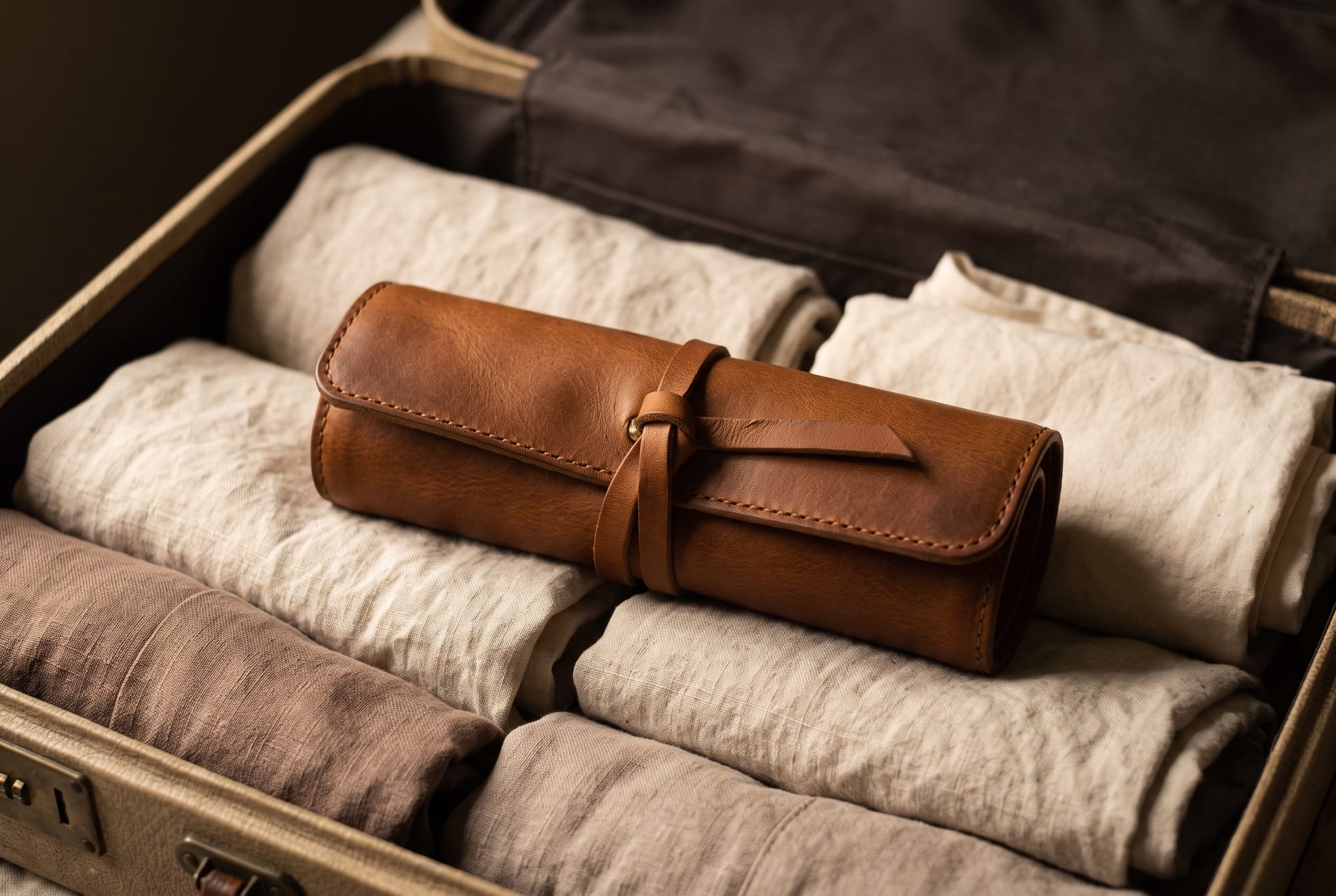
If you travel with a great deal of jewellery — genuinely a lot, and you wear a different thing each evening — one roll will be over-full, and an over-full roll is worse than a pouch, because the pockets stop holding their contents at the depth they were designed for. Two small rolls beat one large one, always. They also pack better, because two flat objects fit a case in more ways than one thick cylinder does.
And if the piece is for someone else, a roll is one of the safest things on the gift matrix — no size to get wrong, no taste to guess — with one exception. It is only a good gift for someone who actually travels. For someone who does not, it is a beautiful object asking to be given a purpose, which is a slightly uncomfortable thing to receive.
A roll is a solution to movement. If nothing moves, there is no problem for it to solve — and no amount of good leather makes an unnecessary object a good one.
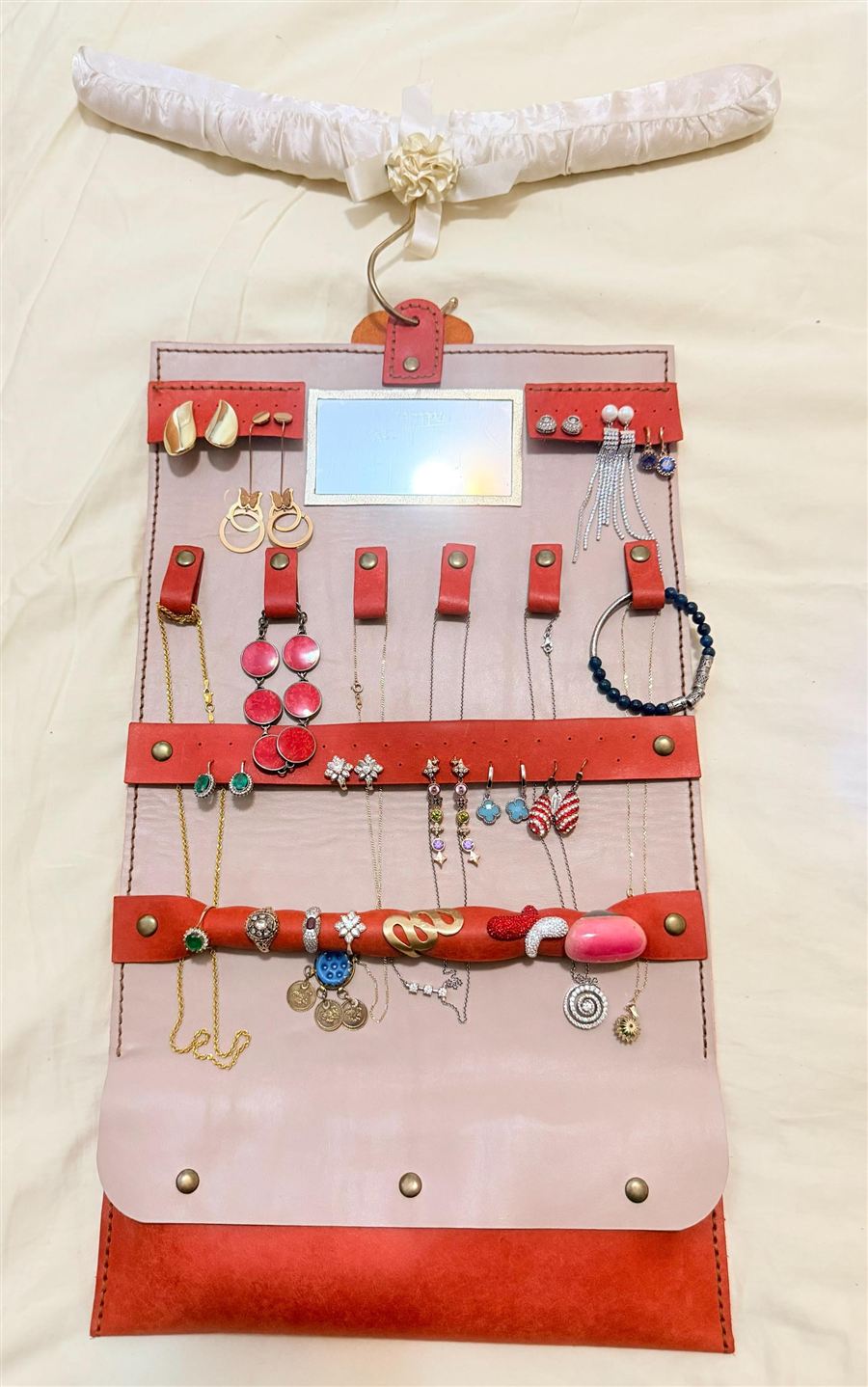
One last practical thing, learned the way most practical things are. Pack it the night before, not the morning of. The whole value of a roll is that it makes an inventory visible, and an inventory is only useful at the point where you can still do something about what is missing.
If you are choosing between sizes and are not sure, lay out everything you took on your last trip — actually lay it out, on a table — and count the pockets you would have needed with stones separated from metal. It is almost always three or four, and almost never the eight people assume. If you want a second opinion on sizing, send us the photograph at info@pazleather.com; it is a question we can answer properly from one picture.
Further reading
- How to choose leather as a gift: two questions, and the pieces that answer both
- Leather thickness: what an ounce means, and why thicker is not better
- Bag hardware: why the metal fails long before the leather
- How to decorate with leather: five surfaces and four pairings
- What is Crazy Horse leather? Meet the hide that scars on purpose
- Leather and sunlight: why it darkens and fades at the same time
- How to store a leather bag for a season or a decade