Guide · 24 October 2026 · by Zafer
Lined or unlined: what a lining is for, and what it hides
The question arrives in the shop as is a lined one better?, and I never manage to answer it, because it is not quite the right question. A lining does three completely legitimate jobs, and one that nobody puts on a product page. A photograph cannot tell you which of the four you are looking at — but a torch and about ninety seconds can.
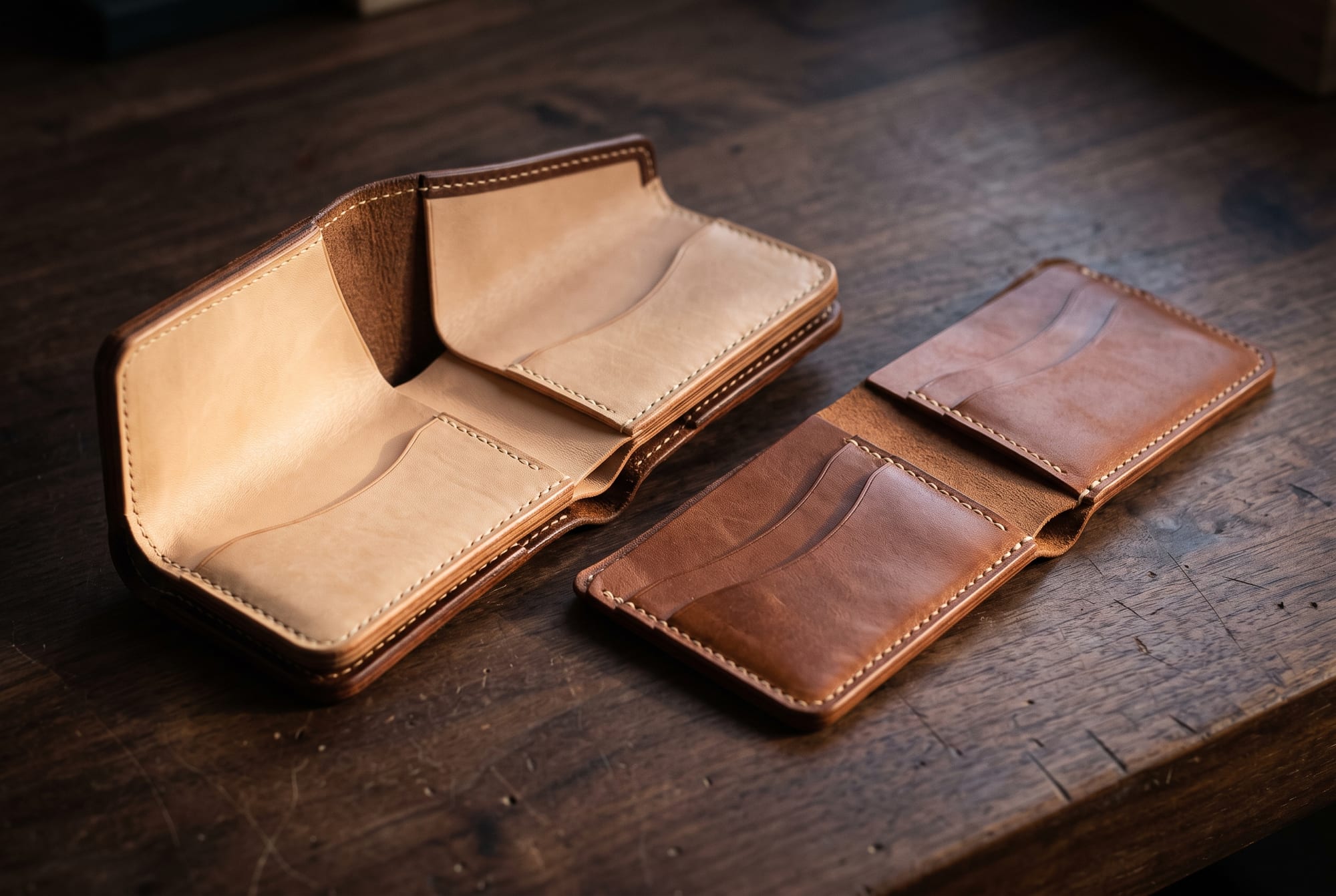
The question arrives in the shop in the same shape every time: is a lined one better?
I have never managed to answer it, because it is not quite the right question. A lining does three completely legitimate jobs. It also does a fourth that nobody writes on a product page, and the fourth is the reason the whole subject is worth twenty minutes of your attention.
The useful version of the question is this one: what would I be able to see, if this were not lined?
The three honest jobs
Structure. Two layers are stiffer than one, and considerably stiffer than twice as stiff, because they resist bending as a pair. On a soft hide that would otherwise collapse into a bag-shaped puddle, a lining is how the object keeps a shape. This is a real engineering reason and it applies almost entirely to bags.
Protecting what goes inside. The flesh side of a hide is open fibre. On a loosely-packed leather it sheds a fine dust, and it is abrasive enough to matter against a phone screen over years. A dyed hide can also crock — give up pigment onto a pale shirt or a silk scarf — and a lining puts a stable surface between the dye and your things.
Closing a raw edge inside a fold. At a mouth, a flap or a turned edge, a lining lets the cut edge be folded inward and hidden between the layers. Done well this is genuinely cleaner than a raw edge, however nicely burnished, and on a wallet's card mouths it is the difference between an edge that stays crisp and one that furs up.
Those three are real. If a maker gives you one of them as the reason, they are telling the truth.
The fourth job
A lining is the only way to put something inside an object where nobody will ever look at it again. That is useful when the thing being hidden is a raw edge. It is useful in a different way when the thing being hidden is a mistake, or a cheaper material.
I want to be careful here, because this is not an accusation against lined goods in general. Most lined bags are lined for the honest reasons. But the capability exists, and it is worth knowing exactly what the capability covers.
- A split used as the inner half. The hide is divided through its thickness; the grain layer goes on the outside where it is photographed, and the suede-like corium goes inside where it is not. The object is described by its outer layer. Everything said about it is true, and half of it is not full-grain.
- A skive that went too far. Skiving is shaving the leather thinner where it has to fold. Go too deep and you leave a translucent, weak patch. On an unlined piece you would see it instantly from the inside. Under a lining it is invisible until it splits.
- Glue standing in for stitching. Adhesive is a legitimate assembly aid — it holds layers in register while they are stitched. It is not a structural fastening. A glued-and-lined edge can look identical to a stitched one from outside for the first few years.
- A panel pieced from offcuts. Two bits joined under the lining, where the join cannot be seen.
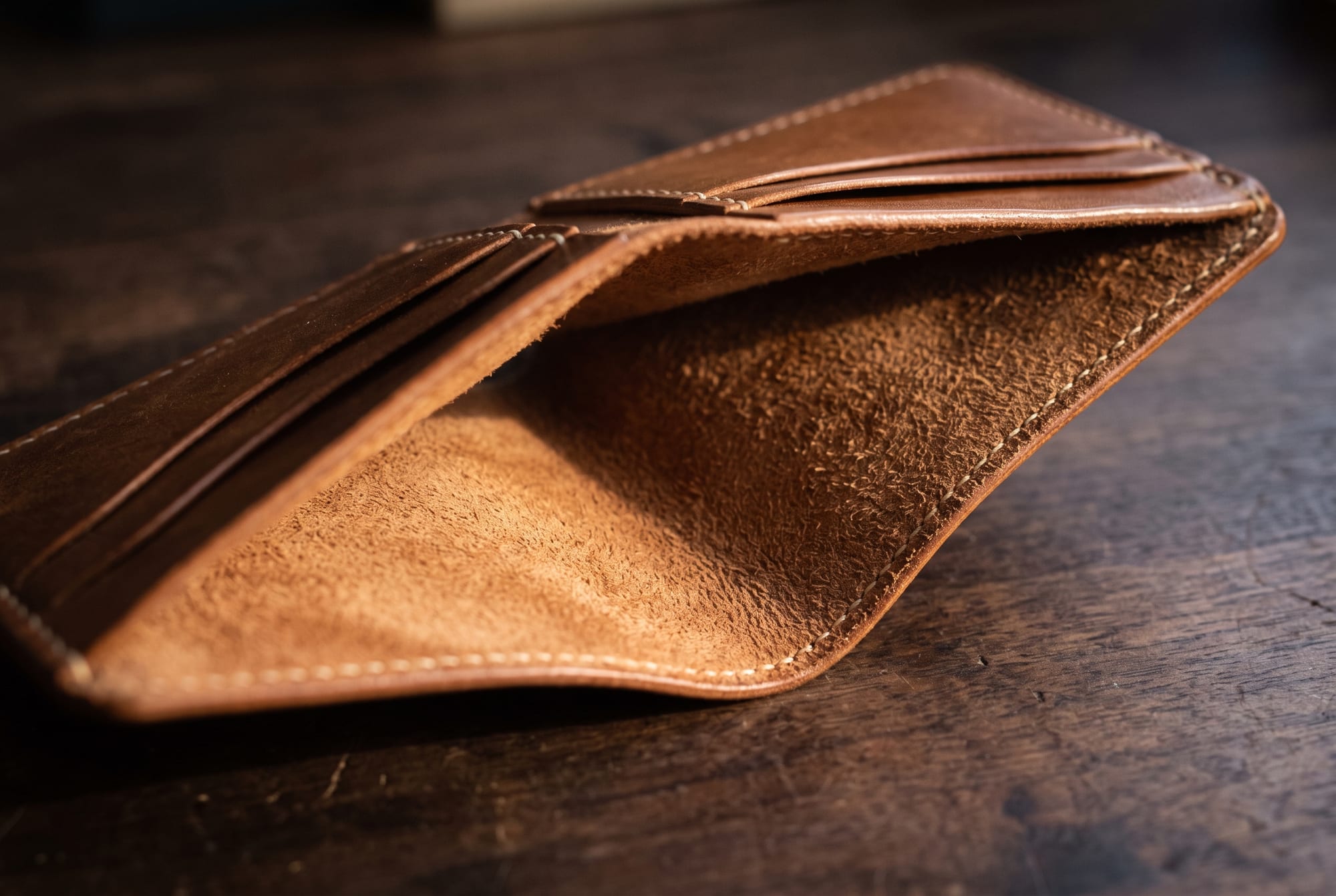
- And the big one: the flesh side itself. The reverse of a hide is the single most reliable quality read available to anyone without a laboratory. A lining removes it from the conversation entirely.
Why unlined is the harder thing to make
This is the asymmetry that explains the whole market, and it is worth stating plainly.
On an unlined piece, every surface is a finished surface. The flesh side has to be slicked and burnished smooth, because you will be looking at it every time you open the thing. The skiving has to be even, because an uneven skive shows as a ridge. Both faces of every edge have to be finished rather than one. There is no inside.
Which means an unlined object cannot hide a bad day at the bench. A maker who sends out unlined work is handing you the inspection report along with the object, every time, and the only way to do that comfortably is to have nothing to hide.
So the economics run the way you would expect: hiding is cheap and showing is expensive. Below a certain price almost everything is lined, and not because of structure.
The one problem with a lining nobody mentions
A lined panel is a laminate, and a laminate dries from one side only.
Get an unlined piece wet and it dries through its thickness in both directions, and if you let it dry slowly at room temperature it generally comes back. Get a lined bag wet on the inside — a bottle, a flask, rain through an open top — and the water goes between the two layers, where there is no airflow, no light and often a film of adhesive.
That is where mould starts, and it is why a lining that is mouldy through to the fabric is a repair rather than a wipe: you cannot dry the inside of a laminated panel by rubbing the outside of it. It is also why a lined bag that got soaked once can smell faintly of damp for years while looking perfect.
None of which is an argument against lined bags. It is an argument for knowing that the inside of a lined object is a sealed space, and treating a soaking as a more serious event than it looks.
The thickness arithmetic
Everything in the top half of that first diagram has a practical consequence that shows up in the hand.
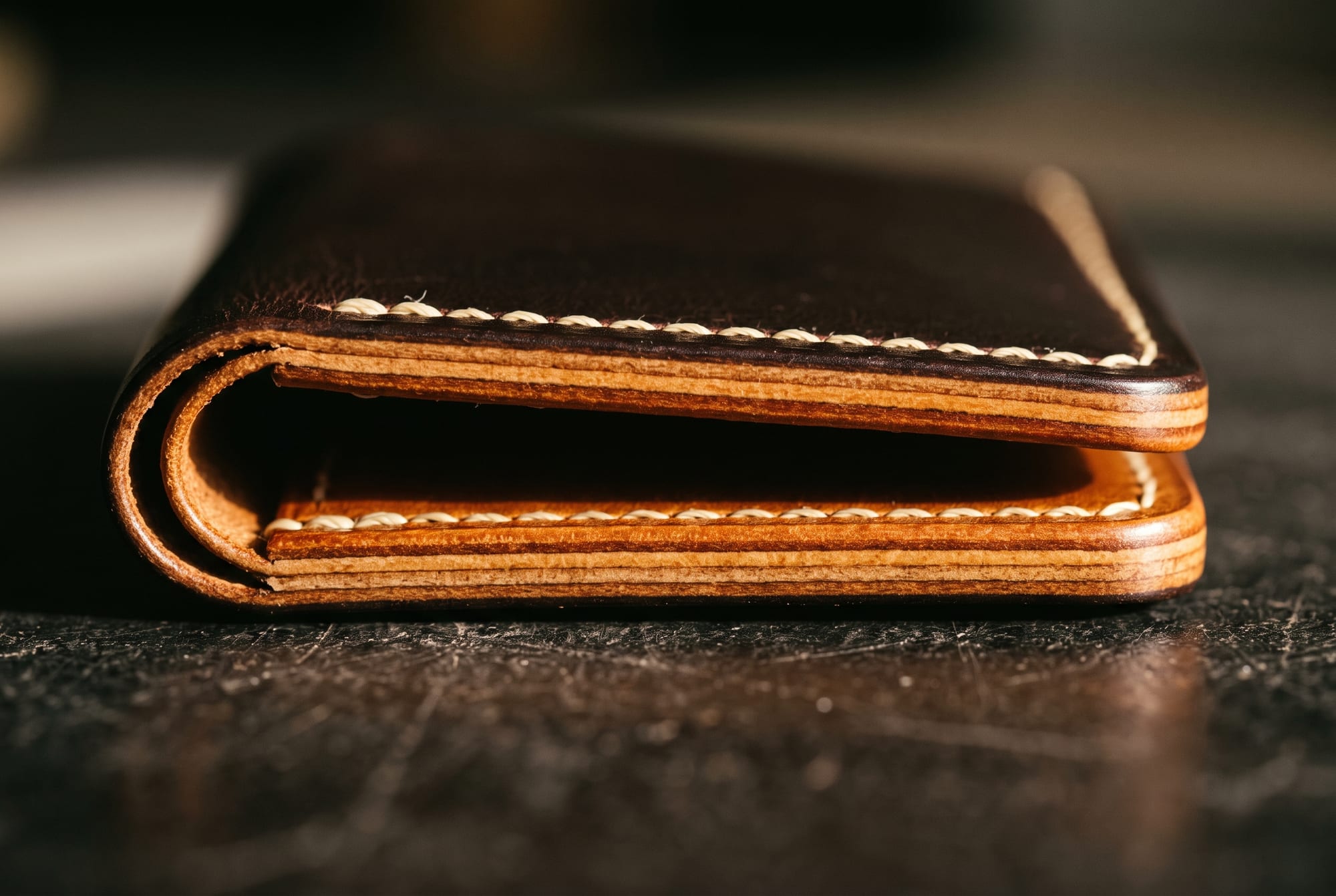
A lining does not add its thickness once. It adds it everywhere the object folds and everywhere it is stitched, and at a folded stitched edge you have four layers rather than two. A 1.2 mm shell with a 1.0 mm lining gives you 4.4 mm at that edge against 2.4 mm unlined — and the bending resistance of a stack rises much faster than its thickness, so that edge is not twice as stiff. It is several times as stiff.
This is most of why a lined wallet lives fat and a well-made unlined one lives flat, and it is why card slots are the place lined construction shows up first. It is also why thickness and lining have to be chosen together rather than one after the other: a lined object needs a thinner shell than an unlined one doing the same job, and a maker who simply adds a lining to an existing pattern produces something stiff and dead.
So which should you buy?
It depends almost entirely on what the object is, and the answer is clearer than the debate suggests.
Flat goods — runners, placemats, desk pads, straps, trays, tiebacks. Unlined, essentially always. There is no structure to add, nothing inside to protect, and no mouth to close. A lining on a flat piece is either padding or concealment, and it stops the piece from developing a readable back face. Ours are unlined, and the reverse of a desk pad after five years is one of my favourite things to show people.
Structured bags. A real decision, and often a lining is right. Ask what it is made of, and prefer leather or pigskin over textile on an object you expect to keep: a cotton twill lining is an excellent lining that will wear out in year eight inside a shell that was good for forty, and replacing a lining is major surgery.
Wallets and small goods. This is where lining does the most damage, because thinness is the entire point of the object. A lined wallet is a thicker wallet in every dimension and it will not improve with use the way an unlined one does. If there is one category where I would actively seek out unlined, it is this one.
Anything described as “leather lined” at a low price. Ask which leather. The phrase covers pigskin, which is good, and it covers bonded leather, which is scraps and adhesive pressed into a sheet and which will crumble quietly inside the object. Same two words.
What we do
Almost everything we make is unlined, and I have tried in this article to explain why without making it sound like a slogan. It is not because linings are dishonest — most are not. It is because on the objects we make, a lining would hide the half of the work I would most like you to see, and would stop the piece from doing the thing the material is for.
The flesh side of a Pueblo hide, slicked down and burnished, is a beautiful surface in its own right, and it darkens and polishes with handling exactly as the grain side does. Covering it with a piece of cotton to make an object look “finished” has always struck me as the wrong way round.
Where we do line something — a structured bag, occasionally a card mouth — it is leather, it is stitched rather than glued, and I will tell you the weight if you ask. Which is the test from the diagram, and I would rather pass it than explain it.
Further reading
- How to buy leather accessories: a maker’s 60-second inspection
- Full-grain, top-grain, “genuine”: what leather labels really mean
- Leather thickness: what an ounce means, and why thicker is not better
- How many cards should a leather wallet hold? A slot stretches once
- Why “real leather” doesn’t mean good leather
- Saddle stitch vs machine stitch: the seam that decides how long a bag lives