Guide · 4 November 2026 · by Pınar
Black leather: what it hides, what it shows, and when to choose it
Every other leather colour has a future tense. Tan goes honey, cognac deepens to mahogany, olive quietly greys off. Black arrives finished and stays where it is — which makes it the easiest colour to live with, the kindest to a careless owner, and by some distance the hardest colour to buy well.
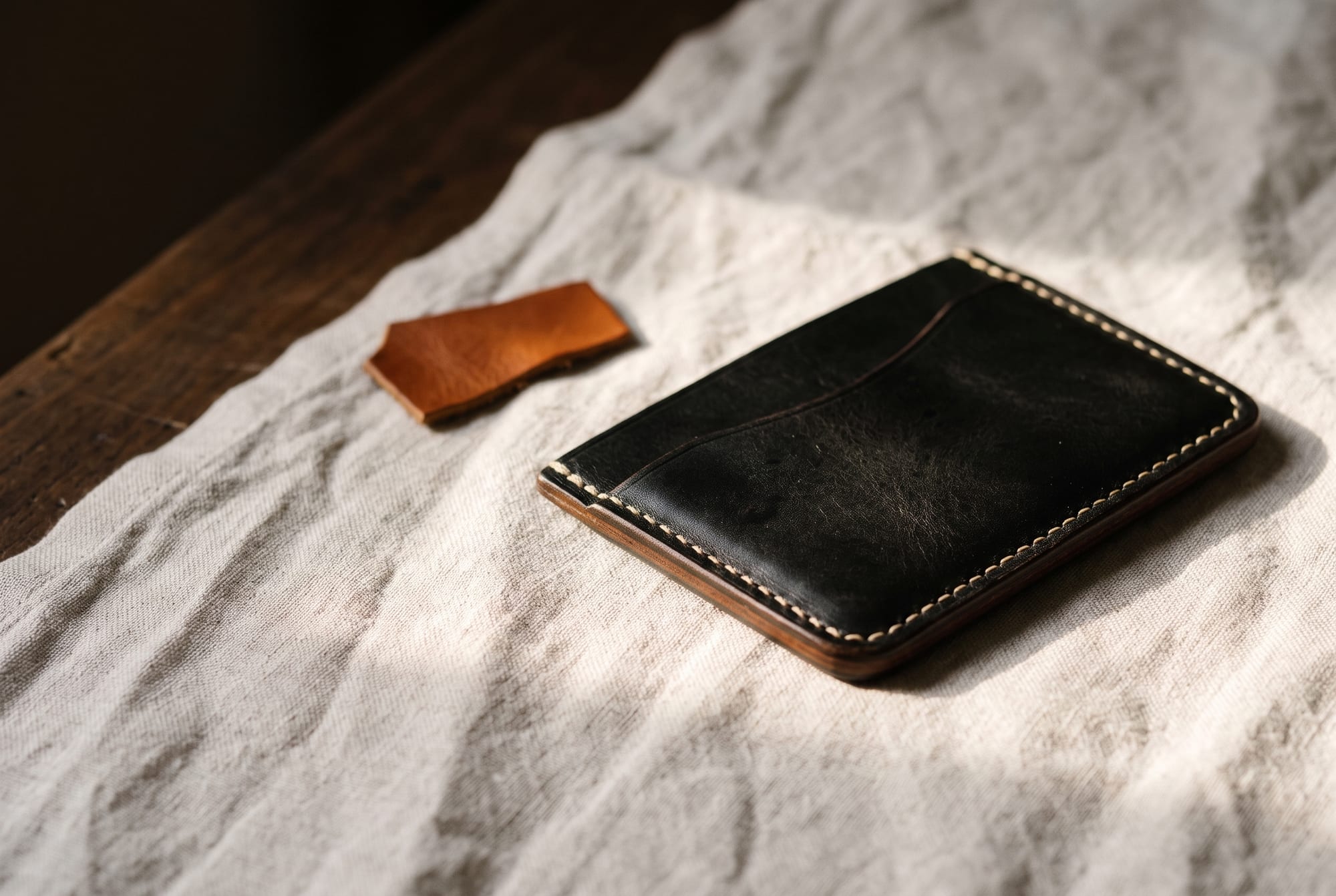
The short answer: choose black when you want the object to stop being a colour — in a formal wardrobe, in a room that is already busy, on anything you will carry daily and treat roughly. Avoid it when you wanted a piece that visibly becomes yours, because black has almost nothing to show you over ten years. And when you do buy it, buy it differently: black hides the grain, so the usual way of judging leather by eye barely works. Look at the cut edge, rub it with a white cloth, and fold it hard.
I am a designer, so I will admit my bias early. I reach for cognac and tan most days, and the Journal is full of pieces about what browns do over time. But I have also watched enough people stand in the atelier holding a cognac bag and a black one, visibly wanting the first and sensibly buying the second, to know that black is not the boring answer. It is a different proposition, and it deserves its reasons rather than its reputation.
Black is the only colour with no future tense
Ask what a leather colour will look like in ten years and almost every answer is a verb. Tan deepens. Cognac goes to mahogany. Natural veg-tan tans like skin. Olive loses its green and drifts to a grey-brown. Burgundy browns at the high points and keeps its red in the recesses. These journeys are the real subject of choosing a leather colour, and they are the reason people fall in love with brown leather.
Black does not do this. A black hide is already carrying as much pigment or dye as leather can hold; there is no lighter state for it to darken from. What ages on a black piece is everything except the colour: the sheen rises where hands touch it, the creases set, the edges polish, the surface softens. Those changes are real and they are lovely, but they are quiet, and they are not what most people mean by patina.
That is the whole decision in one picture. If you want a piece that records your life on its surface, a brown will do it and black will not. If you want a piece that looks the same at the end of a decade of hard use as it did in the shop, nothing else comes close.
What black hides, and what it shows
The same property does both jobs. Black has almost no colour information left to lose, so anything that removes colour is invisible and anything that adds a lighter colour is shouting.
The practical consequence is that black rewards a cloth and punishes nothing else. Five seconds with a dry cloth puts a black bag back to new, because the only things it shows are things sitting on the surface. A cognac bag in the same state needs a decision about whether the mark is now part of its history.
Why black is the hardest colour to buy well
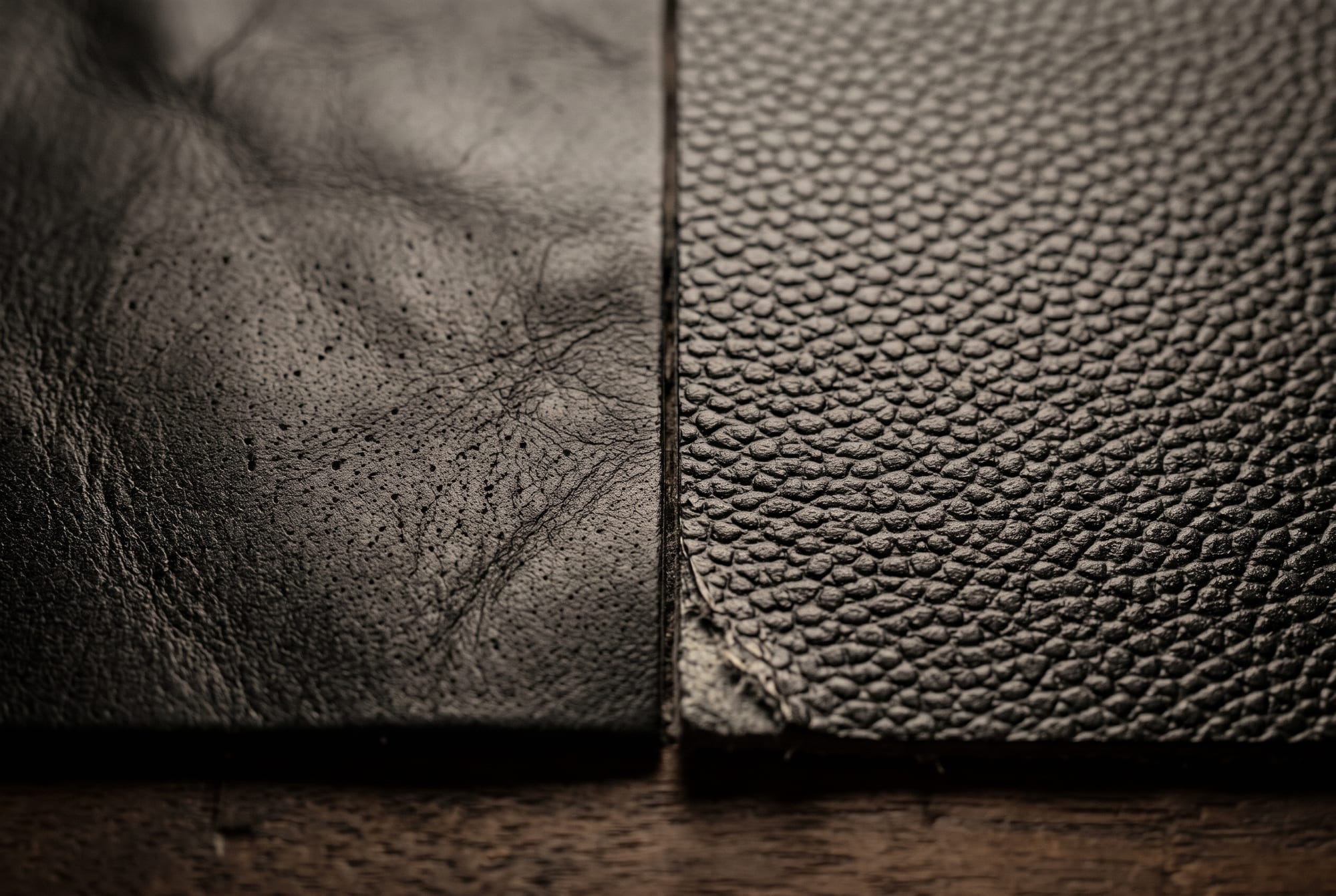
Here is the uncomfortable half. Almost everything we normally tell people to look at — the irregular pores, the subtle shifts of tone across a panel, the slight darkening at a fold — depends on being able to see colour variation. Black deletes that information. A superb full-grain hide and a sanded, pigmented, re-embossed one look far more alike in black than they ever do in tan, and the trade knows it.
So when the colour stops helping, switch to the tests that do not need it. Four, in this order:
- The cut edge. Look at an unpainted edge in bright light. Dyed-through leather is dark all the way across, usually a shade warmer and lighter in the middle, which is normal. A crisp black skin a fraction of a millimetre thick, sitting over a pale grey or beige core, is a pigment film on corrected grain. That is the single most useful thing you can see on a black piece.
- The white cloth. Rub firmly with a slightly damp white cotton cloth for a few seconds, somewhere discreet. Nothing, or the faintest grey, is fine. Clear black on the cloth means loose surface dye, and it will come off on a pale shirt. The trade word is crocking.
- Raking light on the grain. Hold the piece almost edge-on to a window. You are not looking for colour, you are looking for whether the pore pattern repeats. A repeat means it was rolled on, and black is where embossing hides best. The full set of surface tests is in how to tell if leather is real.
- The hard fold. Bend a panel firmly against itself. Full-grain wrinkles into many fine irregular lines and springs back with no colour change. A coated hide tends to rise into one sharp ridge and, often, to go faintly pale along it. That pale line is the finish splitting, and on black you can actually see it — one of the few places where the colour helps.
Black is also where the word “leather” does its most slippery work, because a bonded or coated material is far more convincing in black than in any brown. If the piece is black, cheap and perfectly uniform, read what leather labels really mean before you decide it is a bargain.
Black does fade — just not the way brown does
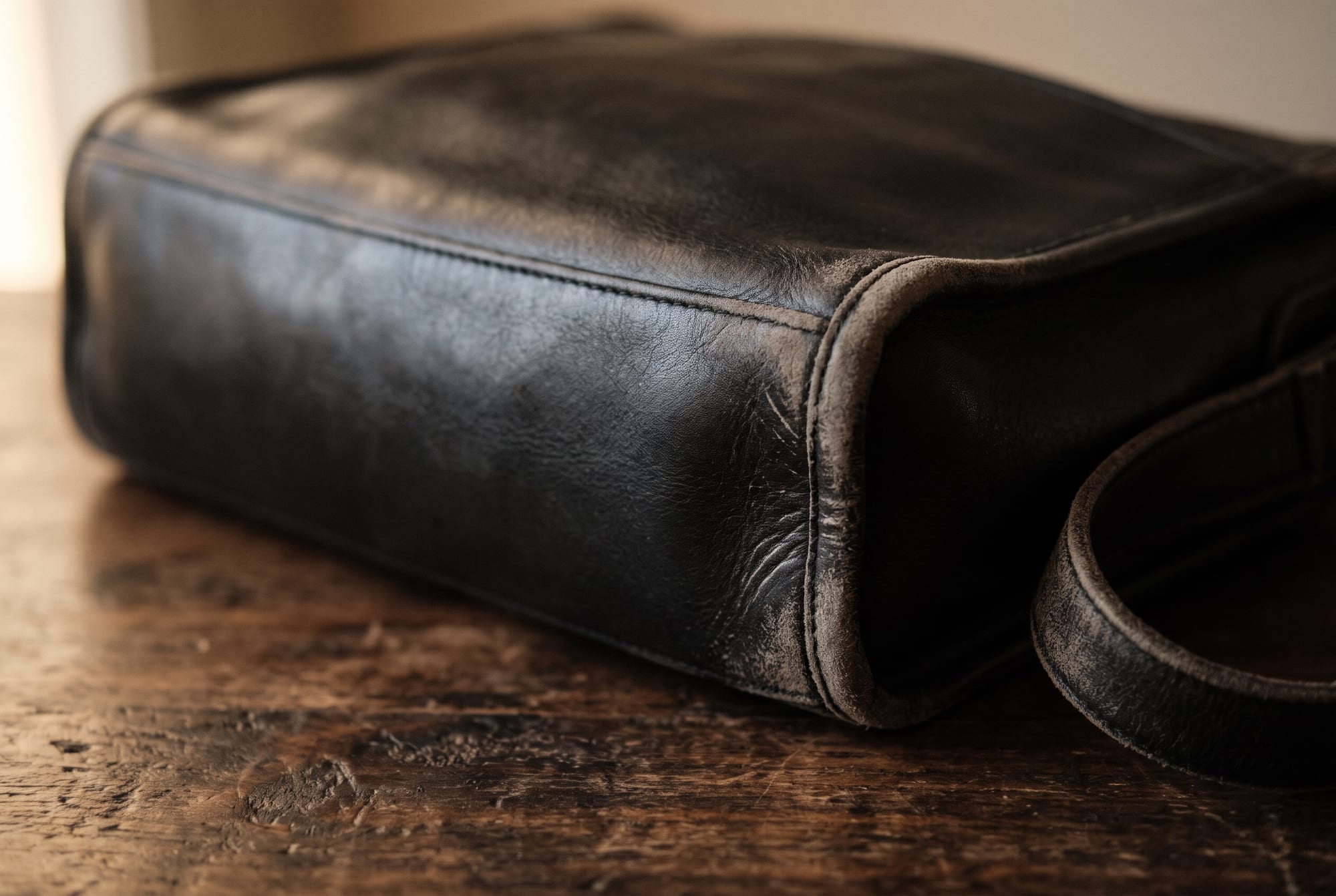
The one thing black does on its own is lose. Sunlight breaks down black dye from the surface inwards, and because there is no lighter colour underneath to reveal except the leather's own warm brown, a sun-aged black bag goes brown, then a chalky grey-brown, usually unevenly and usually on one side. Anyone who has left a black bag on a car seat for a summer has seen this.
This is not the gentle, desirable fading that happens to indigo or to some tanned hides. It is a one-way change, it cannot be reversed by conditioning, and it is why a black piece should be stored out of direct light even more carefully than a brown one. The mechanism, and how fast it happens through glass, is in leather and sunlight.
There is a second kind of black fade worth naming, because people confuse the two. If the black is a pigment film rather than a dye, it does not fade so much as wear: the film thins at the corners, the edges and the handle, and a grey or brownish halo appears where the colour has physically gone. Conditioner will not bring it back either, because there is nothing left to feed. That failure, and what can be done about it, is in why leather peels.
When black comes off on your clothes
New black leather, especially chrome-tanned and heavily dyed, can rub colour onto light fabric: shirt cuffs, a cream sofa, the inside of a pale coat. It is usually worst in the first few months, worst again when the leather is damp, and it is almost always surface dye that never got fully fixed or rinsed.
Test before you commit, with the white cloth above. If a piece you already own is transferring, wipe the surface repeatedly with a barely damp cloth, letting it dry between passes, until the cloth comes away clean; a very light conditioner afterwards helps seal what is left. The reverse case, where something else stains the leather, is the subject of dye transfer on leather — and it is worth noting that black is the one colour you never need to worry about on that side.
Living with black in a room
This is the part I actually think about when I am designing. Brown leather is a surface in a room: it holds light, it has depth, it changes as the day moves. Black leather is a line. It absorbs light instead of returning it, so at any distance it reads as a shape and an outline rather than a material, and the texture you paid for simply disappears.
That makes black excellent at some jobs and poor at others. It is superb as punctuation: a black desk pad on a pale oak desk, black tiebacks against linen curtains, a black tray on a marble counter. It gives an interior a hard edge and makes everything near it look more deliberate, which is why it belongs so naturally to the restrained palettes discussed in quiet luxury.
It is poor at warming a room, and it is poor at the thing people most often buy leather for in a home, which is a material that visibly ages alongside everything else. A black leather runner on a dark table is nearly invisible; the same runner in cognac is the reason the table looks finished. If you want the leather to be felt rather than seen, read leather in the home first and then decide.
One practical note on pairing. Black sits comfortably with cool metals — steel, nickel, chrome — and with grey, white and cold stone. Warm brass on black reads as a deliberate, slightly formal contrast rather than a natural match, which can be exactly right, but it is a decision rather than a default. Brown leather and brass need no such decision.
When to choose black, and when not to
- Choose black for a formal wardrobe where the object must disappear: a belt under a suit, a slim card holder, a laptop sleeve carried into meetings.
- Choose black for anything that will be treated carelessly and expected to look fine anyway. It is the single most forgiving colour for a daily bag.
- Choose black when the room is already doing a lot, and you want the leather to be structure rather than warmth.
- Think twice if you are buying the piece partly for what it will become. Ten years of black is ten years of the same colour.
- Think twice if the piece will live in daylight. Black fades the most visibly of all, and it fades towards something no one chooses.
- Think twice if you cannot inspect it properly. Black is the colour that most rewards a careful buyer and most punishes a hurried one.
What we do with black
We do not dye our hides black, and it is worth being clear about why, because it is a limitation rather than a verdict. Everything we cut is full-grain, vegetable-tanned cattle hide chosen for how it darkens, and the whole argument of our work is that the colour arrives slowly. A black veg-tan is a genuinely beautiful material — properly dyed through, it goes to a soft graphite with use — but it is a different hide bought for a different reason, and we would rather point you at a maker who works in it than pretend our cognac is a universal answer.
Where black does appear in our work is in thread. A black waxed linen stitch on a cognac panel is one of the few places black does something no brown can: it draws the line of the seam, makes the stitching itself the ornament, and stays exactly where it is while the leather around it deepens for a decade. That is black used as a line, which is what it is best at.
Quick answers
Does black leather fade? Yes, but only in light. Indoors and out of direct sun, black holds its colour almost indefinitely. In daily sunlight it fades towards brown and then a chalky grey-brown, unevenly, and conditioning will not bring it back.
Does black leather develop a patina? Not a colour patina. What develops is sheen where it is handled, set creases, polished edges and a softer hand. If patina is what you are buying, a brown will give you far more of it.
Why does my black leather bag mark my clothes? Excess surface dye that was never fully fixed, usually worst when the leather is new or damp. Wipe repeatedly with a barely damp white cloth, drying between passes, until the cloth stays clean.
Is black leather better quality than brown? No, and black makes quality harder to judge, because it hides the grain, the tonal variation and the repairs. On a black piece, test the cut edge and the fold rather than trusting the surface.
Further reading
- How to choose a leather colour, and what each one becomes
- Tan, cognac, whiskey, saddle, chestnut, tobacco: what leather colour names mean
- Leather and sunlight: what light actually does to a hide
- How to tell if leather is real: seven tests, in the order that matters
- Dye transfer on leather: when colour moves where it should not
- Quiet luxury, and what it actually asks of a material