Guide · 29 August 2026 · by Zafer
How to fix scratches on leather: a maker’s guide by depth and finish
The message we get more than any other: “I scratched my new bag on day three — is it ruined?” Almost never. But the internet’s fixes ruin more leather than the scratches do.

Here is what happens on the bench when someone brings us a scratched bag. Before we touch it, we do two things that take ten seconds and decide everything: we read how deep the mark goes, and we read what finish it went through. The same scratch needs four different answers depending on the leather it’s on — and the wrong answer, applied confidently, is how a thirty-second fix becomes a permanent stain.
First, read the depth
Run a fingernail across the mark, at a right angle to it. Then look at its colour against the leather around it.
A scuff is the one everyone panics about and the one that matters least: the surface oils and waxes have been pushed aside, which is why the mark looks lighter than the leather. Nothing has been cut. A scratch catches your nail and usually looks darker — the grain fibres have been opened and are drinking light. A gouge shows fuzz, or the paler colour of the hide’s core. Only the third kind is a repair. The first two are maintenance.
Then, read the finish
This is the step the internet skips, and it’s why the “one weird trick” articles cause so much grief. The finish decides whether a scratch can heal at all.
- Aniline vegetable-tanned leather has open pores and its own oils. Marks fade because the oils move. It heals; it also marks easily. Most of what we make is this.
- Pull-up leathers — Crazy Horse, Pueblo — are flooded with wax that shifts when bent or scratched. They are designed to scuff and to recover with warmth.
- Pigmented or coated leather wears a layer of paint. A scratch here isn’t in the hide, it’s in the paint — and paint doesn’t heal, it chips. It can only be filled and recoloured.
- Suede and nubuck are napped fibre. Nothing oily belongs anywhere near them; they respond to a brush.
The fixes, gentlest first
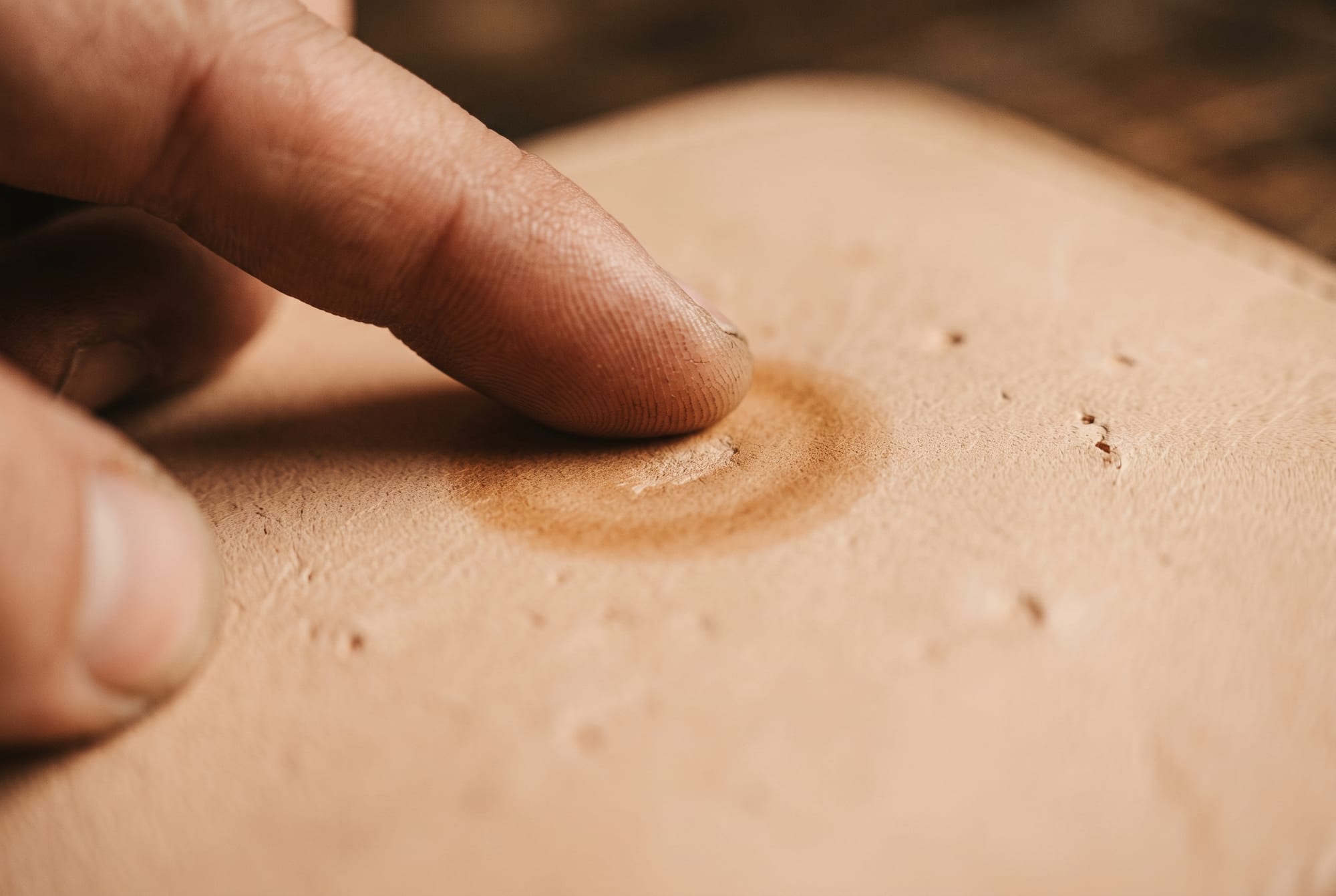
The warm finger. For a scuff on aniline or pull-up leather: press the pad of a clean finger on the mark and rub in slow circles for thirty seconds. Your skin’s warmth softens the wax and oils; the pressure moves them back over the mark. It looks like a magic trick the first time. It’s just physics — and it’s also why a well-used bag has fewer visible marks than a shelf-kept one: hands are maintenance.
The balm, on the whole panel. For a scratch that catches the nail on veg-tan: a pea of beeswax-based balm on a soft cloth, worked over the entire panel — not the scratch alone, or you’ll get a dark island. Rest it overnight so the oils sink, then buff. The cut fibres drink the oil and lie down; the darker line fades to a faint one, then to nothing you’d notice without looking. The same rule as our stain protocol: treat the panel, not the spot.
Warmth, carefully. On pull-up leathers a warm palm is usually enough. If a deep pull-up mark won’t move, a hairdryer on its lowest setting, from arm’s length, kept moving, for a few seconds — and then your thumb. Never on aniline (it dries the oils you’re relying on), never on coated leather (it lifts the paint), and never hot.
Laying down a gouge. Don’t sand it. Raised fibres can be pressed flat with the back of a spoon or a bone folder and a drop of balm, working along the cut, not across it. The line stays — a gouge is a gouge — but it becomes a smooth, darkened mark rather than a fuzzy one. On a full-grain piece that’s the honest end point; if the colour has gone too, that’s a job for a bench, and worth doing on a piece that’s meant to last thirty years.
A scuff is displaced wax. A scratch is an opened fibre. Only a gouge is a wound — and even then the leather is on your side.
Cat scratches, specifically
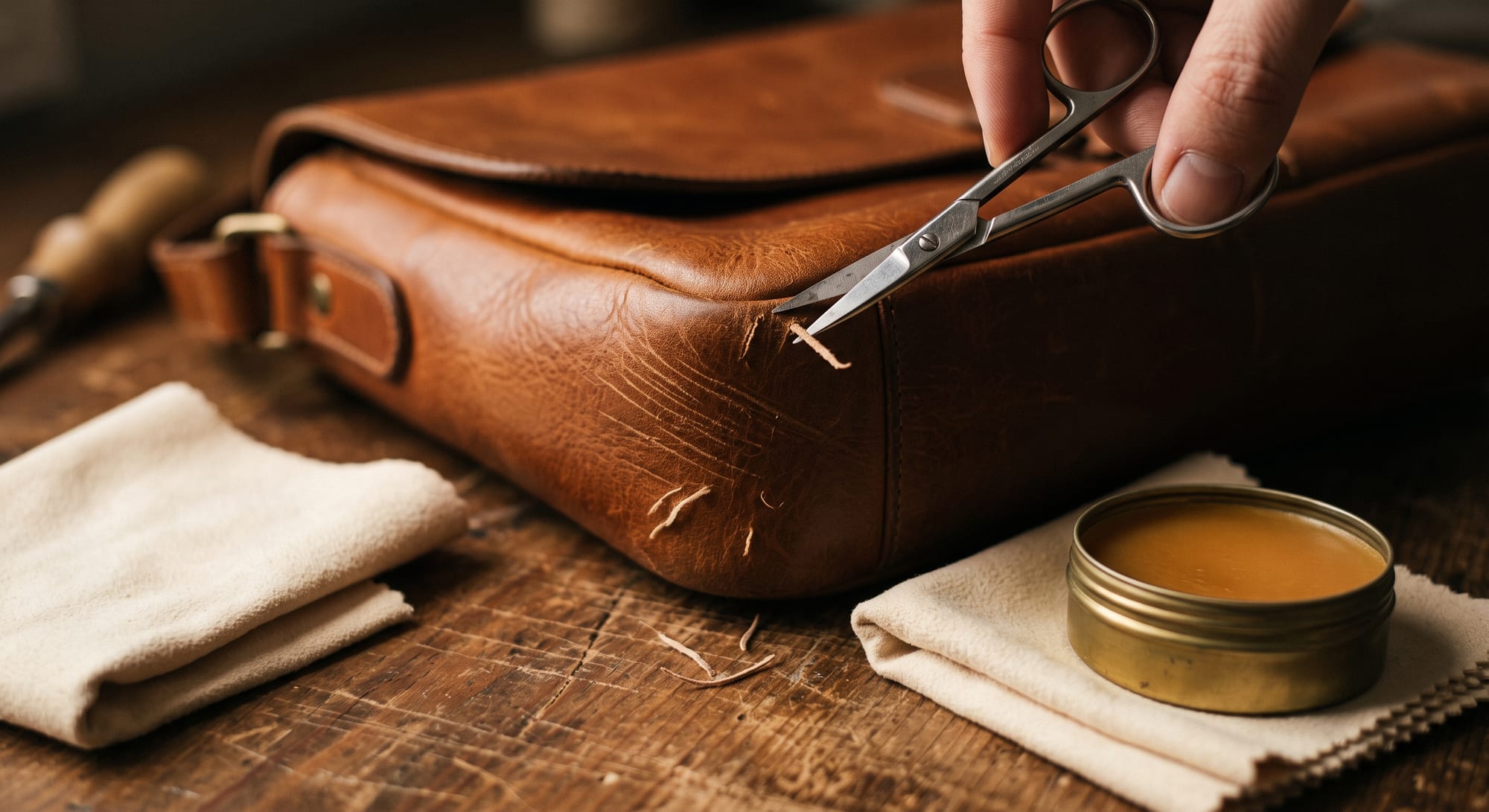
The most-searched version of this question, and the most misunderstood. A cat doesn’t leave one scratch; it leaves a cluster of fine parallel ones with lifted fibres — which is why the area looks fuzzy and pale even though each line is shallow. On aniline or pull-up leather: snip any fibres standing proud with tiny sharp scissors, flush and never pulled (pulling tears a longer strip). Then the warm finger, then a thin coat of balm, then patience — the area darkens back over a week or two of use. On a coated sofa the fibres are the same but the colour is paint, so once the pale core shows you’re into filler-and-colour territory, or a professional. And the honest advice: put a throw where the cat lands. Prevention costs nothing; the second repair costs more than the first.
What never to put on a scratch
- Olive oil, coconut oil, any kitchen oil. The internet’s favourite, and the one we repair most. It darkens unevenly, never fully absorbs, and goes rancid inside the hide. Same reason we banned it from softening.
- Shoe polish on a bag. Pigment that transfers to every shirt it touches.
- Markers, nail polish, wood-scratch pens. Permanent, wrong shade in daylight, impossible to undo.
- Alcohol, vinegar, nail-polish remover. They strip aniline dye and leave a pale halo far larger than the scratch. We’ve written that warning before; here it is again.
- Sandpaper or a nail file. You are removing grain to hide a mark in grain. It never ends well.
- Super glue on a gouge. It makes a hard shiny scab that cracks when the leather flexes.
The scratch you should keep
My grandfather used to say a scratch is a receipt: proof the thing was used for what it was made for. He wasn’t being sentimental — he simply knew that on full-grain, vegetable-tanned leather a scratch is the beginning of patina, not the end of the object. Fix the scuffs, because they’re not really marks. Soften the scratches, because that’s care. But the deep line you got dragging a suitcase through an airport at midnight? Leave it. In five years it’ll be the part of the bag you point to when you tell the story.
Full-grain leather marks easily and damages rarely. Coated leather does the opposite — and that is the whole difference in one sentence.
Not sure which depth or which finish you’re looking at? Photograph the mark in daylight, from straight above and from a low angle, and send both to info@pazleather.com. We’ll tell you which cell of the grid you’re in before you touch anything.
Further reading
- Suede and nubuck care: why everything that feeds smooth leather ruins nap
- Olive oil, Vaseline, baby wipes: what not to put on leather
- The art of leather restoration: bringing old leather back to life
- Leather stain first aid: what to do in the first five minutes
- What is Crazy Horse leather? Meet the hide that scars on purpose
- Patina: the story your leather writes about you
- Leather FAQ: does real leather scratch easily?