Guide · 13 November 2026 · by Pınar
Leather napkin rings: the smallest thing on the table, and the one that reads first
A napkin ring sits on top of everything else — above the runner, above the placemat, above the plate — which makes it the highest, smallest and most visible decision on a laid table. It is also the one most people buy in the wrong size, because almost nothing on the market is cut for a real linen napkin.
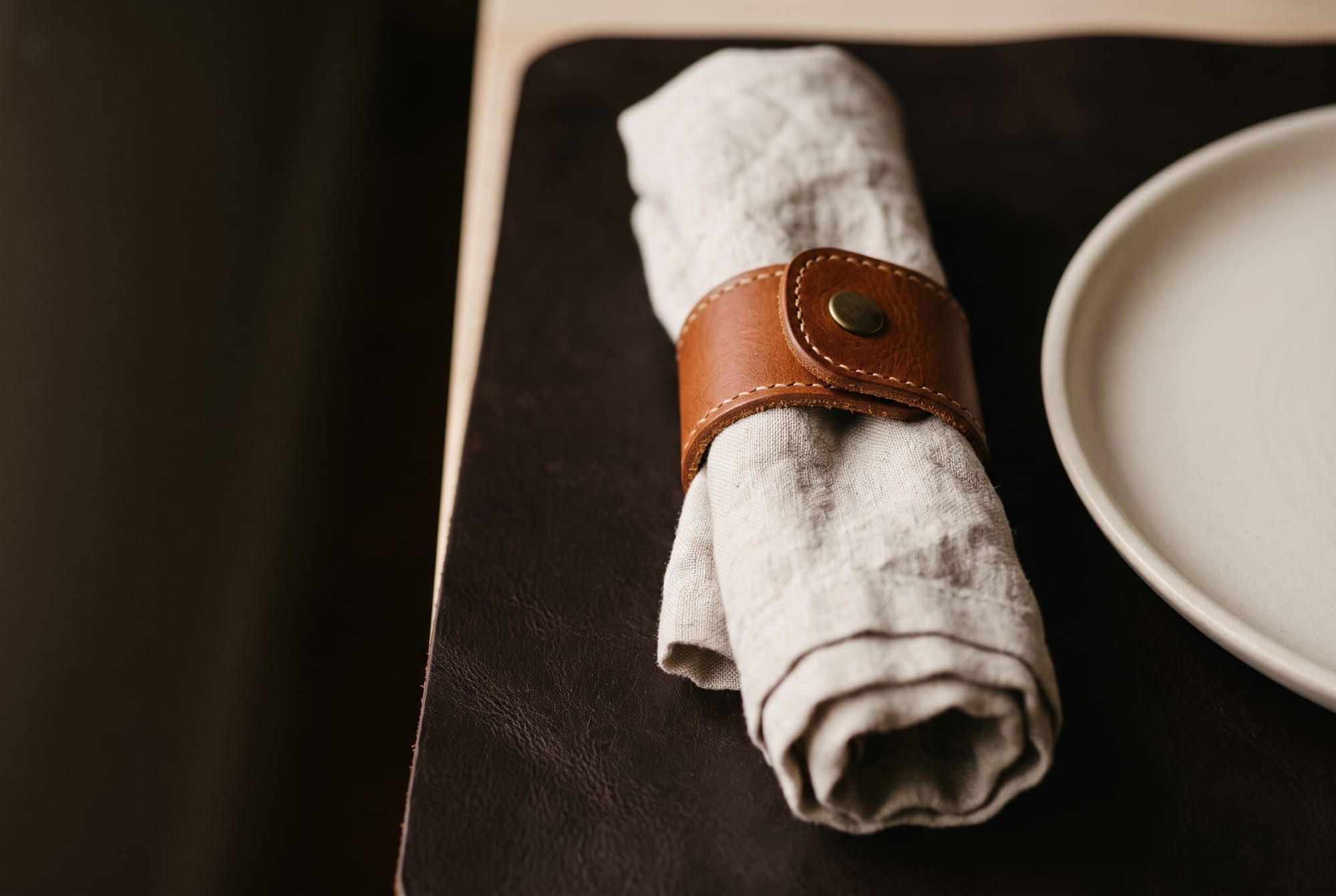
The short answer: measure your napkin rolled before you buy anything. A washed linen napkin rolls to around 45–50 mm across and needs a ring of about 55 mm internal diameter; most rings sold are nearer 40 mm, which is sized for thin banquet napkins. If your napkins are linen, an adjustable leather cuff is the safer buy than a fixed ring, because it fits whatever the laundry has done to the cloth that week.
I came to napkin rings late and sceptically. They looked to me like the most ornamental object in the whole table repertoire — the one thing that does no work at all. I was wrong about that in one specific way, which is the reason I ended up designing some.
It is the top of the stack, and the only cheap place to be bold
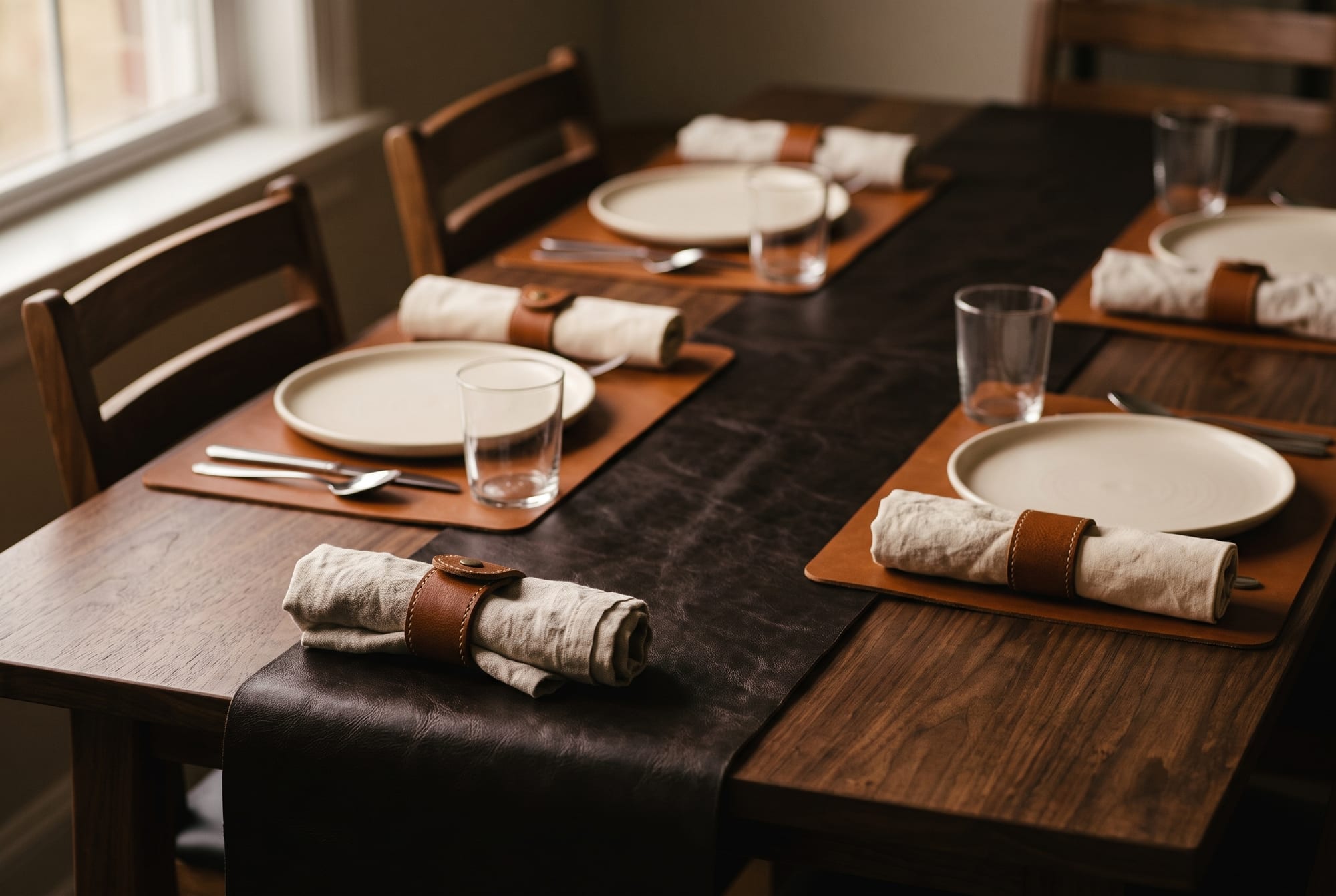
Think about a laid table as a stack rather than a surface. The runner goes down first and sets the temperature of the whole thing. The placemat sits on it and defines a person’s territory. The plate sits on that. The napkin sits beside or on the plate, and the ring sits around the napkin.
So the ring is physically the highest thing on the table apart from the glassware, and it is the only element that is both small and seen at close range from a seated position. That combination is unusual and useful.
Everything underneath the ring has to get along with the room. The ring only has to get along with the napkin, which is why it is the one place on a table where a strong choice costs nothing.
Change the runner and you have changed the dining room. Change the napkin rings and you have changed the table, for the price of six small objects, and you can change them back next week. For anyone who likes the current direction in table setting — layering, mixing materials, letting things not match — this is the lowest-risk entry point there is.
The sizing failure nobody warns you about
Here is the practical core of the piece. Napkin rings are overwhelmingly sized for the napkins used in catering: thin cotton-polyester, pressed flat, folded into a narrow band. Those slide into a 40 mm ring with room to spare.
A domestic linen napkin is a completely different volume. Linen is thick, it does not press flat the way a synthetic does, and it is almost always rolled rather than flat-folded because rolling is what looks relaxed. Rolled, a 45 cm washed linen napkin is a soft cylinder of about 45–50 mm. It will not go through a 40 mm ring, and if you force it, the roll compresses into a hard little baton and looks like a cigar.
Ring, cuff or tie
Three forms, and the difference between them is entirely about whether the circumference can change.
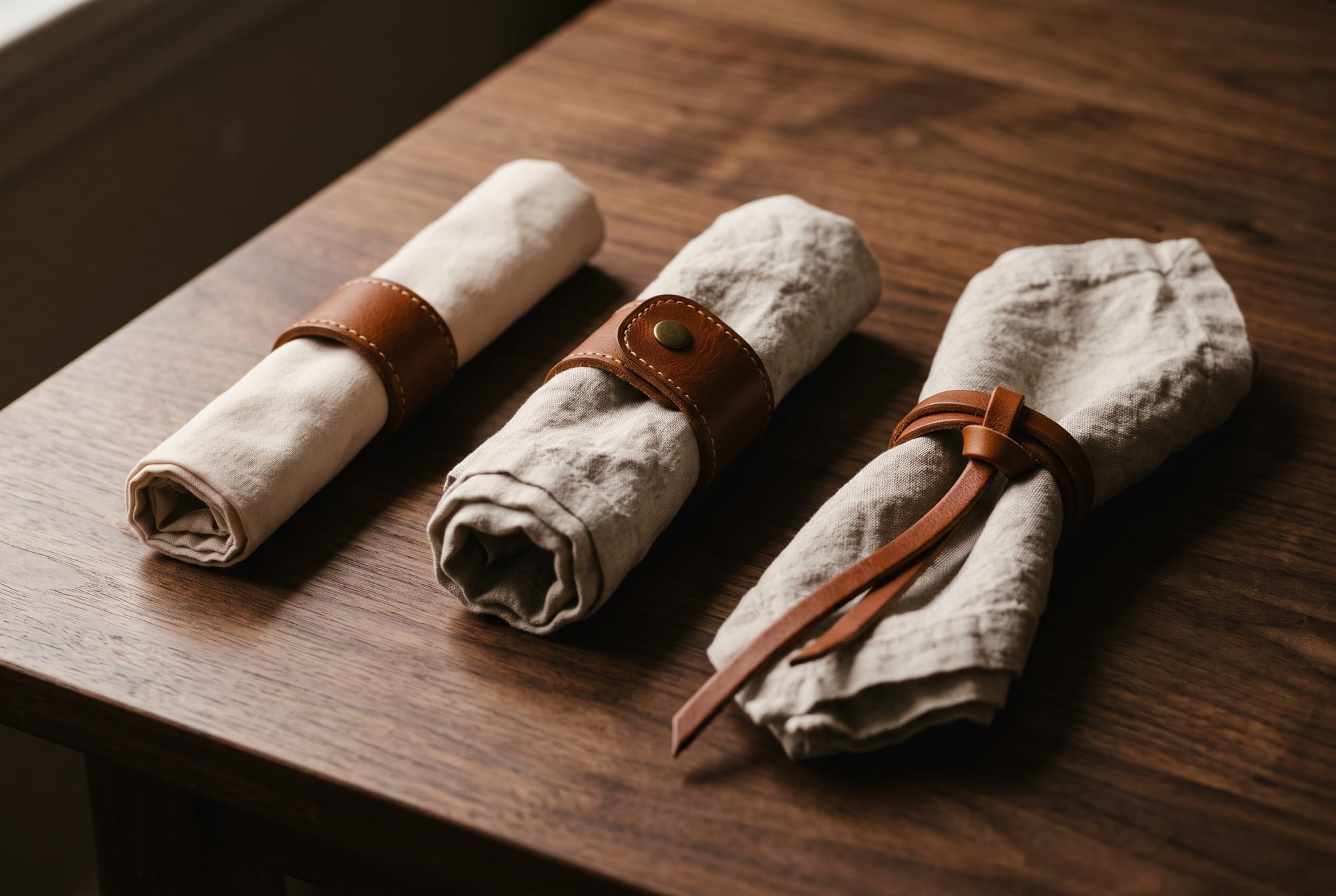
- The ring is a closed circle. One diameter, for ever. It is the cleanest-looking of the three and the most demanding: it has to be right for your cloth, and it stays right only as long as you keep using the same napkins. The upside is that a ring holds a roll perfectly round, which no other form quite does.
- The cuff is a band that overlaps itself and closes with a snap, a rivet or a buckle. The circumference adjusts, usually across two or three positions, so one cuff handles a rolled linen napkin at dinner and a flat-folded cotton one at breakfast. It is also much easier to take off one-handed, which matters more than it sounds.
- The tie is a strap long enough to wrap and knot or thread through itself. Infinitely adjustable, informal, and the only one that works on a napkin folded into an awkward shape. It is also the slowest to lay and the one guests most often mangle.
I design cuffs almost exclusively, and the reason is the laundry. A napkin ring has to come off before the napkin is washed, every time, by whoever is clearing the table — often in a hurry, with one hand, over a pile of plates. A cuff with a snap releases in that situation. A tight ring has to be worked off, and the thing people do when a ring will not come off easily is tug the cloth through it, which is how a linen napkin gets a pulled thread along one edge.
The design brief for a napkin ring is not “hold a napkin”. Every form does that. It is “come off cleanly at the end of the meal”, and that is where the fixed ring quietly loses.
Why leather, against porcelain and cloth
Leather is an unusual material for this job and I think it is a genuinely good one, for reasons that are specific rather than general.
- It is silent. A metal or ceramic ring clicks when it is set down next to a plate, and clinks against cutlery when the table is cleared. On a small table with four people, that noise is a surprisingly large part of how the meal feels.
- It does not mark a plate rim. Anything harder than glazed porcelain can leave a grey scuff on a rim. Leather cannot.
- It does not tarnish. Silver rings need polishing, and because they are small they get polished last and least. Brass goes patchy where fingers touch it. Leather simply darkens, evenly, where hands go — which is the only kind of ageing I actually want on a table object.
- It is the texture the current table is missing. A laid table is mostly smooth and cool: glass, glaze, polished wood, pressed cloth. Leather is the one element that is matte and soft-edged, and in a setting built on layered texture it does more work than its size suggests. That is also the argument in the piece on leather in the home, scaled down to its smallest possible object.
And one honest point against: leather should not go in a dishwasher, a washing machine, or under a tap. If what you want is a table object you can throw in with the napkins, buy wood or steel, and I would not argue.
Colour: read it against the cloth, not the room
This is the mistake I see most in photographs of tables that nearly work. People choose a napkin ring to match the runner, or the chairs, or the floor. But at the scale a ring is seen, it is only ever against the napkin — a band of leather on a field of cloth, a couple of centimetres of contrast.
So the decision is a two-colour decision, and there are really only three outcomes:
- High contrast — dark espresso or black leather on white or oatmeal linen. The ring becomes a deliberate accent and the table looks composed. This is the safest version for a plain table, and the least forgiving of a badly sized ring, because everyone can see the proportion.
- Tonal — cognac on cream, tobacco on sand. The ring reads as texture rather than as an object, and the whole setting goes quieter and warmer. My preference, most of the time, and the right choice if the table already has a patterned runner or a lot of flowers.
- Colour against neutral — burgundy, olive or navy leather on plain cloth. Works beautifully and dates faster, because it ties the table to one palette. Worth it if you own several sets, which at this size is a reasonable thing to own.
The full reasoning about how leather colours behave — and which ones drift as they age — is in the colour guide. The short version for this object: everything moves a shade or two darker and warmer over a few years, so a tonal pairing gets more tonal and a high-contrast pairing stays high-contrast. Neither goes wrong.
How many, and the motif question
Buy for the table you actually lay, which for most households is four or six, plus two. Not twelve. A set of twelve napkin rings is bought once, used once, and stored for a decade, and the two spares in a set of six get used constantly because one always goes missing in the wash.
On motifs — leaves, flowers, initials, seasonal shapes — I have one rule that has never let me down. A motif reads as intentional when it matches something that is genuinely true on the day, and reads as a souvenir when it does not. A maple leaf cuff in October is a seasonal table and looks considered. The same cuff in April is a thing someone bought once. This is why our own motif pieces are deliberately seasonal rather than generic: they are meant to come out for a few weeks and go away again.
Initials are the exception, because they are always true. A monogrammed cuff per person turns a napkin into a place setting and solves the problem of who had which napkin over a long dinner. The monogramming piece covers the technique; at this size, a blind deboss rather than foil, and smaller than feels right.
Living with them
- Take them off before the napkins go in the wash. The only real rule. A leather cuff through a wash cycle is finished.
- Store them away from the napkins, not with them. Folded linen holds a little moisture, and leather pressed inside a stack of damp cloth in a drawer is a textbook setup for the beginnings of mould. A shallow open box or a tray is better.
- Flat or standing, not stacked under weight. A cuff left under a pile of plates takes the shape of the pile.
- Oil and wine are the two spills that matter. Both go for the leather rather than the cloth if they reach it, and oil is the one that does not come out. The protocols are in stain first aid; the summary is blot immediately and never apply water to an oil mark.
- Do not condition them. They are small, they are handled constantly, and hands do the work. A conditioned cuff transfers to a white napkin, which is the one outcome worse than a slightly dry cuff.
What we make
Ours are cuffs: a single piece of leather, saddle-stitched along both long edges, closed with a snap, sized by default for a rolled linen napkin at around 55 mm and adjustable down two positions from there. Some carry a seasonal leaf or flower cut from a second layer of leather and stitched on, and those are made in small runs for the few weeks they belong to. They started as offcuts from the table runners, which is both true and, I think, the right reason for a small object to exist.
If you want a set matched to a particular napkin, roll one, measure across the roll, and send the number with the cloth type through the custom order form. It is a two-minute job to cut to a given diameter, and it is the difference between a ring that gets used every week and one that lives in a drawer.
Quick answers
- What size napkin ring do I need for linen napkins? About 55 mm internal diameter for standard washed linen rolled, 65 mm for heavy linen or damask. Measure across the roll to be sure.
- Ring or cuff? Cuff, if your napkins vary or if the table is cleared quickly. Ring, if you have one set of napkins you love and want the cleanest possible look.
- Can leather napkin rings go in the dishwasher? No. Wipe with a dry or barely damp cloth only.
- Do they need to match the placemats? No, and matching exactly often flattens the table. Same temperature, different value, is the easier rule.
- Are they worth it on an everyday table? More than on a formal one, in my experience. On a plain weekday table they are the only decoration, and they take ten seconds to lay.
Further reading
- How to style a leather table runner: six rules, and the one about the edge
- Leather placemats: a placemat is a boundary, not a decoration
- Leather in the home: the five surfaces and the four pairings
- The leather colour guide: five colours, ten years
- Monogramming leather: blind, foil or paint, and where it can go
- Leather and Turkish needle lace: how we join them, and never with glue