Guide · 6 November 2026 · by Pınar
Leather notebook covers: refillable or bound, and what actually wears out
Every other leather object we make keeps the same job for its whole life. A notebook cover is the only one whose job is to be the permanent part of something consumable — it is designed to outlive its own contents, perhaps twenty-five times over. That single fact should decide almost every choice you make about it, starting with the one measurement nobody takes.
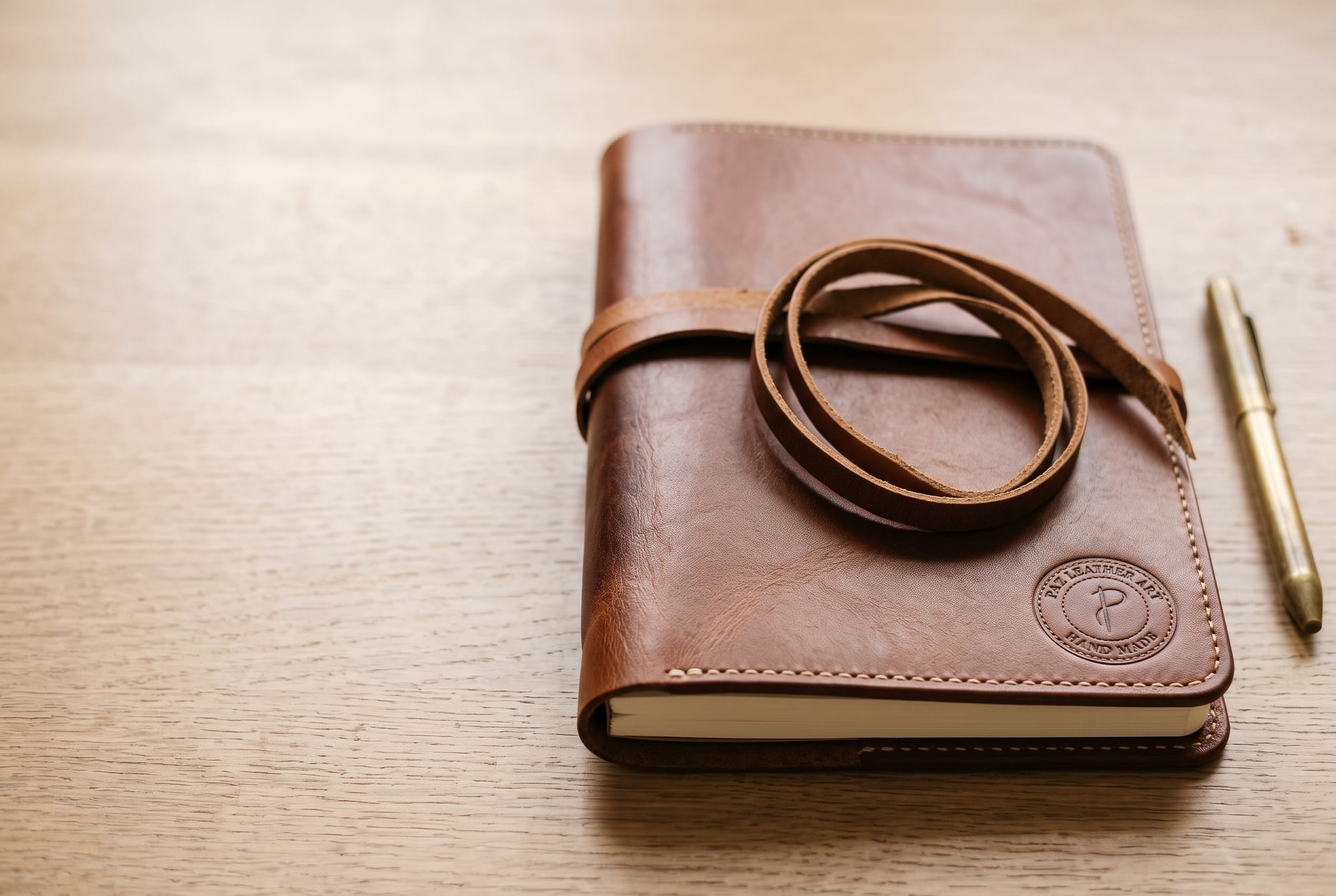
The short answer: buy a refillable cover rather than a bound leather journal, and size it to your insert including the spine thickness, which is the measurement almost everyone forgets. Choose 1.2 to 1.6 mm leather for a cover that folds softly, or 1.8 to 2.2 mm for one that stands up on a desk; thicker than that and it will fight you every time you open it. Prefer corner slots or replaceable elastics to anything glued, and treat the pen loop and the closure as wear parts, because they are.
I keep coming back to this object because it breaks the rule I use for everything else. When I design a table runner or a card wallet, I am designing the thing itself: it arrives, it is used, it ages, and at the end it is still the same object doing the same job. A notebook cover is not that. It is a frame around something that gets used up. Its whole value is that it stays while the thing inside it goes.
The only leather object meant to outlive its contents
Work out how much you write. A person who keeps one notebook going will fill something between one and two a year; a person who takes notes for work will do three or four. Over twenty years that is somewhere around twenty-five notebooks. Then ask what happens to the leather in each case.
I want to be fair to the bound journal, because it has a real argument. A book sewn into its own leather becomes a finished object: it has a date, it sits on a shelf, and in ten years it is a record rather than a tool. People who keep diaries almost always want that. But if you are buying leather because you want leather that ages, the refillable cover wins without a contest — it is the only version where one piece of leather gets twenty years of hands on it instead of eight months.
The measurement everyone gets wrong
Covers that do not fit are almost never wrong in height or width. They are wrong in the spine. A cover sized as though the notebook were flat will close over an empty notebook and refuse to close over a full one, because a 10 mm book needs 10 mm of leather that a flat drawing does not account for.
If you are buying a cover for a notebook you already own, measure that notebook rather than trusting the name on it: “A5” covers a surprising spread once you add a hard back board, and makers differ by several millimetres on the same label. If you are buying a cover first and inserts later, buy for the commonest size you can find locally, because the refills are the part you will be replacing for twenty years.
Four ways a cover holds a book
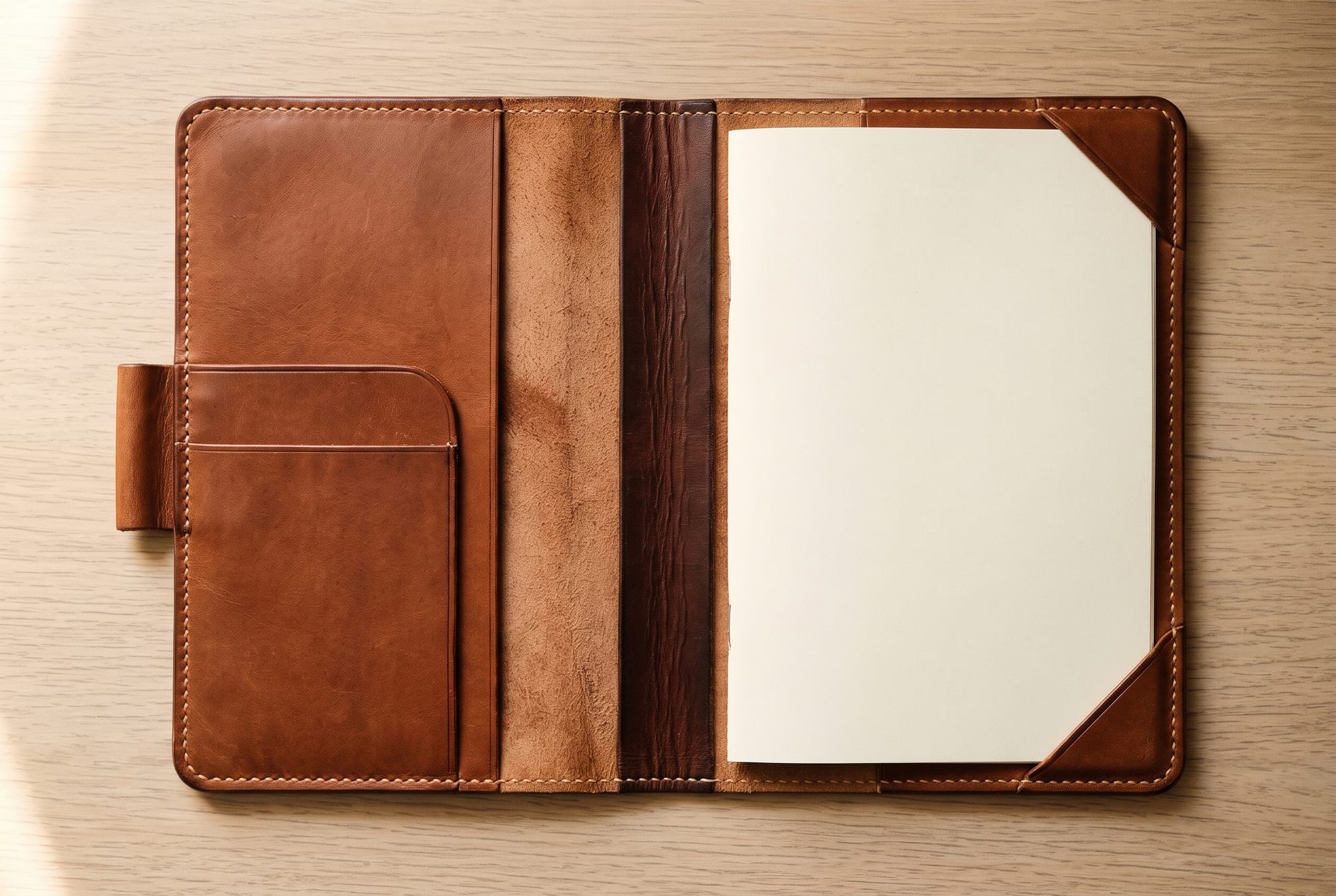
- Corner slots. Four leather triangles that the front and back boards slide into. Secure, completely reversible, nothing to perish, and the book sits flat. The drawback is that it only takes one notebook, and a very thick one is a struggle to insert.
- Elastics through the spine. The traveller's-notebook system: one or more cords running down the inside of the spine, each holding a stapled insert. Takes two or three booklets at once, swaps in seconds, and lets you carry a diary and a notebook together. The elastic is a consumable, and that is fine if it can be replaced through holes rather than being glued in.
- A stitched-in spine or sewn signatures. Properly bookbound: lovely, permanent, and no longer refillable in any practical sense. This is the bound journal by another name.
- A clamp, ring or disc mechanism. Pages can be reordered and individual sheets removed. Genuinely useful for some kinds of work, but you are now buying a piece of hardware with leather around it, and the hardware is what will fail — the same reasoning as in leather bag hardware.
For most people the honest ranking is corner slots for one notebook, elastics if you carry more than one, and the other two only if you specifically want what they do.
Thickness, and why the fold is the whole object
A notebook cover folds in half every time it is opened and closed, which is several times a day for years. That makes it closer to a belt than to a table runner: the material has to be chosen for a hinge, not for a surface.
- 1.2 to 1.6 mm: a soft wrap cover. Folds immediately, drapes around the book, goes limp and personal within months. Best for a cover that lives in a bag.
- 1.8 to 2.2 mm: a structured cover. Holds its shape, protects the corners of the paper properly, stands on a desk. Takes a few weeks to loosen at the spine.
- Over 2.5 mm: too much. It will not fold cleanly over a thin insert, it springs open, and the closure has to fight it. If a maker offers a 3 mm cover, ask whether the spine has been skived.
That last word is the detail that separates a considered cover from a cut rectangle. Skiving — thinning the leather along the spine band and at the turn-backs — lets a thick cover fold like a thin one while keeping its body everywhere else. You can feel it: run a thumb across the spine from outside and the leather should step down gently and come back. The general case for choosing a thickness by the job rather than by feel is in leather thickness.
Closures and pen loops, which are both wear parts
No closure at all is a real option and my own preference for a soft cover: the leather holds itself shut once it has taken the shape of the book. For everything else:
- A wrap strap and stud is the most durable, adjusts as the notebook fills, and ages with the rest of the piece. It is also the slowest to use.
- An elastic band round the fore edge is quick and holds a fat notebook, but elastic perishes — expect three to five years. Check that it is replaceable before you buy; one that disappears into a glued channel is not.
- A button or stud through a punched hole is simple and strong, but it is sized for one thickness of notebook and will be wrong when the book is full.
The pen loop deserves a sentence of its own, because it is the first thing that goes on almost every cover. A loop stretched by a fat pen never comes back, so size it to the pen you actually use, and prefer a loop stitched at both ends to one held by a single rivet. If it is elastic, the same three-to-five-year arithmetic applies.
Lined, or not
An unlined cover is one piece of leather: lighter, more flexible, and the flesh side inside darkens and polishes with use into something rather beautiful. A lined cover is stiffer, hides the back of the stitching, and gives you somewhere to put pockets — but it is also two materials glued together, which is one more thing that can part at the fold. For a cover that will be opened thousands of times, I would take unlined unless you specifically want inside pockets. The trade-offs in full are in lined or unlined.
On tannage, this is one of the few objects where I would argue firmly for vegetable-tanned leather rather than treating it as a preference. A cover is handled more than almost anything else you own, always in the same places, and veg-tan rewards exactly that: the spine and the front corner darken first, and within a year the object is visibly yours. The comparison is in vegetable-tanned vs chrome-tanned.
What ages, and in what order
Covers wear in a very predictable sequence, which is useful when you are judging a second-hand one or deciding how much to spend.
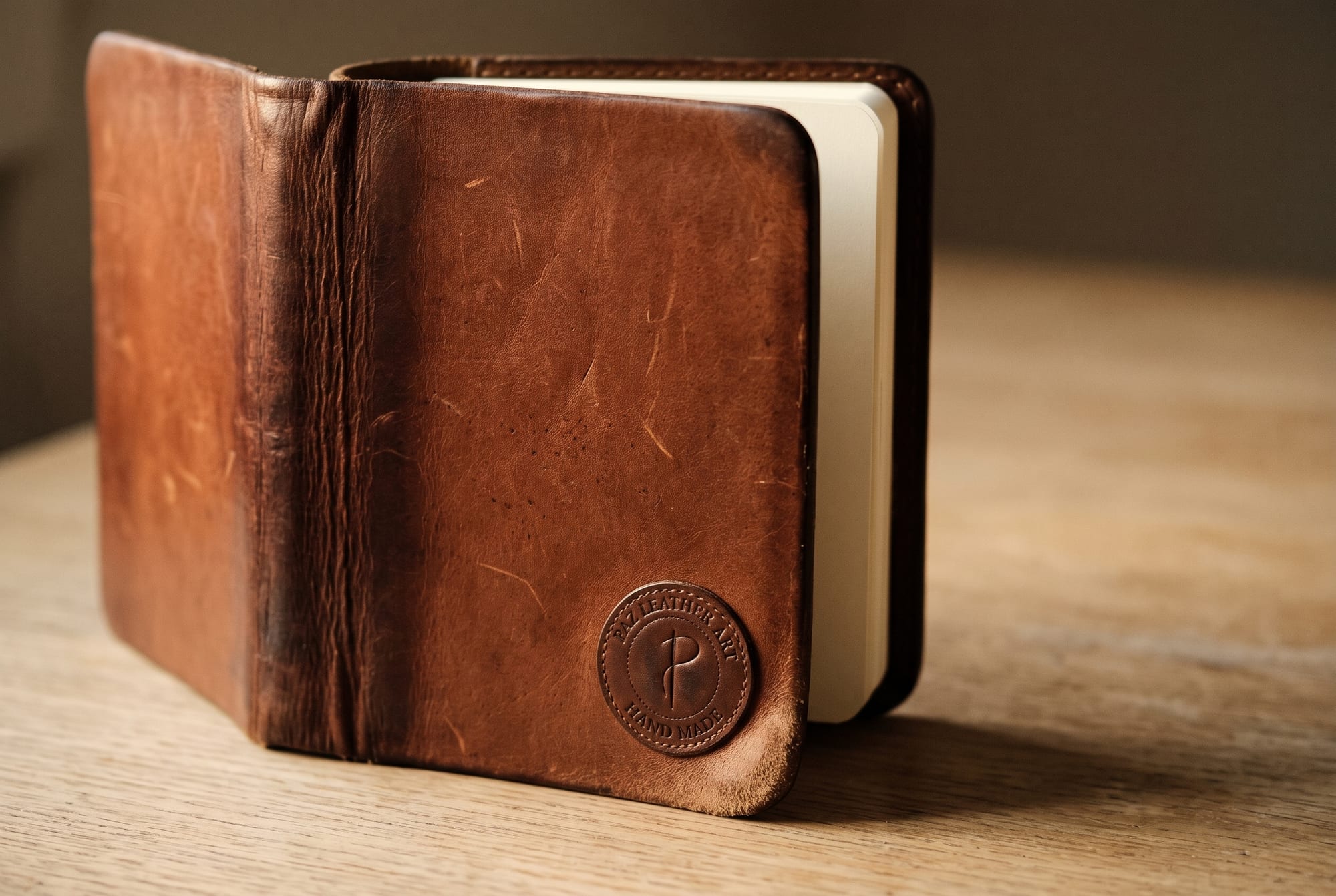
- The spine darkens within months, because it is where the hand holds it and where the leather flexes. On veg-tan this is the whole pleasure of the object.
- The front lower corner rubs, from being pushed in and out of bags. It will go slightly paler and softer; on a burnished edge this renews with a thumb.
- The elastic or pen loop gives up, somewhere between three and five years. Replaceable on a good cover, terminal on a glued one.
- The corner slots stretch gently and stop gripping a thin notebook as firmly. This takes many years and is usually solved by the next, slightly thicker insert.
- The spine fold eventually creases through the grain — fine, even lines, not cracks. If it is cracking rather than creasing, the leather was too thick, unskived, or has been allowed to dry out.
Note what is not on that list: the leather itself, anywhere except the fold. Which is the point of the whole object.
Six things to check before buying
- Does it open flat? Press it down on a table. A cover that springs back will annoy you daily.
- Is the spine skived or at least thinner than the panels? Feel it from the outside.
- Can the elastic and pen loop be replaced? Look for holes and stitching rather than a glued channel.
- Is there ease for a full notebook? Ask, or put your own full notebook in it before paying.
- Are the corners of the slots stitched or only glued? Glued slots lift first.
- Is the edge burnished or painted? On an object handled this much, a burnished edge renews and a painted one chips. The difference is in burnished or painted edges.
A note on what we make
A notebook cover is not in our standing collection, and I would rather say that plainly than imply otherwise. It is, however, the piece people ask us about most often after the tool rolls, because it belongs to the same family: a flat panel, a fold, and a way of holding something. When someone asks, the three things we need are the page height, the page width and the spine measured with the notebook full — and if you want two inserts, the spine measured with both of them stacked. Everything else is a conversation about leather and size.
If you are choosing between this and a desk piece for the same person, the two are more different than they look. A desk pad is a surface that stays put and ages evenly across its whole face. A cover is a hinge that goes in a bag and ages in three places. They want different leather, and they make quite different gifts.
Quick answers
What size leather cover do I need for an A5 notebook? For a 148 × 210 mm insert with a 10 mm spine, the flat leather panel is roughly 316 × 216 mm before turn-backs and slots: twice the page width, plus the spine, plus about 10 mm of ease, by the page height plus 4 to 6 mm.
Is a refillable cover better than a bound leather journal? For most people, yes, because one piece of leather gets twenty years of use instead of eight months. A bound journal is the better choice if you want each finished book to become a keepsake.
How thick should a leather notebook cover be? 1.2 to 1.6 mm for a soft cover that folds immediately, 1.8 to 2.2 mm for a structured one. Thicker than 2.5 mm will not fold cleanly unless the spine has been skived.
How long does the elastic last? Typically three to five years, less if it is kept stretched around a very full notebook. Buy a cover whose elastic runs through punched holes so it can be replaced.
Further reading
- Leather thickness: what an ounce means, and why thicker is not better
- Lined or unlined: what a lining is actually for, and what it hides
- The leather desk pad: what it does for a desk, and how it ages
- Burnished or painted edges: what the edge of a leather piece tells you
- Vegetable-tanned vs chrome-tanned: what the tannage decides
- How to choose a leather gift, by the person rather than the object