Guide · 19 September 2026 · by Pınar
The leather desk pad: what size to buy, and what it becomes in five years
The desk is the last surface in most homes that nobody designed. The table got a runner, the sofa got a throw, the floor got a rug — and then there is a rectangle of laminate with a laptop on it, in the corner of a room that is now also an office. A desk pad is the cheapest piece of interior architecture you can buy. It is also the one people most reliably buy in the wrong size.
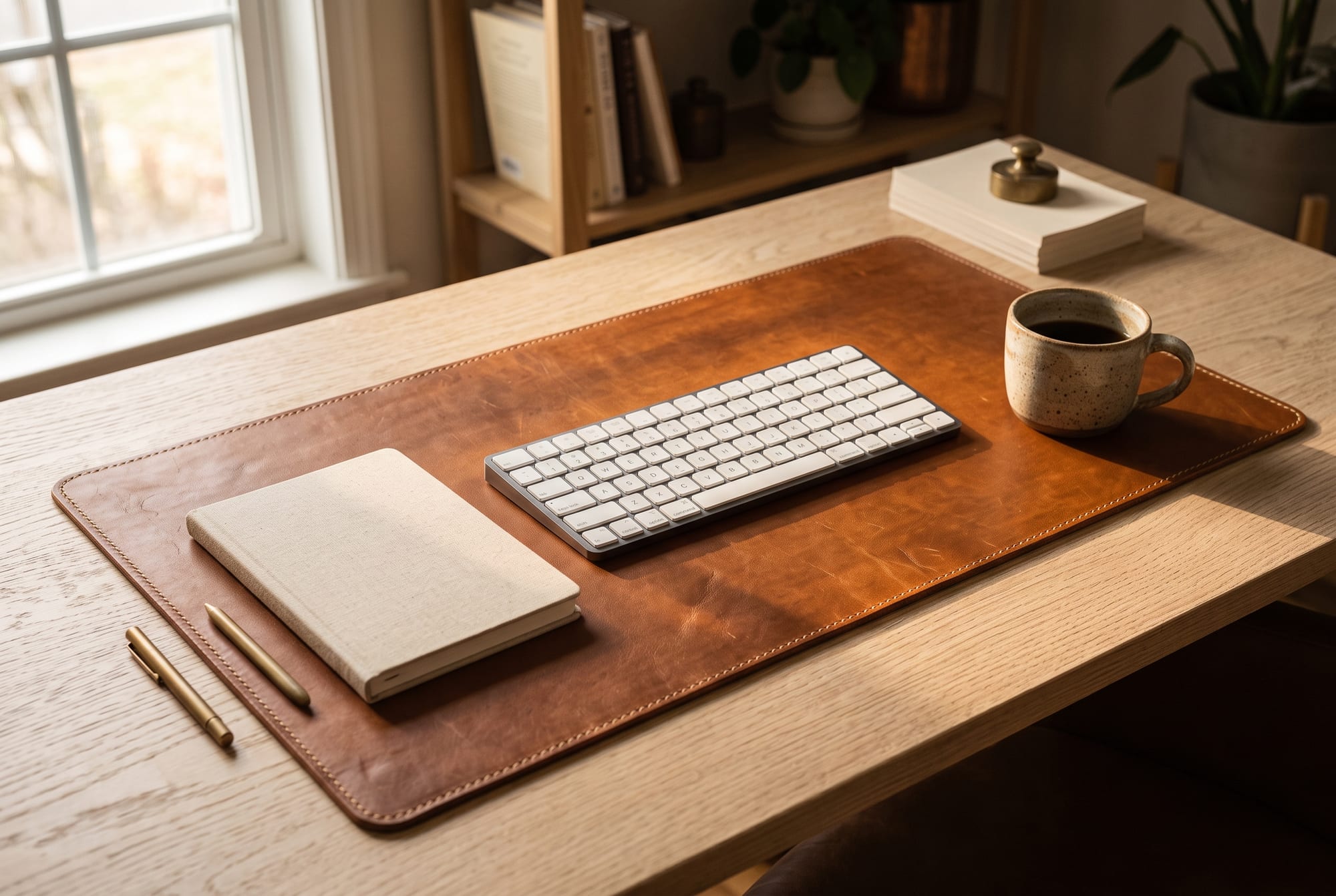
I have spent most of my working life drawing rooms, and the thing I notice about the home offices people send me photographs of is never the furniture. It is that the desk has no edges. Everything simply floats on it — the laptop somewhere near the middle, a mug wherever there was room, cables arriving from three directions. The eye has nothing to hold on to, so the whole corner reads as clutter even when there are only four objects on it.
A desk pad fixes that before it does anything else. It draws a boundary, and inside the boundary things suddenly look arranged rather than abandoned. This is exactly the argument I have made about placemats and about a table runner, and it is the same mechanism: a defined field makes ordinary objects look composed.
Four jobs, only one of which is protection
People buy a desk pad to protect a desk. That is the least of it, and if it were the only job a sheet of felt would do.
- It gives the desk a centre. The pad becomes the work surface and the desk becomes the surround. Everything outside the pad now reads as deliberately outside it, which is why the same clutter looks tidier the moment a pad arrives.
- It quiets the desk. This is the one nobody anticipates and everyone notices. Two to three millimetres of leather under a keyboard takes the hard clatter out of typing, stops a mug landing with a knock, and softens the small percussion of a day at a desk. On a glass or laminate desk the difference is startling.
- It warms a cold surface. Glass and laminate stay several degrees below the room and feel it under a forearm, especially in winter. Leather takes your temperature within a minute and holds it.
- And yes, it protects — in both directions. The desk is spared pen pressure and mug rings; the laptop is spared the grit that lives on every hard surface and quietly polishes scratches into aluminium.
Three numbers
Here is where most of them go wrong. A desk pad that is too small does not read as a smaller pad. It reads as a mistake — a mat marooned in the middle of a desk with a mouse falling off the side of it.
Depth is the number that matters, and it is the one that is always cut. Forty centimetres is my floor. The reason is simple and physical: your forearms rest at the near edge, and if the pad stops before they do, you spend the day with a two-millimetre step running across both wrists. You will not consciously notice it for a week and you will never stop feeling it. A 30 cm pad is a laptop mat, not a desk pad.
Width is decided by the mouse, not the keyboard. A keyboard is around 36 cm; people then buy a 60 cm pad and wonder why the mouse keeps sliding off onto the wood. A mouse needs roughly 30 cm of travel to the right of the keyboard for ordinary work. That puts the honest minimum at 80 cm, and 90 is the size nobody outgrows.
And leave the desk visible. This is the rule I have to argue for most often. The instinct is to cover the whole desk, and it always makes the desk look smaller and the room look heavier. Five centimetres of bare wood on three sides gives the pad an edge to be an object against — the same reason a rug that stops short of the skirting makes a room read as larger. If your desk is 120 cm wide, a 90 cm pad is right. If it is 140, go to 100 and stop.
Which leather, and how thick
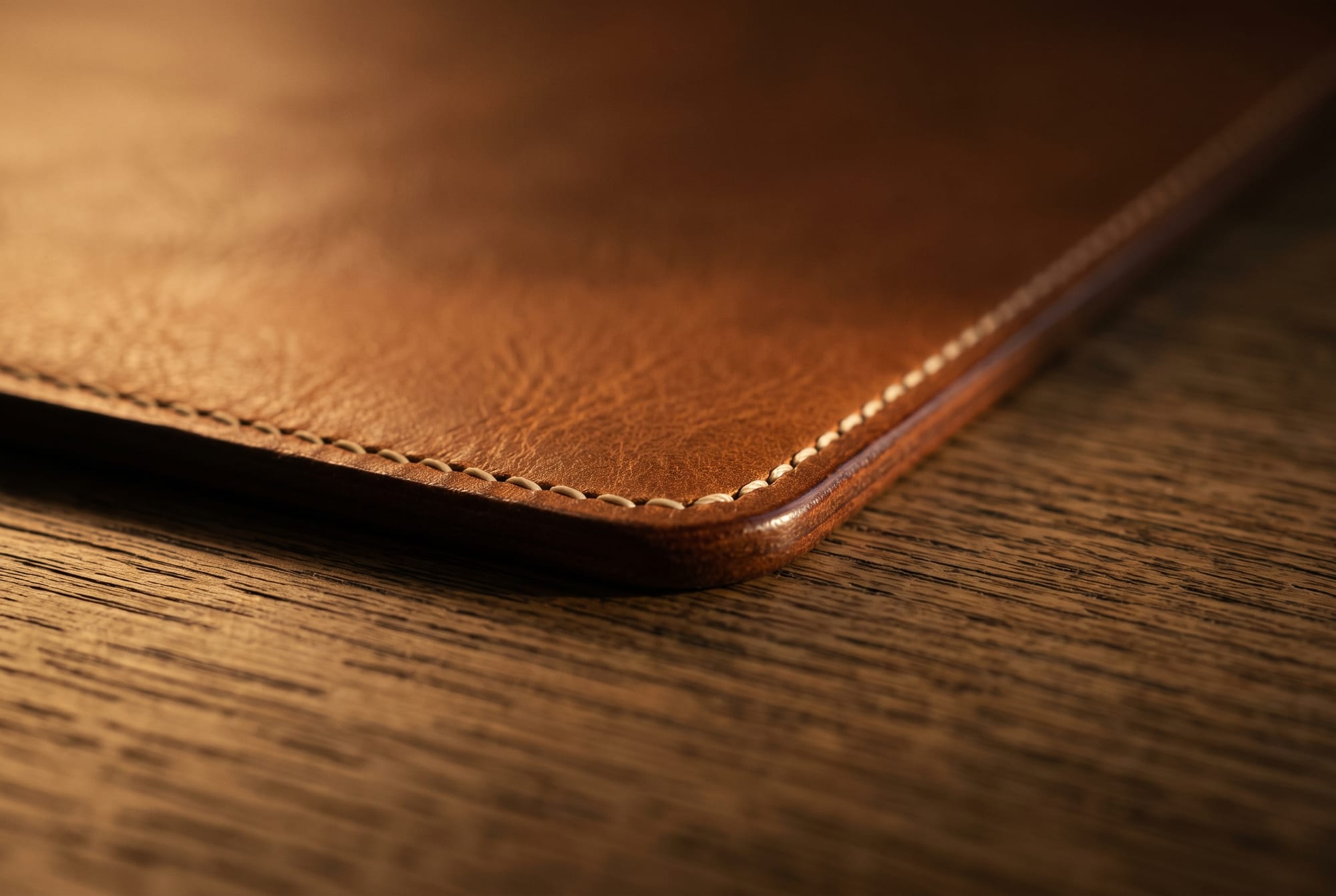
A desk pad is a flat object, and flat objects have nothing holding their shape but their own stiffness. That puts it in the same bracket as a placemat: 2 to 3 millimetres, which is 5–6 oz in the weight ladder. Thinner and the corners lift; much thicker and the pad stops being a surface and starts being a plinth, with an edge your wrist has to climb.
On the finish, there is a genuine trade-off and I would rather set it out than pretend there is not. An uncoated, aniline hide — what we work in — will take the impression of a ballpoint through a single sheet of paper, permanently. It will also darken beautifully, take a mug ring as a shadow rather than a stain, and look like something after three years. A coated pad will stay pristine and stay dead. Which you want is a real question, and it depends entirely on whether you write on paper at your desk or only type.
One thing that is not a trade-off: whatever is underneath matters as much as the leather. A single layer of hide on a hard desk slides. A pad wants either a suede or felt backing, or enough weight to stay put. If you are looking at a listing that does not mention the back at all, it is a single layer, and it will travel across the desk every time you push the keyboard.
What it looks like after five years
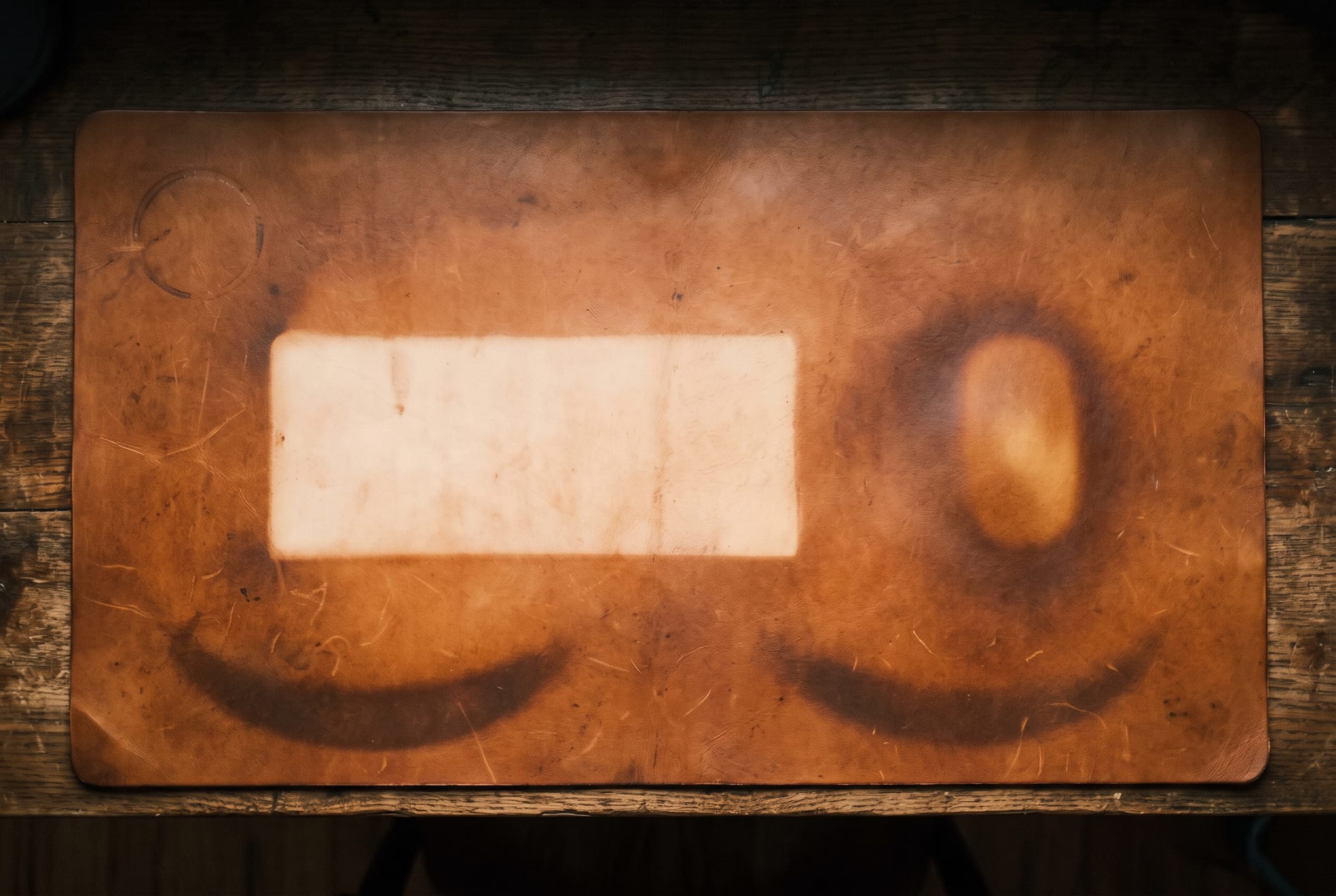
This is the part I find genuinely lovely about leather on a desk, and it is the reason I would not use anything else there. A desk pad wears in a pattern that is a drawing of how you work. Nothing else in a home records a person quite so precisely.
The three things that actually ruin one
Very little goes wrong with leather on a desk, which is part of the appeal. But there are three, and one of them is specific to desks in a way that catches people out.
- Half of it in the sun. Desks live under windows. If a window puts a hard line of daylight across part of the pad for hours a day, that part will fade at a different rate and you will end up with a permanent bright stripe with a visible boundary. Even light is not the problem — a room's daylight simply darkens the whole thing evenly, which is the good version. It is the edge of a sunbeam that does the damage. If you cannot move the desk, turn the pad end for end twice a year.
- Hand sanitiser and alcohol wipes. The most desk-specific hazard there is, and it lives next to the keyboard in half the homes I visit. Alcohol strips oils and dyes out of an uncoated hide on contact and leaves a pale blotch with a hard edge. It belongs on the other side of the desk, off the pad — along with everything else on the list of things that should never touch leather.
- A laptop running hot, in one place, forever. Not a crisis, but worth knowing: sustained warmth dries the hide beneath it faster than the rest, and over years that patch goes stiffer. If your laptop lives on the pad rather than on a stand, feed the pad once a year and it will never become an issue.
Otherwise the care is nothing: wipe it with a dry cloth, condition it lightly once a year, and follow the ordinary care routine. Do not oil it more than that — a saturated pad picks up dust and holds it.
The gift nobody buys for themselves

A note on why these appear under so many trees in December. A desk pad sits exactly in the gap that makes a good present: it is used every single day, it is immediately visible to the person using it, and almost nobody buys one for themselves — because a desk works fine without one, and the argument for it is aesthetic and tactile rather than functional. You cannot want one until you have used one.
Two practical notes if you are buying one as a gift. Measure the desk first, or at least photograph it with something of known size on it; the sizing rules above fail silently if the desk turns out to be 100 cm wide. And if you are tempted by a monogram, put it in a corner, small, and in blind embossing rather than foil — initials in gold across the middle of a desk pad are the fastest way to make an object the recipient has to be polite about.
We do not stock desk pads in fixed sizes, so this is written as a buying guide rather than a sales pitch — the rules hold whoever you buy from. If you want a second opinion before you commit, send me the width of the desk and a photograph of the corner it lives in and I will tell you what size to get, even if you buy it elsewhere: info@pazleather.com.
What I would say, having had one on my own desk for years: it is the only object in the room that has got better since I bought it. Everything else has merely survived me.
Further reading
- How to decorate with leather: five surfaces and four pairings
- Leather placemats: what size to buy, and what hot plates really do
- Leather thickness: what an ounce means, and why thicker is not better
- Aniline, semi-aniline, pigmented: what a leather’s finish actually decides
- Patina: the story your leather writes about you
- Glossary: patina