Guide · 9 November 2026 · by Zafer
Wet-moulded leather: how a flat hide becomes a bowl
A leather bowl with no seam in it was not cut to that shape. It was wetted, pulled over a form and dried there, and the drying is the part that matters. Here is what happens inside the hide, why only one kind of tannage will do it, and the one thing you must never do to the finished object.
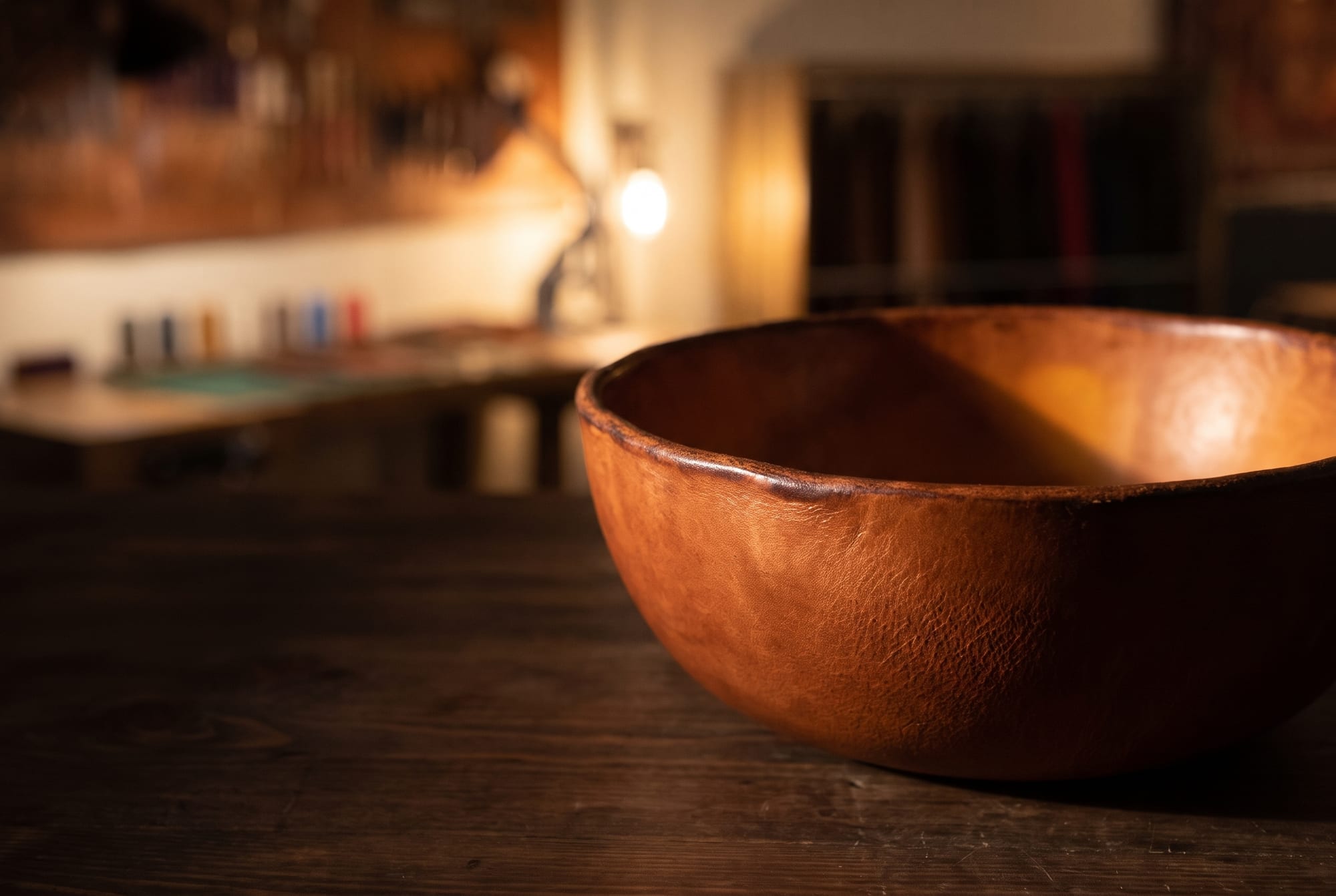
The short answer: wet moulding works because water is a plasticiser for collagen. Damp leather lets its fibre bundles slide past one another, so it can be forced over a form; as it dries, the bonds between those fibres re-form in their new positions and the shape becomes the leather’s new resting state. It only works properly on vegetable-tanned leather, the drying must be slow and cold, and the finished piece must never be soaked again — water is the one thing that can undo it.
Sculptural leather has had a conspicuous year. Seamless vessels, pressed wall pieces and moulded furniture details turned up at Milan and at Dutch Design Week, and in every write-up the same phrase gets used as though it explained something: wet-formed. It does not explain anything. It names a step.
I want to go through what that step actually is, because it is one of the few processes in leatherwork where the physics is simple enough to describe honestly in a few paragraphs, and knowing it tells you exactly how to look after the object afterwards — and how to tell a formed piece from a leather skin wrapped round a resin shell.
A bowl with no seam has been through water
Start with the giveaway. Leather arrives flat. Any leather object with volume got it in one of three ways: it was cut and joined, so there are seams or darts where the flat pieces meet; it was stuffed or lined into shape over something else, so the shape belongs to the thing inside; or it was wet-moulded, where a single flat piece was made to curve in two directions at once and then kept there.
Only the third one gives you a continuous curved wall with no join. If you are looking at a leather bowl and you cannot find a seam, a dart, a glued lap or a stitched rim, you are looking at a piece that was wet.
Cutting and stitching makes a shape out of flat parts. Wet moulding makes the flat part itself stop being flat. They are not two routes to the same object.
Why water lets leather move, and why drying stops it
Leather is not a sheet of material. It is a three-dimensional felt of collagen fibre bundles, woven tightly and at a steep angle near the grain surface and more loosely and horizontally towards the flesh side. That structure is why the same hide behaves differently at different thicknesses, and it is the whole mechanism here.
Those fibres are held in place relative to each other by hydrogen bonds. Water competes for those bonds. Wet the leather through and a large number of them let go, which does not dissolve anything — the fibres themselves are untouched — but it does mean the bundles can now slide past one another instead of holding their weave. The leather becomes, briefly, formable: you can stretch it, compress it, and push it into a curve it could never take dry.
Then you dry it in that position, and the process runs backwards. As the water leaves, the bonds re-form — but the fibres are now in different places, so the bonds form there instead. In vegetable-tanned leather the bulky plant tannins already bound to the collagen act as spacers and anchors through all of this, and they are the reason the new arrangement sets hard rather than relaxing.
The piece comes off the mould noticeably stiffer and harder than the flat hide you started with, because the fibres have also been compacted: squeezed closer together, with less air between them, in the areas you worked hardest. A well-formed wall will ring faintly if you tap it with a fingernail. That is the sound of a density change, not a coating.
Casing: the step that decides everything
The commonest mistake, and the one I made for the first year, is to think of this as soaking. It is not. The target state has a name — cased — and it is specific: damp all the way through the thickness, no free water on the surface, noticeably cooler to the back of the hand than dry leather, and a shade or two darker than it started.
You get there with a brief dip in cool water, a few seconds for 2 mm, perhaps half a minute for 4 mm, and then you wait. The wait is the real step. Left in a bag or wrapped in a cloth for twenty minutes or so, the water distributes itself evenly through the thickness. Formed straight out of the water, the outside is saturated and the core is dry, and the two layers then try to take different shapes.
Two things to keep away from it. The first is hot water. Collagen has a shrinkage temperature, and for vegetable-tanned leather it sits somewhere around 70–80 °C when wet; go near it and the fibres contract and gelatinise, and what you get is a smaller, brittler, permanently ruined piece. This is the same ceiling that makes heat so much more dangerous to leather than water, and wet leather has far less margin than dry.
The second is time. Leather left wet for hours starts to give up its tannins into the water, which leaves pale patches, and the warm damp is an invitation to the beginnings of mould before the piece is even finished.
What the mould actually does
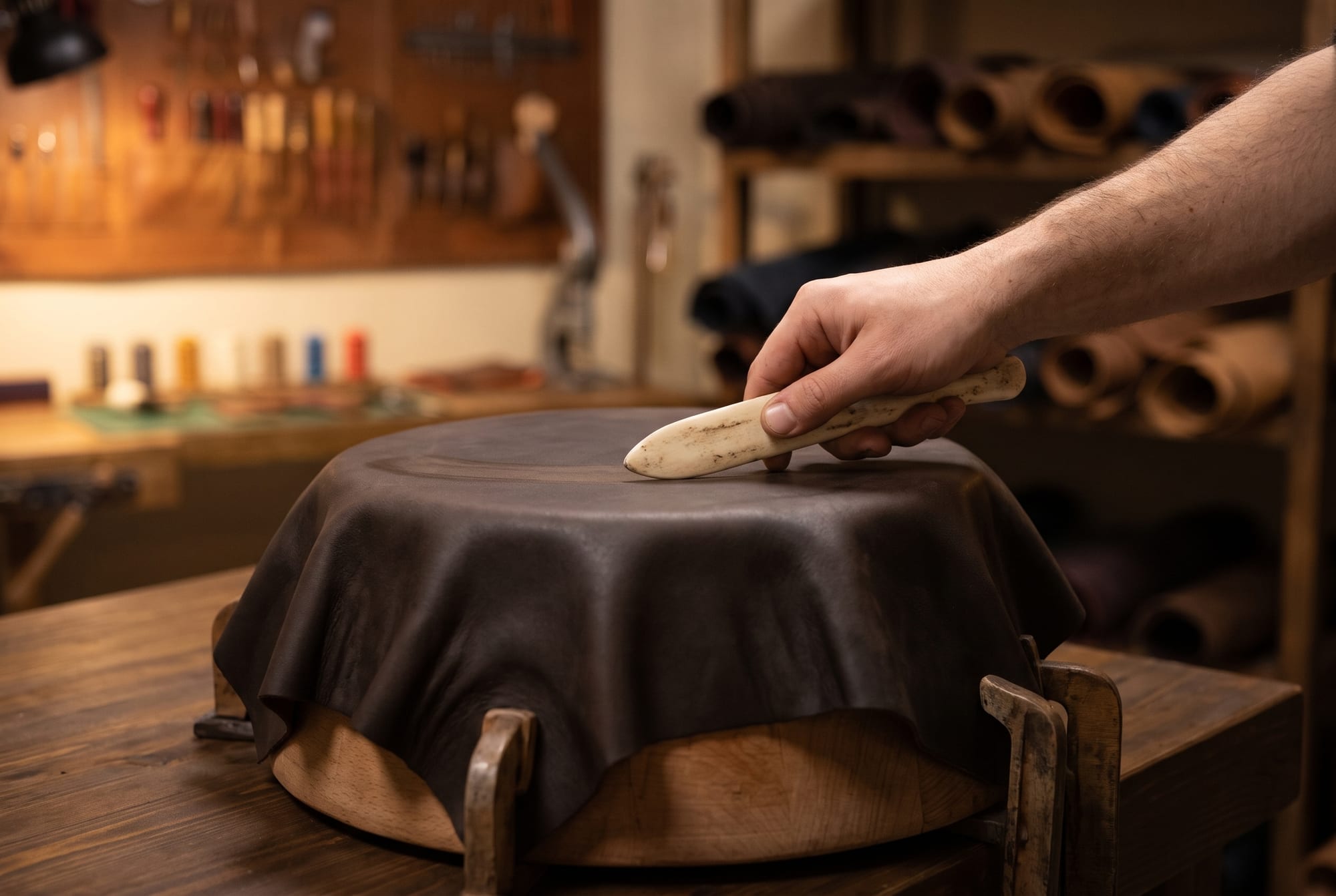
A mould is not a cookie cutter. It is the thing that holds the leather still for a day while the water leaves, and most of its design is about that day rather than about the shape.
- It has to let go. Leather shrinks slightly as it dries, which means it grips the form harder and harder as the hours pass. A straight-sided mould can be impossible to get the piece off without tearing the rim. Working moulds are tapered, or made in parts that come out one at a time.
- It has to breathe. If the leather is sealed against a non-porous surface, the side touching it dries last and sometimes not at all. Wooden moulds work partly because they take water out of the back of the leather.
- It decides where the leather thins. Stretching is not free. Wherever the draw is deepest, the leather gets thinner — a 3 mm hide can come out near 2 mm at the bottom of a steep curve. This is why a bowl is formed from a thicker piece than its wall thickness suggests, and why a deep narrow shape needs a hide that started heavier than a shallow wide one.
- It cannot fix slack. Any fullness you fail to work outwards while the leather is damp becomes a permanent wrinkle, because drying sets wrinkles exactly as faithfully as it sets curves.
This is also where a workshop and a factory diverge. The sculptural pieces in the design-week reports are often made with a hydraulic or vacuum press, which forces the leather into a two-part mould in one movement and gives crisp, repeatable geometry. By hand you get there slowly, with a bone folder and your thumbs, and the result carries small irregularities at the rim that a press removes. I prefer the hand version, but I would not claim it is more accurate. It is less accurate, on purpose.
Which leathers hold a shape, and which only pretend to
This is the part worth knowing before you buy anything described as moulded, because the word is used freely and only one tannage genuinely does it.
The reason sits in what the two tannages do to the fibre. Vegetable tanning deposits large phenolic molecules throughout the fibre structure, which is why veg-tan is firm, takes a stamp, burnishes, and sets when dried under tension. Chrome tanning cross-links the collagen with mineral salts and leaves the fibres far more lubricated and mobile, which is exactly what you want in a soft garment hide and exactly what you do not want here. Wet a chrome-tanned offcut, pull it over a form, dry it, and it will come off looking vaguely domed and be flat again in a fortnight.
The three ways a moulded piece is faked
None of these are illegal and one of them is even reasonable. But they are different objects, priced as though they were the same one.
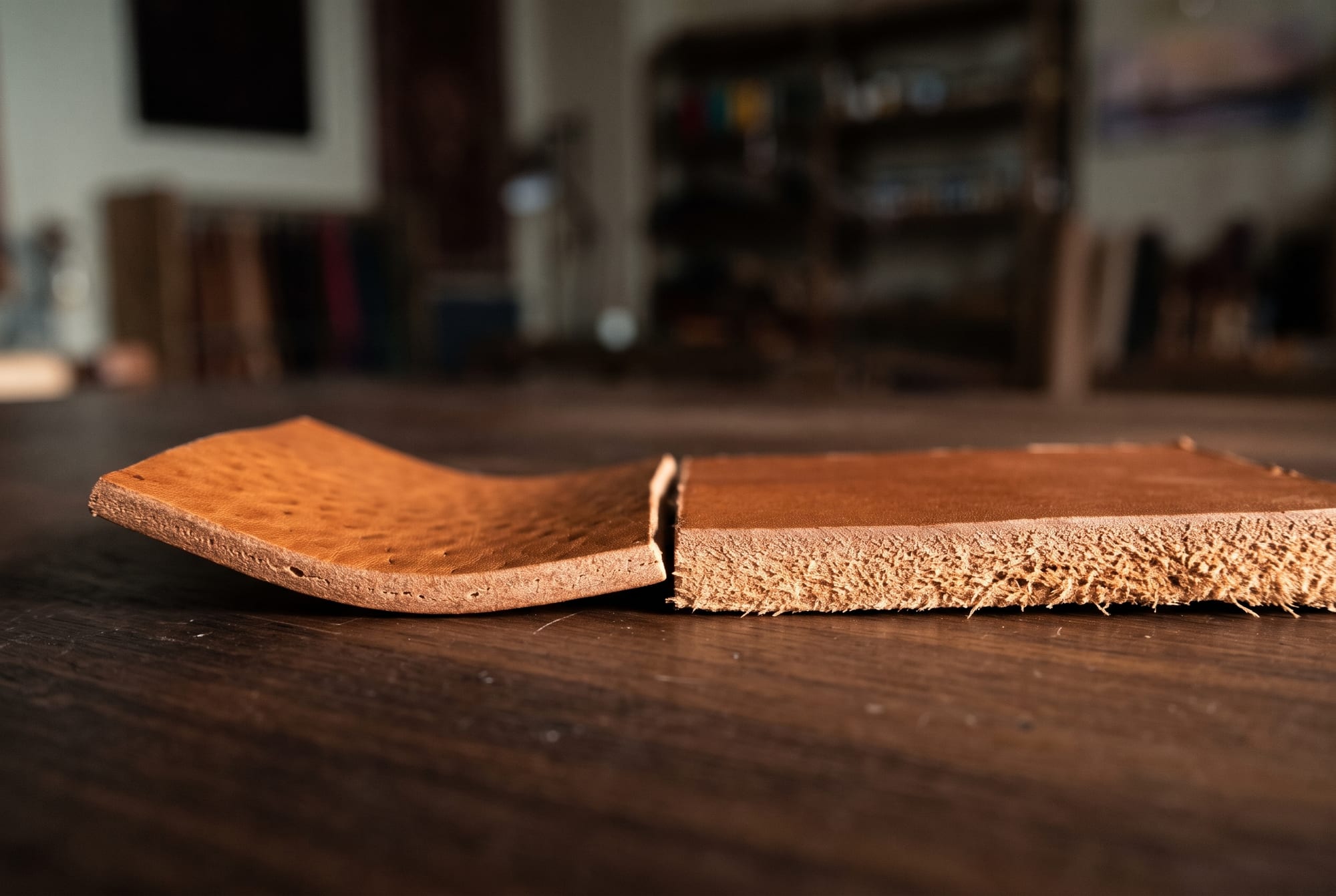
- A leather skin over a shell. A thin hide, often chrome-tanned, glued over a moulded plastic, resin or papier-mâché body. Tell: look at the inside. A wet-formed piece is the same leather inside and out, with the flesh side visible and a continuous curve; a wrapped one usually has a different material, a lining disc, or a glue line where the skin was turned over the rim.
- Stiffened rather than formed. A soft hide saturated with latex, PVA or a shellac-type stiffener and dried in a shape. Tell: press the wall hard with a thumb. Wet-formed veg-tan is firm and springs back with a faint click; a stiffened piece feels dead, creases with a pale line, and often smells faintly of the binder.
- Pressed board with a grain print. The bonded material from the table above, pressed into a tray shape. Tell: the cut edge at the rim. A hide has a visible structure through its thickness, denser at the grain and more fibrous towards the flesh; bonded material has an even, chalky core, exactly as described in the piece on what the word “leather” actually promises.
There is a fourth category I will defend: pieces that are genuinely wet-formed and have a discreet internal stiffener at the rim, because a rim is where a formed vessel loses its shape first. That is engineering, not deception, as long as nobody pretends the leather is doing all the work.
Living with one: the single rule
Everything above leads to one piece of care advice, and it is unusually absolute for this Journal.
A wet-moulded piece holds its shape for exactly as long as it stays dry. Water is not a stain risk here. It is a reset button.
Soak a leather bowl and you are not cleaning it, you are repeating stage two of the process — and this time there is no mould inside it and nobody working the slack outwards. It will sag, the rim will go wavy, and it will dry into a slumped version of itself. A splash wiped off promptly is nothing. A rinse under a tap is the end of the object’s geometry. The general advice in the piece on leather and water holds here too, but with a much shorter fuse: for a formed object, soaking is a structural event rather than a cosmetic one.
So the rules are short. Dust it dry, or wipe it with a barely damp cloth and let it dry away from heat. Do not use it for anything wet without a liner: a formed tray is for keys and a bowl is for fruit you have not washed yet, not for ice or cut flowers. Keep it off a radiator and out of a sunny window, since warmth and light together will dry it harder and darker on one side. Condition it rarely and lightly, because a heavily fed piece goes limp, and limp is precisely the failure mode a formed object cannot afford.
If one does get soaked, there is a salvage path and it is worth trying: re-case it properly, put it back over something close to the original form — a bowl, a jar, a ball of cloth — and let it dry slowly at room temperature. It will not come back as crisp as it was. It will come back usable.
What we form, and what we stitch
Most of what leaves our bench is cut and saddle-stitched, because most of it needs to be flexible, and a formed object is deliberately the opposite of flexible. But the shaped pieces in the collection — the sculptural catchall baskets and the leather flower bowls — are wet-formed from vegetable-tanned hide over wooden forms, dried for two to three days, and then stitched only where the structure actually needs it.
They are also the pieces most likely to come back looking better than they left. Formed leather darkens unevenly in a way that follows use: the high points your hand lands on first go amber and glossy, the hollows stay matte, and because the geometry never changes, the pattern of the patina maps your own habits onto the object. The entryway bowl ends up with a bright patch exactly where a thumb pushes keys out.
If you want the longer argument for why a shaped bowl earns its place at a door, the piece on the entryway catchall makes it properly, including the uncomfortable part about it needing to be too small.
Quick answers
- Is wet-moulded leather the same as cuir bouilli? No. Cuir bouilli is the hardened, often wax- or hot-water-treated armour tradition, which goes much further and makes the leather genuinely rigid and brittle at the edges of the technique. Wet moulding is the gentle end of the same family.
- Can I wet-form a finished object I already own? Only if it is vegetable-tanned, unlined and unfinished, and you are prepared to lose it. Any surface finish will mark, and a lining will shrink at a different rate from the leather.
- How thick should the leather be? For a shallow tray, 2–2.5 mm. For a bowl with real walls, 2.5–3.5 mm, remembering the deep draw will thin it. Thinner than 2 mm will take the shape and then lose it under its own contents.
- Does it need to be stitched at all? A formed vessel can be a single seamless piece. Stitching appears when two formed parts meet, or at a rim that needs to stay round.
- Will it stiffen further over time? Slightly, as it loses the last of its moisture over the first months. After that it is stable unless you wet it or cook it.
Further reading
- Vegetable vs chrome tanning: the choice that decides everything else
- The entryway catchall: why the bowl by the door has to be too small
- Can leather get wet? What water actually does inside the hide
- Leather and heat: how hot is too hot, and why heat damage does not come back
- Leather thickness: what an ounce means, and why thicker is not better
- What patina actually means, and why we do not seal it away