Guide · 5 November 2026 · by Zafer
Leather and heat: how hot is too hot, and why heat damage does not come back
Every leather care article ends with “keep it away from heat”, and almost none of them say how hot, or what happens if you do not. Heat is the only ordinary household hazard that reaches past the kind of damage you can feed back into the kind that is chemistry. Here are the actual numbers, the three stages, and the one rule that replaces a thermometer.
The short answer: leather is comfortable at anything a person is comfortable at. Above roughly 50 °C it starts drying faster than it can cope with; somewhere between about 60 and 85 °C the fats in it melt and move, finishes soften and adhesives let go; and above its shrinkage temperature — roughly 75 to 80 °C for a wet vegetable-tanned hide, against about 100 °C for a dry one — the fibre itself contracts and the damage is permanent. The rule that saves you owning a thermometer: if you cannot rest the palm of your hand on it comfortably, do not put leather there.
I have taken in exactly one category of leather damage that I have never been able to improve at all. Not water, which dries. Not scratches, which burnish out. Not even mould, which can usually be killed and cleaned. Cooked leather. A bag dried on a radiator overnight, a boot finished off with a heat gun, a wallet left on a dashboard through an Istanbul August. It arrives hard, curled, slightly shrunken, and no amount of anything will soften it, because what has gone wrong is not a missing ingredient. It is a structure that has changed shape.
The temperatures that actually matter
Leather's famous number is its shrinkage temperature: the point at which the collagen fibre denatures and contracts. It is a real measurement, used in tanneries and testing houses, and it is a good way to compare tannages. Wet vegetable-tanned leather starts to shrink irreversibly at roughly 75 to 80 °C — the figure we have used on this site since the placemats piece — and testing houses generally put the ceiling for vegetable and alum tannages no higher than about 85 °C. Chrome-tanned leather is considerably more hydrothermally stable and often sits above 100 °C, which is one of the quieter reasons chrome tannage took over the shoe trade.
But those numbers come with a large asterisk, and it is the asterisk that matters at home: shrinkage temperature is measured on wet leather. Dry, a good hide shrugs off far more and only begins to stiffen and scorch somewhere around 100 °C. Wet, it gives up at three quarters of that. And long before you reach either figure, two other things have already happened to your bag.
Look at where the everyday numbers fall. Body heat is harmless. Hand-hot water is harmless. But a radiator surface, a hairdryer nozzle and a car dashboard all sit squarely inside the band where fats melt, finishes soften and glue gives up — and a dashboard in full sun has been measured, on average, at around 69 °C, with peaks approaching 90 °C. That is a surface most of us have put a bag on without a second thought.
What heat does, in three stages
The useful thing about heat damage is that it is not one thing. It is three, in a strict order, and knowing which one you are looking at tells you immediately whether there is anything to be done.
Stage one is just dryness, arriving faster than usual. A piece that has spent a winter on a shelf above a radiator is not damaged, it is thirsty, and a light conditioner over a few sessions will bring it back. The temptation here is to over-correct, which creates a different problem entirely — see over-conditioned leather for what too much feeding looks like.
Stage two is where it gets interesting, because the leather often looks worse than stage three at first glance and is far more salvageable. Many of the fats and waxes used to dress leather soften somewhere between about 40 and 60 °C; once they are liquid they move, usually to the surface, where they cool into a dark, slightly tacky, glassy patch. Most leather adhesives begin to let go between roughly 60 and 80 °C, which is why a hot car will open a glued edge that twenty years of use did not touch. All of this is recoverable: light feeding over weeks redistributes what moved, and a leatherworker can re-glue and re-stitch an edge.
Stage three is the one with no answer. When collagen passes its shrinkage temperature it denatures — the triple helix unwinds, the fibre contracts, and the leather physically shrinks, hardens and curls. People describe it as leather that has turned to plastic or to horn, and that is a good description. Conditioner will not enter it, because the structure that used to hold the fat has closed. There is no treatment. The honest options are to cut the dead area out and patch it, or to accept it.
Wet and hot together is the fatal combination
This is the one I would most like people to take away, because it is where the two most common pieces of advice collide. Leather survives getting wet perfectly well if it dries slowly. Leather survives moderate heat reasonably well if it is dry. Put the two together — a soaked bag in front of a heater, a wet boot on a radiator, a rained-on jacket in a tumble dryer — and you move straight to stage three at temperatures that would have been harmless dry.
The reason is that water inside the fibre lets heat do its work at a far lower temperature; this is exactly why shrinkage temperature is measured wet in the first place. So the single most destructive thing anyone routinely does to a leather object is trying to help it dry faster. The correct method, and why patience is not merely caution, is in can leather get wet?, and the differences between tannages when water is involved are in which leathers can get wet.
Where leather actually meets heat
Almost nobody damages leather deliberately. It happens in a short list of ordinary places:
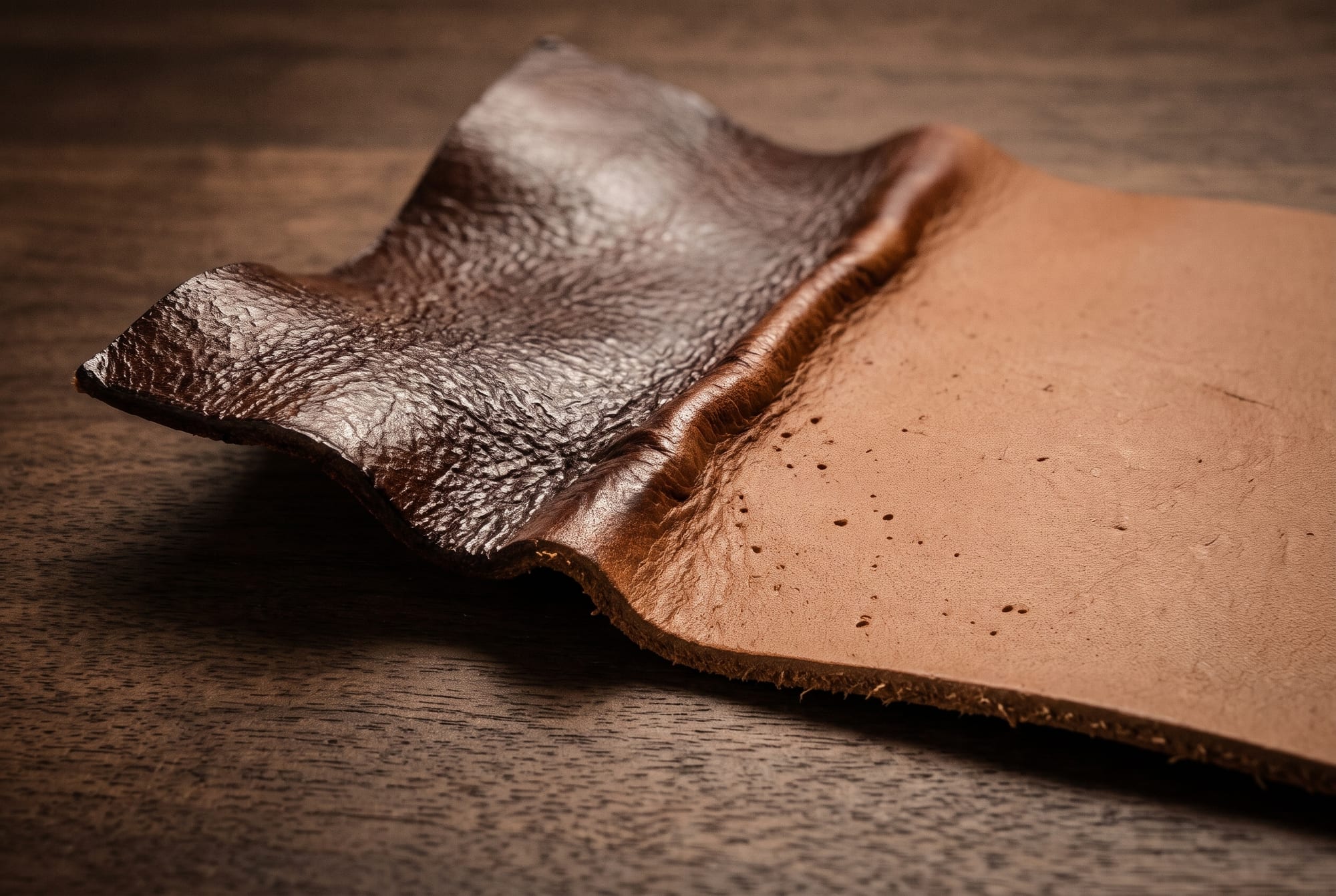
- A car. The worst place in daily life, and the one people trust most. The dashboard and the parcel shelf are direct sun on a dark surface in a sealed box; a bag left there in summer is being baked, not warmed. The boot is cooler but still well above a room. Nothing leather should live in a car.
- A radiator, or the shelf above one. Not just during the drying accident — permanently. A hall shelf above a radiator is a slow dehydrator, and a bag that lives there will be at stage one every winter.
- A hairdryer or heat gun. The nozzle air is around 80 °C, concentrated on one small patch, usually on leather that is wet. This is the fastest route to stage three available in a house.
- A tumble dryer. Low setting is around 60 °C with mechanical tumbling on top. There is no leather item for which this is a good idea, including the small leather patch on a pair of jeans.
- Hot plates and dishes. The reason a leather placemat needs a rule about serving dishes rather than a vague warning; the numbers are in leather placemats.
- Laptops and heated desks. A laptop underside commonly runs at 40 to 50 °C, which is stage one territory for the leather desk pad underneath it — not dangerous, but it is why the patch under a laptop dries and stiffens before the rest of the pad.
- Sunlight through glass. A dark leather surface behind a window gets considerably hotter than the room, and it is also being faded at the same time. Both mechanisms are in leather and sunlight.
- Hot water. Washing a leather piece in hot water combines both hazards at once. Cleaning is a cool, damp, patient business — see how to clean leather.
The palm rule
Nobody is going to take a thermometer to a shelf. So use the one instrument you already carry. Rest the palm of your hand flat on the surface for five seconds. If you want to take it off, the surface is above roughly 50 °C, and it is not a place for leather. If you can leave it there indefinitely, the surface is fine.
This works because the point at which human skin becomes uncomfortable sits remarkably close to the point at which leather starts to lose water faster than it can manage. It is not precise. It does not need to be: everything on the dangerous list above fails the palm test obviously, and everything on the safe list passes it obviously.
The heat that is useful
It would be dishonest to leave this as “heat is the enemy”, because the bench uses heat constantly — just a very little of it.
Warming a conditioner slightly, or warming the leather to about the temperature of a hand before applying it, genuinely helps absorption: the fats thin, the leather relaxes, and less product goes further. The limit is body temperature. Above that you are not helping it in, you are driving it too deep and leaving the surface tacky.
Edge burnishing is heat too, made by friction rather than a heater: a cloth or a wooden slicker rubbed fast enough to warm the edge, which melts the natural waxes and compresses the fibre to a polished surface. It is intense, local and brief, which is exactly why it works without cooking anything — the heat has nowhere to accumulate. There is more on what that edge is and why it matters in burnished or painted edges. The same principle applies to a hot stamp for a monogram: a short, controlled, local press rather than a sustained bake.
The pattern in all three is identical. Controlled, brief and local is a tool. Sustained and general is damage.
If it has already happened
Work out which stage you are looking at first, because it decides everything.
- Is it smaller or curled? Lay it next to an undamaged part, or an identical piece. Genuine shrinkage means stage three, and that area will not come back. Stop trying.
- Is it tacky or glassy in patches? Stage two. Wipe the surface with a barely damp cloth, let it dry at room temperature for a day, then feed very lightly with a plain conditioner and wait a week before deciding whether to repeat. Fats that moved will partly redistribute, and the shine will dull back.
- Is an edge or a lining lifting? Stage two, mechanical. That is a repair, not a treatment: a leatherworker can re-glue and, better, stitch it.
- Is it simply stiff and thirsty? Stage one, and the most common of all. Light feeding, several small applications over a few weeks, handling it in between — movement helps as much as the conditioner. Full method in how to soften leather.
One warning about the middle case. The instinct when leather goes hard is to put more oil on it, and with cooked leather that instinct produces a dark, greasy, still-hard object: the surface takes the oil, the denatured fibre does not, and you have added a stain to a casualty. If it is stage three, feeding it only changes its colour.
Drying a soaked piece, properly
Since heat accidents overwhelmingly begin with something wet, the method is worth stating plainly. Blot — press a towel against it, do not rub. Empty it and open it out so air reaches both faces. Stuff a bag loosely with dry cloth or paper to hold its shape, and change that stuffing when it is damp. Then leave it somewhere with moving air at room temperature, out of sun, away from every heat source, and wait. A soaked bag takes a day or two. When it is dry to the touch and no longer cool against the back of the hand, feed it lightly, because drying took fats with it.
It feels like doing nothing. Doing nothing is the treatment.
Quick answers
How hot is too hot for leather? Above roughly 50 °C it dries faster than it can manage; between about 60 and 85 °C fats melt, finishes soften and glues let go; above its shrinkage temperature — roughly 75 to 80 °C once vegetable-tanned leather is wet, against about 100 °C when it is dry — the damage is permanent.
Can you dry leather with a hairdryer? No. Hairdryer air is around 80 °C and the leather is wet, which is precisely the combination that shrinks and hardens it. Dry at room temperature with moving air instead.
Is it bad to leave a leather bag in a hot car? Yes, and worse than most people assume. Cabin air in a car parked in the sun averages around 47 °C after an hour and dashboards average near 69 °C, which is well inside the range where fats migrate and adhesives fail.
Can heat-damaged leather be repaired? If it is merely dry and stiff, yes, by feeding it slowly. If a finish has softened or an edge has come unglued, partly, with a repair. If the leather has shrunk, curled and gone hard, no treatment will restore it; the area can only be cut out and patched.
Further reading
- Wet-moulded leather: how a flat hide becomes a bowl
- Can leather get wet? What really happens, and how to dry it
- Leather and sunlight: what light actually does to a hide
- How to soften leather, and the shortcuts that ruin it
- Over-conditioned leather: what too much feeding looks like
- Leather in winter: salt, damp and dry indoor air
- Leather placemats: what size to buy, and what hot plates really do