Guide · 31 October 2026 · by Pınar
Cowhide, lambskin or goatskin: which leather for which object
Cowhide is the strong, generous workhorse for bags, belts, wallets and anything that lies on a table. Lambskin is the softest and lightest, made for garments, gloves and linings. Goatskin is tough for its weight, with a pebbly grain that suits wallets and small goods. The animal sets the starting point; the cut, the tannage and the finish decide the rest.

The short answer: choose cowhide for anything that has to carry weight, hold its shape or cover a large surface: bags, belts, straps, wallets, table runners and placemats. Choose lambskin for anything that has to drape and feel soft against the body: jackets, gloves, linings. Choose goatskin when you want something thin that still wears hard, which is why it turns up on wallets, card holders and bookbindings. The animal decides the starting point. Which part of the hide was used, how it was tanned and what was put on its surface decide most of what happens after.
“Which is the best leather?” is one of the questions I hear most often, and as a designer I can only answer it with another question: best for what? A glove cut from belt leather is a mistake. So is a belt cut from glove leather. Neither material is bad. The object simply asked for something that animal could not give.
What the animal actually decides
Every leather is the same basic material: a web of collagen fibre, packed tight in a thin grain layer on top and looser in the corium below. What changes from one animal to the next is how that web is woven, how thick it is, how much natural fat sits between the fibres, and how big the skin is. Those differences show up as five things you can feel at the bench:
- Fibre density. A tight, interlaced weave resists tearing and stretching. A loose, open one is soft and supple and gives way sooner.
- Grain pattern. Each animal leaves its own arrangement of hair follicles, so the surface has a signature you can learn to read.
- Softness. Part weave, part natural fat, part thickness. Lambskin is soft before anyone has done anything to it.
- Size of the skin. Easy to forget, and the one that most often decides what a maker can cut.
- How it wears. Scuffing, stretching, creasing and the way the surface ages all start from the fibre.
What the animal does not decide is just as important. It does not decide the grade: whether you are holding the full, untouched grain or a sanded and coated surface, which is the whole subject of what leather labels really mean. It does not decide the tannage either. A cowhide can be vegetable-tanned or chrome-tanned, and that choice changes how it feels and ages as much as the animal does.
Cowhide: the workhorse
Most of the world’s leather comes from cattle, largely as a by-product of the meat trade, and there are good reasons beyond supply. A cattle hide is thick, its fibres are dense and interlaced, and it is large. A tannery can split it to almost any thickness a maker asks for, from a thin lining to a heavy belt. Cut well and left full-grain, it is strong enough to carry a loaded bag every day for decades and stiff enough to lie flat on a table. That is why it is the default for bags, belts, straps, wallets, desk pads, and the runners and placemats we make.
It is also not one material. The firm, even leather along the backbone and over the rump behaves very differently from the softer, creased shoulder or the loose, stretchy belly, and a good maker knows which part every piece came from. We go through that map, and the marks each region carries, in natural marks on leather. Many of the leathers people know by their finish rather than their animal are cowhide underneath: Crazy Horse is cowhide flooded with waxes and oils, for example.
Calf, the finer sibling
Calfskin comes from younger cattle. The skin is smaller and thinner, the grain is finer and tighter, the pores sit closer together and there are fewer marks, because a young animal has had less time to collect them. It feels smoother and takes a high polish, which is why it is the classic leather for dress shoes, watch straps and fine small goods. It usually costs more per square metre. Whether it is “better” than cowhide depends on the object: for a slim card holder, perhaps; for a bag strap that has to carry weight, the thicker adult hide is the right call.
Lambskin and sheepskin: softness, at a price
Lambskin is the leather people reach for when they want to describe softness. The fibre structure of sheep is more open and loosely woven than cattle, and the skin holds more natural fat between its layers. The result is light, thin and supple from the start, and it drapes like heavy cloth. That makes it the natural choice for jackets, gloves, linings and anything that moves with the body. (When the wool is left on, it becomes shearling, a different object altogether.)
The same structure is its weakness. Lambskin scuffs easily, marks under a fingernail, stretches when it is pulled and tears more readily than a denser leather of the same thickness. A bag body cut in lambskin will slump unless something stiffer is laminated behind it, and a lambskin strap will lengthen. None of that makes it a poor leather; it is a garment leather doing garment work. Not every sheep is the same either: skins from hair sheep, prized by glove makers, are generally tighter and tougher than skins from wool breeds.
Goatskin: tough for its weight
Goatskin is the one I wish more people knew. The skin is small and fairly thin, but its fibres are compact and tightly knit, so it resists scuffing and tearing far better than its weight suggests. Its natural grain is pebbly: small raised areas with the pores set in curved rows between them. That texture hides everyday marks well, which is one reason goatskin has such a long history in bookbinding, the morocco of fine old book covers, and why it suits wallets, card holders, gloves, linings and small goods that live in pockets and hands. Kid, from young goats, is finer again and has long been used for gloves and shoes.
One caution: a pebbled surface does not prove goat. Plenty of cowhide is embossed with a pebble pattern, and an embossed grain repeats in a way a natural one does not. More on reading that below.
The others, briefly
Pig. Pigskin has a distinctive grain, with bristle holes in small groups of three that pass right through the skin. Most of it reaches the market as suede: inexpensive, hard-wearing and common in shoe linings, gloves and casual footwear. It can feel coarser than calf or goat suede.
Buffalo. Water buffalo hide is thick and tough, with a coarser, more open grain than cowhide and a lot of variation between hides and tanneries. It turns up in heavy bags, belts and upholstery where ruggedness matters more than refinement.
I have left exotic skins out on purpose. They are a separate conversation, about sourcing and regulation as much as about leather, and not one this atelier is part of.
Why the size of the hide matters to a maker
This is the part buyers rarely think about and makers think about constantly. A wallet is assembled from small panels; you can cut one from almost any skin, including the offcuts of a larger one. A table runner is a single, uninterrupted piece. A seam across a runner is a line across your table, and everyone at dinner will see it.
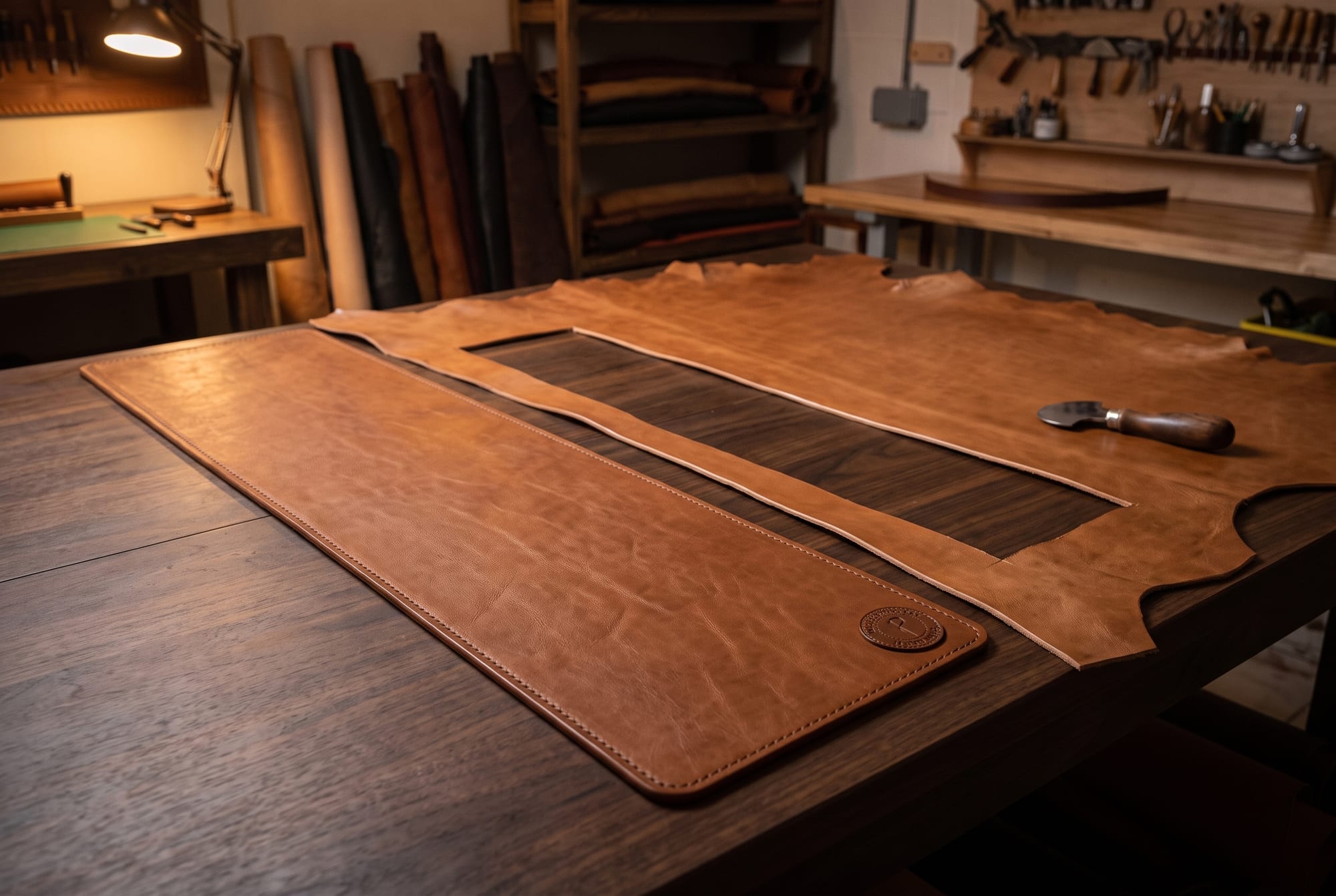
Our runners are cut to 137 and 150 cm, the lengths we explain in how to style a leather table runner. A whole cattle hide covers several square metres and is usually sold as two halves, and each half runs well over two metres along the backbone. A goatskin or a lambskin is commonly under a metre long. The arithmetic decides the animal before any question of taste: a 150 cm runner can only come from cattle, or from something as large.
And it should not come from just anywhere on that hide. A runner is a flat object with nothing to hold its shape but its own fibre, so we cut it along the backbone, where the leather is most even and firm, and it lies flat for years. The placemats come from the next-best areas, ideally all from the same hide so their tone matches across the table, and the smaller pieces come from what is left. The heavier your design’s demand for long, clean areas, the more each scar and growth wrinkle matters, and the more a hide’s yield shapes the price.
How to tell them apart by eye
You need raking light, from a window or a lamp held low, and ideally a loupe. Then look at the grain the way you would read a fingerprint, because that is more or less what it is: the pattern of hair follicles the animal grew.
- Cowhide: small, round pores scattered fairly evenly, with no strong pattern. On shoulder leather you may see growth wrinkles running across the piece.
- Calf: the same idea, finer. The pores are smaller and closer, the surface smoother, almost glassy when polished.
- Lambskin: pores so fine they are hard to find at all, sometimes in faint wavy lines. The surface looks silky, and the leather feels thin and gives when you pull it gently.
- Goatskin: a natural pebble, with the pores arranged in short curved rows, a little like fish scales. The pattern varies across the skin rather than repeating.
- Pig: pores in clear groups of three, often visible from both sides because they pass right through.
Two honest caveats. First, this only works on a surface that still carries its own grain. A sanded, pigmented and embossed hide can be stamped to look like any animal on this list, which is exactly the problem described in what full-grain leather really is. If a pattern repeats, a cluster you can find again a few centimetres away, it was rolled on. Second, the same animal varies from belly to backbone, so judge a piece from its best-lit, most typical area rather than from an edge.

Then the rest matters more than the animal
Here is the thesis I would want anyone to leave with. Choosing the animal gets you to the right shelf. What you are actually buying is decided by four more choices, and each of them can outweigh the first:
- The cut. Which part of the hide. A strap from the backbone of a cowhide and a strap from its belly are the same animal and very different straps.
- The grade. Full grain, with the strongest layer intact, or a sanded and coated surface. A full-grain goatskin wallet will usually outlast a corrected-grain cowhide one.
- The tannage. Vegetable or chrome decides whether the leather darkens and develops a patina or keeps its first-day look for as long as it can.
- The thickness. Lambskin at the wrong thickness is flimsy; cowhide at the wrong thickness will not fold. What an ounce means, and why thicker is not better covers the numbers for each object.
So when someone asks which leather is best, the honest answer is a short list of questions: which animal, which part, which grade, which tannage, which finish, how thick. A seller who can answer all six is usually selling something worth having.
What we cut, and why
Everything on our shelves is cattle hide, full-grain and vegetable-tanned. That is a design decision before it is a material one. Our table runners, placemats and desk pads need length and flatness that only a large hide gives, and once a hide is on the bench we cut the card wallets, trays and charms from the same leather, so every piece we make ages in the same way and the offcuts of the large pieces become the small ones. Lambskin and goatskin are fine leathers. They are simply the right answer to different objects from the ones we make.
Quick answers
Which is better, cowhide or lambskin? Neither, in general. Cowhide is stronger, firmer and comes in large hides, so it suits bags, belts, wallets and table pieces. Lambskin is softer and lighter but scuffs and stretches, so it suits jackets, gloves and linings.
What is goatskin leather good for? Small goods that see hard daily use: wallets, card holders, gloves, linings and bookbinding. Its compact fibre makes it tough for its thickness, and its pebbly natural grain hides small marks.
Is calfskin better than cowhide? It is finer, smoother and usually more expensive, with fewer marks. It is not stronger than adult cowhide of a sensible thickness, so the right choice depends on the object.
How can you tell goatskin from cowhide? In raking light, goatskin shows a natural pebble with pores in short curved rows; cowhide shows small round pores scattered evenly. If a pebble pattern repeats exactly, it has been embossed, often onto cowhide.
Further reading
- What is full-grain leather, really? A maker’s anatomy lesson
- Leather thickness: what an ounce means, and why thicker is not better
- Vegetable-tanned vs chrome-tanned: what the tannage decides
- Natural marks on leather: where each one came from
- How to tell if leather is real: seven tests, in the order that matters
- Leather placemats: what size to buy, and what hot plates really do