Guide · 6 September 2026 · by Zafer
What is full-grain leather, really? A maker’s anatomy lesson
The words are on every listing we write and, lately, on a lot of listings that don’t deserve them. So let’s put a hide on the bench and show you exactly what “full-grain” means — and what it doesn’t.
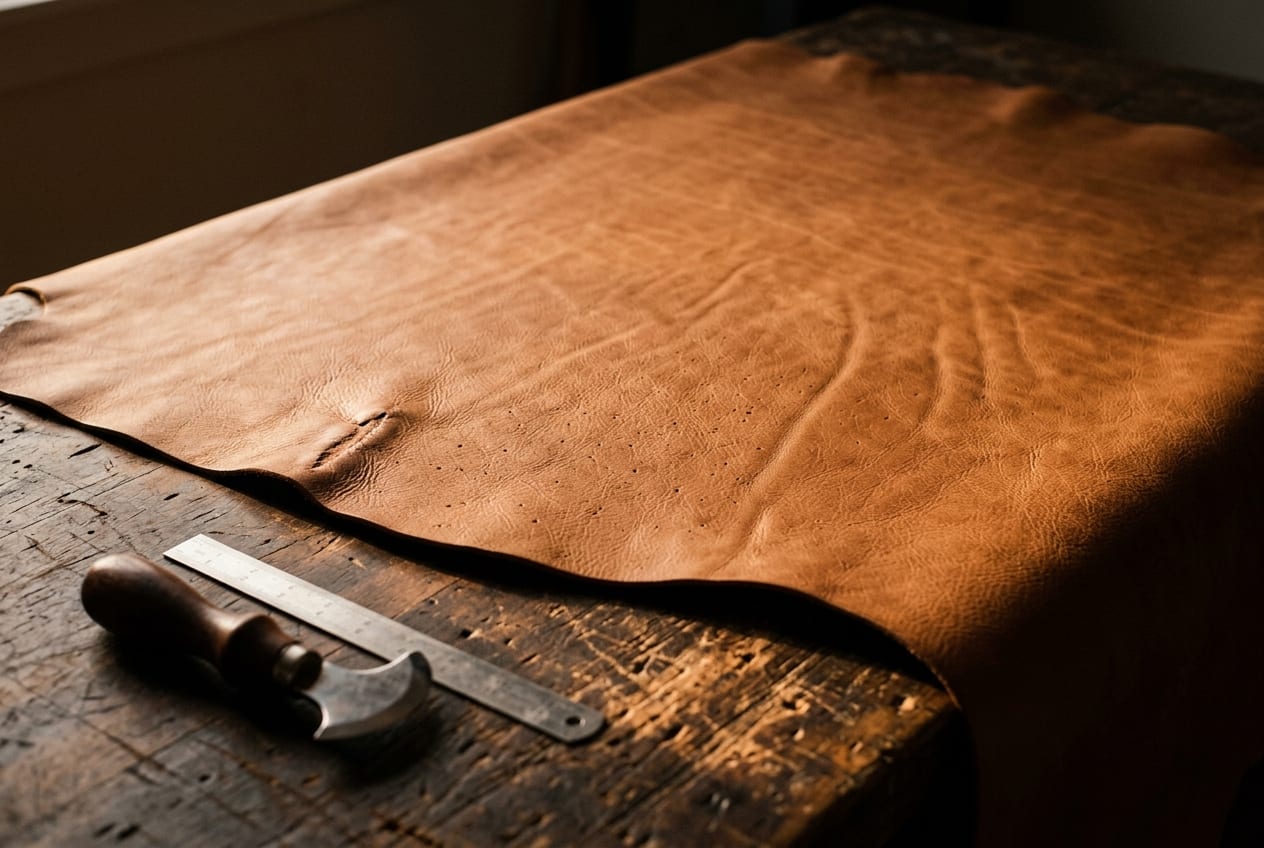
Every trade has a word that gets borrowed until it means nothing. Ours is full-grain. It began as the most precise term in the leather trade — a statement about anatomy, as factual as “solid oak” — and it is turning into a perfume word, sprayed on product pages to make coated splits smell expensive. This is the anatomy lesson we give visitors at the bench, and it takes five minutes.
The hide, in section
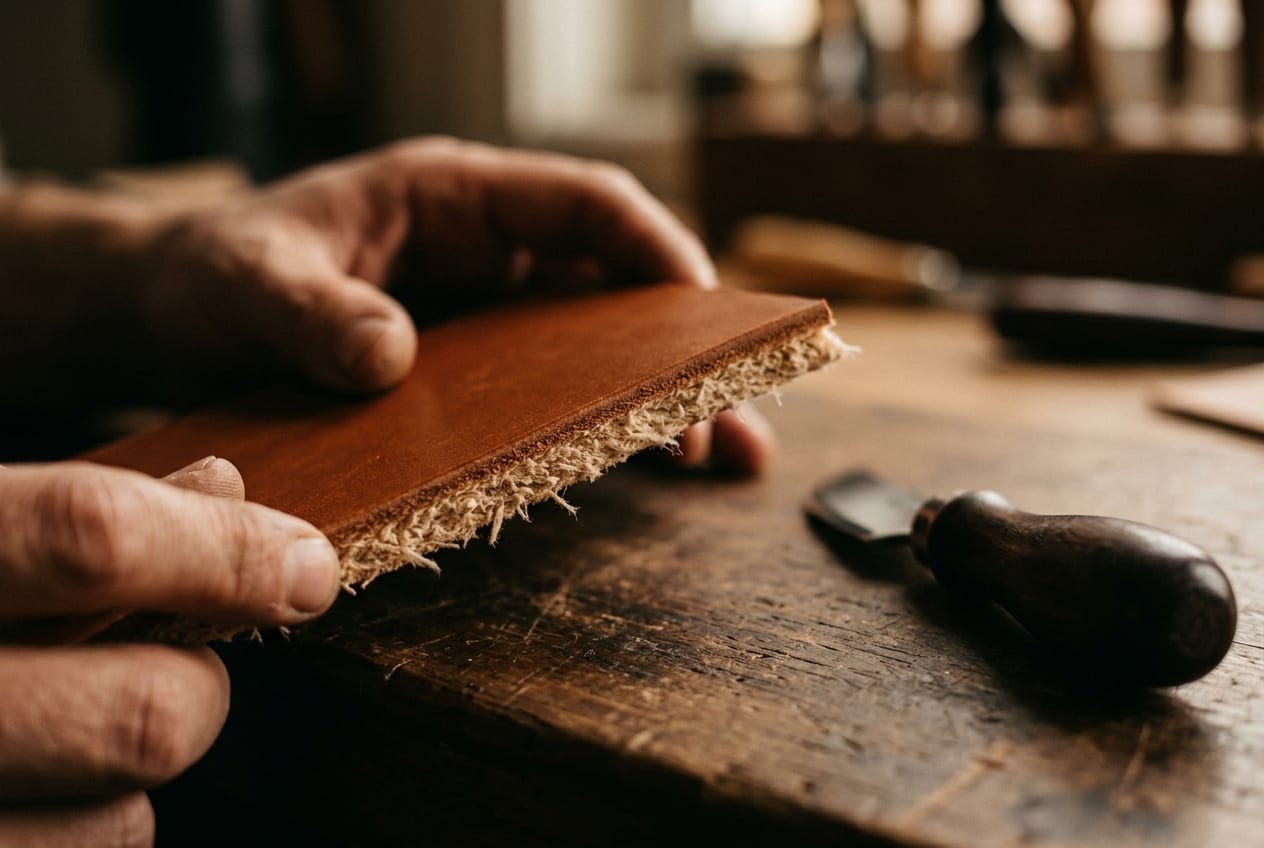
Cut a hide and look at the edge. The top one to two millimetres is the grain layer: fibres packed so tightly they read almost as a solid, because this is the side that spent an animal’s lifetime facing sun, rain, thorn and weather. Below it lies the corium — the same collagen, but woven loose and open, softer and far weaker. The two layers are one continuous material; the strength is not evenly distributed. It lives at the top.
Full-grain simply means the grain layer is left intact: no sanding, no buffing, no embossed fake grain, nothing removed. Top-grain means the very surface has been sanded off to erase marks and then refinished — one pass of sandpaper that costs the hide its densest fibres and its ability to patina. And “genuine leather”, in trade practice, usually means a lower split of the corium wearing a coat of paint. All three are real leather. Only one of them is the whole material.
What “intact” buys you
- Strength where the stress lives. Handles, seams and fold lines all pull on the surface. The dense grain takes it; sanded surfaces and splits tear years earlier — it’s why the honest lifespan table runs 30+ years for full-grain and 5–10 for “genuine”.
- A surface that breathes. The pores are still open, so the hide drinks conditioner, releases moisture, and darkens with your hands — patina is literally the grain layer at work.
- Edges that burnish. Only dense fibre polishes into that glassy, dark edge; coated splits can only be painted.
- A face with a history. Growth marks, a healed scar, the faint wrinkle of a neck — the record of a life, visible because nobody sanded it away.
Four things full-grain is not
It is not flawless. The opposite: flawlessness is the warning sign. A hide that lived outdoors carries marks, and full-grain keeps them. If every panel of a “full-grain” bag is perfectly, identically smooth, someone either cherry-picked the world’s luckiest cow or embossed a corrected hide.
It is not, by itself, a quality guarantee. Full-grain answers one of the four decisions that decide quality — the cut. A full-grain hide can still be chrome-tanned in a day, dyed carelessly and machine-sewn. The word starts the conversation; it doesn’t finish it.
It is not what “top-grain” sounds like. The most successful naming trick in the industry: “top” sounds like the summit. It means the top was removed.
It is not rare because it’s fancy — it’s rare because it’s unforgiving. Only clean, well-raised hides can be used un-sanded, the cutter must work around every scar, and no coating will ever hide a lazy stitch. Factories avoid full-grain for the same reason we insist on it: it shows everything.
The grain is the part the animal spent a lifetime toughening. Everything below it is filler.
The four tells in a shop

Why we cut nothing else
Every piece that leaves this atelier is full-grain — vegetable-tanned for the pieces that will patina brightest, or waxed pull-up full-grain (Crazy Horse, Pueblo) for the ones that will be handled hard. Not because the word sells, though it does, but because everything else we believe in depends on it: a saddle stitch is only worth six hours if the material around it lasts thirty years, and a patina can only grow on grain that’s still there.
Sandpaper makes a hide prettier for a year and weaker for a lifetime. We were taught to leave it in the drawer.
Holding something labelled full-grain and not sure the label is honest? Run the four tells, photograph the surface and the cut edge, and send them to info@pazleather.com — we’ll give you a bench-side verdict.
Further reading
- Leather thickness: what an ounce means, and why thicker is not better
- Burnished vs painted edges: why makers read the edge first
- Quiet luxury is a material, not a logo: a bench-side definition
- Full-grain, top-grain, “genuine”: what leather labels really mean
- Why “real leather” doesn’t mean good leather
- Patina: the story your leather writes about you
- How long does a leather bag last? The honest numbers
- Glossary: full-grain leather