
Guide · 7 November 2026 · by Zafer
Sweat and leather: why the strap always goes first
A watch strap dies in two or three years while the watch runs for fifty. A belt cracks at the fold while the middle stays perfect. The handle of a bag goes limp and dark long before anything else on it. These are the same story told three times, and it is not about quality — it is about how many hours a week that piece of leather spends against skin.
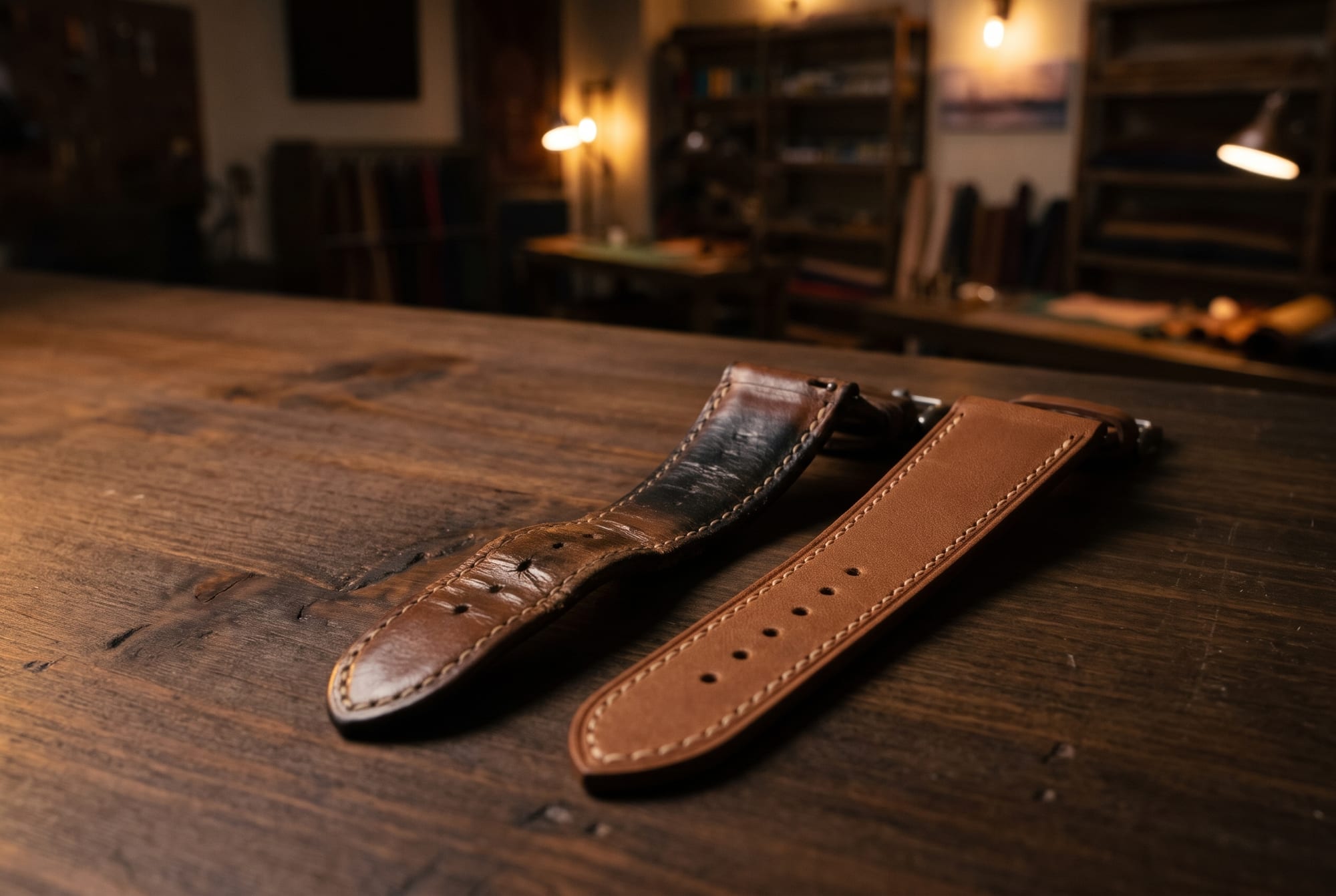
The short answer: sweat is about 99 per cent water, and almost all of the lasting harm is in the one per cent that is not. The water repeatedly wets and dries the leather, carrying fats out with it. The salt stays behind, pulls damp in and out long after you have taken the thing off, and crystallises between the fibres. The skin oils and acids locally over-grease and slightly acidify one small area. Three different problems, and the routine that answers all of them is the same: wipe the contact face dry, let the piece rest a full day, and own two.
I have re-stitched a lot of watch straps and re-buckled a lot of belts, and the question that comes with them is nearly always some version of “was this just badly made?” Usually not. A strap worn ten hours a day against a wrist is doing something no other piece of leather in your life is asked to do, and two to four years of that is a reasonable innings. Knowing that changes what you buy and how you treat it.
It is not the object, it is the contact time
Rank the leather you own by hours per week spent touching skin and you have ranked it by how fast it will fail. The order is almost perfectly reliable, and it explains why the most expensive bag in the house will outlive a cheap belt and also why its handle will not.
Those lifespans sit oddly next to the ones in how long leather lasts, which gives full grain thirty years and more. Both are right, because they measure different things. That article measures the hide; this table measures a contact surface. The leather in the middle of a belt really will see thirty years, and the leather at its fold will not — and on a watch strap, almost the whole object is contact surface. Nothing on this list fails because the hide ran out.
Three things in sweat, three different problems
“Keep it dry” is good advice that stops too early, because only one of the three things sweat does is about being wet.
The salt row is the one worth dwelling on, because it is the least intuitive. Salt is hygroscopic: it attracts water out of the air. A strap that has absorbed months of sweat is therefore never quite stable — it takes up damp on a humid day and gives it back on a dry one, so the leather is being gently flexed and unflexed by its own chemistry even when it is in a drawer. That is why a neglected strap can stiffen noticeably over a summer in which it was not worn at all.
The failure everybody recognises
Watch straps fail in a sequence so consistent you can almost date one by looking at it:
- The inside face darkens within weeks, unevenly, worst where the wrist bone sits. This is normal and not damage.
- It goes slightly tacky and limp, a few months in — the skin oils have over-greased that face while the water has carried structural fats away. The strap feels softer than new but less lively.
- Then it stiffens. The fats that actually mattered are gone, and the salt is cycling damp through the fibre. This is the turn, and most people read it as the strap finally “breaking in” when it is the opposite.
- It cracks at the two stress points: the fold at the lug end, and the hole you always use. Both places where the strap is simultaneously the wettest and the most bent.
A belt follows the same path more slowly, protected by a shirt, and fails at exactly the equivalent two places: the fold around the buckle and the band of holes. That overlap is not a coincidence — it is the same mechanism at a different dose, and it is why the belt advice in how to buy a leather belt and the strap advice here end in the same place.
Salt bloom, and the two things it is mistaken for
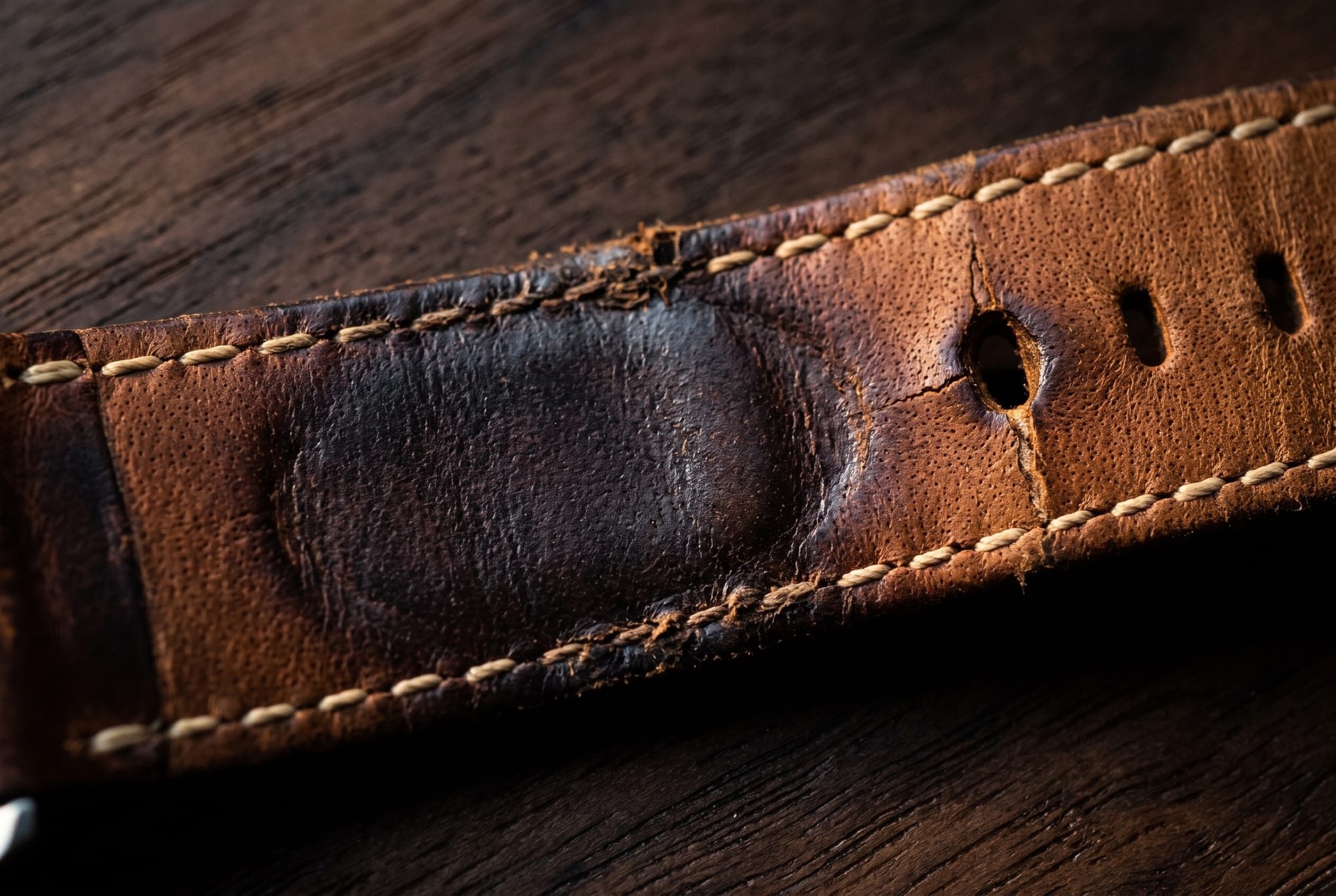
Pale, powdery marks on leather cause more unnecessary panic than anything else I am asked about, largely because three different things look alike at arm's length. They are easy to tell apart up close.
- Salt bloom sits on the contact face in the pattern of where the body touched it, feels faintly gritty under a fingertip, and redissolves if you touch it with a barely damp cloth. It is the one that follows sweat — and also the one that follows winter road salt, which is the same chemistry arriving by a different route. Both are covered in leather in winter.
- Fat spue is a waxy white haze that appears over the whole surface, not just where you touched it, often after cold storage. It wipes away with a dry cloth or disappears when gently warmed with the hand, and it means the leather has more dressing in it than it can hold — see over-conditioned leather.
- Mould is fuzzy rather than crystalline, usually greenish or grey, smells, and comes back after you wipe it. It needs a different treatment entirely, set out in leather mould.
If you are unsure: touch it with a slightly damp white cloth. Salt dissolves and vanishes. Spue smears. Mould transfers colour to the cloth and returns within days.
What is on your skin is often worse than the sweat
This is the part I would add to every strap care guide I have read, because in practice it causes more sudden damage than sweat ever does. Sweat is a slow mechanism measured in years. The things people put on their hands and wrists are a fast one, measured in a single afternoon.
- Sunscreen is the worst offender by a distance. The oils and film-formers in it soak straight into an unfinished or lightly finished leather, leaving a dark greasy patch that does not come out, and some formulations stain pale leather yellow. A summer holiday will age a light strap more than the previous two years did. Put it on, let it absorb for a few minutes, then put the watch on.
- Hand sanitiser is alcohol, and alcohol strips both finish and natural fats. Repeated use leaves a pale, dry, slightly chalky band exactly where your hand meets a bag handle. It evaporates fast, which fools people into thinking nothing happened.
- Insect repellent, particularly anything with DEET, is a solvent. It will soften some finishes and can visibly damage coated leather on contact. Treat it the way you would treat nail varnish remover.
- Hand cream and perfume are milder versions of the same two problems: oils that darken locally, and alcohols that dry. Neither is a disaster, but both concentrate exactly where the hand holds the handle.
The habit that fixes all four is the same: whatever goes on your skin, let it dry before the leather touches it. The wider list of what does and does not belong near a hide is in what not to put on leather, and if something has already landed, the first few minutes matter most — see leather stain first aid.
The one place this is welcome
Not all of it is damage, and it would be wrong to leave the impression that skin is the enemy. A bag handle that has darkened to a deep, glossy brown where hands have held it is doing exactly what good leather should: the oils have been worked into the grain rather than left sitting on it, and the surface has been burnished by thousands of small movements. That is the most honest patina there is, and nobody can fake it convincingly.
The difference between that and a ruined strap is dose and drying. A handle gets about twelve hours a week of contact and then has a hundred and fifty-six hours to recover. A watch strap gets eighty-four and recovers in the gaps between. Same chemistry, opposite outcome — which is the practical case for the rest of this article in one sentence. What patina is, and what it is not, is in what patina actually means.
Which leather to want against skin
This is one of the few places where I would steer someone away from the vegetable-tanned leather we work in ourselves. Veg-tan is more sensitive to repeated wetting and to mild acidity, and a strap worn on bare skin gets both daily. Chrome-tanned and combination-tanned leathers are more hydrothermally stable and more tolerant of damp, which is precisely why the shoe and strap trades favour them. If you want the honest comparison rather than the romantic one, it is in vegetable-tanned vs chrome-tanned.
Two more construction points. A lined strap puts a second, sacrificial layer between skin and the structural leather, which genuinely helps — provided the lining is leather rather than a coated fabric that traps moisture against both faces. The general case is in lined or unlined. And thicker is not safer here: a thick strap holds more moisture for longer and takes longer to dry out between wearings, which is the opposite of what you want. A thinner strap in a denser leather beats a thick soft one.
The routine, which is four habits
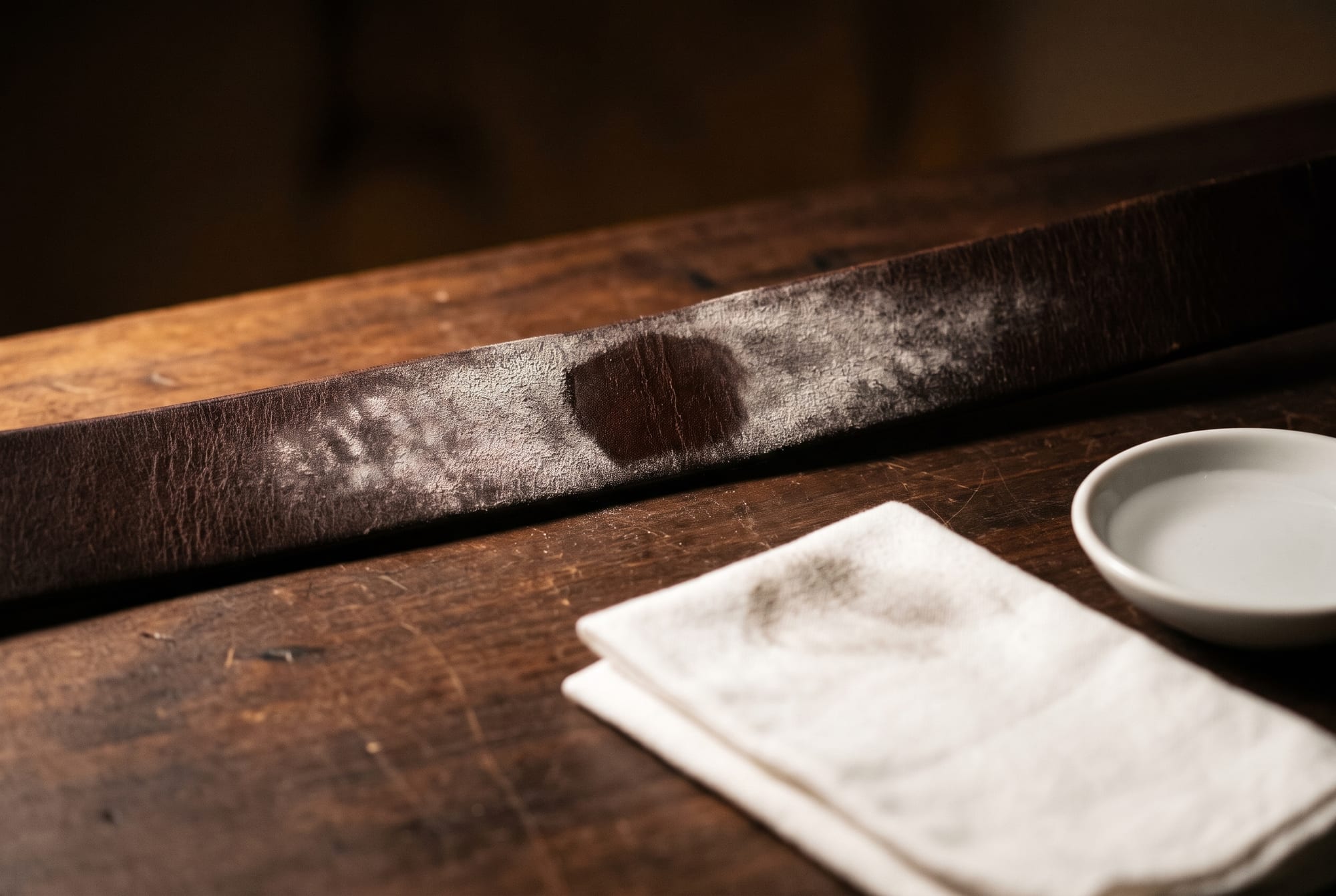
- Wipe the contact face dry when you take it off, with a dry cloth, on any day you noticed the weather. Ten seconds. This is the single highest-value habit in this article, because it removes the salt before it dries into the fibre.
- Let it rest a full day. Leather needs roughly twenty-four hours to return to equilibrium after a day against skin. Worn again before that, it never gets dry, and the wet-dry cycle becomes a wet-wetter cycle.
- Deal with bloom when you see it, not later: barely damp cloth, distilled water if your tap water is hard, one light pass, then dry slowly at room temperature, away from any heat source. Never feed conditioner over a salt bloom — you seal it in.
- Feed sparingly, and not on the contact face. Twice a year, on the outside face, a very small amount. The inside is already receiving more oil than it wants from you.
Drying deserves one line of emphasis because it is where good intentions do the damage: room temperature and moving air, never a radiator, never a hairdryer. Wet leather and heat together is the one combination that destroys rather than wears, and the mechanism is in can leather get wet?
Why two straps last more than twice as long
If you take one thing from this: buy two and alternate them. It is not a linear improvement. A strap worn every day never completes a drying cycle, so it spends its whole life partly wet, and both the fat loss and the salt cycling run continuously. A strap worn every other day dries fully, re-equilibrates and is mechanically relaxed before it goes back on.
I cannot give you a number I have measured, and I distrust the ones I have seen quoted. What I can say from the bench is that the straps that arrive at four years still worth re-stitching almost always belong to people who own several, and the ones that arrive hard and cracked at two years almost always belong to people who own one. The same arithmetic applies to belts, and to any bag you carry daily.
When it is finished
Honest triage, because not everything can be saved:
- Dark and tacky on the contact face: cosmetic. Wipe with a barely damp cloth, dry, leave it alone. It will stay dark, which is fine.
- Stiff but uncracked: recoverable. Light feeding on the outside face over several weeks, worn in between, because flexing matters as much as the conditioner. Method in how to soften leather.
- Pale bloom: recoverable, as above, and it will return unless the habit changes.
- A crack at the lug fold or at a hole: structural. On a strap, that is the end of it — the load passes straight through the crack. On a belt, the buckle fold can often be cut off and re-punched.
- Edges fraying and the stitching loose: repairable. Re-stitching a strap edge is half an hour, and worth it on a strap whose body is still sound.
And accept the premise. A strap worn daily on a warm wrist is partly a consumable, in the way a shoe sole is. Two to four years is not a failure of the leather, and a maker who promises otherwise is either using a coated material you will like less, or has not worn one.
Quick answers
Does sweat ruin leather? Not quickly, and not because it is wet. The water carries fats out as it dries, the salt left behind keeps cycling moisture through the fibre, and skin oils locally over-grease one face. Together they stiffen and then crack the leather at whatever point also bends.
Why does my leather watch strap crack so fast? Because it spends around eighty hours a week against bare skin, and it cracks where the wettest part of it is also the most bent: the lug fold and the hole you use. Two to four years of daily wear is normal.
What are the white marks on my belt or strap? Most likely salt bloom, in the shape of where your body touched it. It feels slightly gritty and dissolves under a barely damp cloth. If it is fuzzy, smells, and returns, it is mould instead.
Should I put conditioner on the side that touches my skin? No. That face already gets more oil than it needs from you, and conditioner over a salt bloom seals the salt in. Feed the outside face, sparingly, twice a year.
Further reading
- Can leather get wet? What really happens, and how to dry it
- Leather in winter: salt, damp and dry indoor air
- Over-conditioned leather: what too much feeding looks like
- Leather mould: what it is, and how to get rid of it for good
- How to soften leather, and the shortcuts that ruin it
- Lined or unlined: what a lining is actually for, and what it hides