Guide · 27 August 2026 · by Pınar
Burgundy leather: what autumn’s “new neutral” actually does on a real hide
Every few autumns a colour gets promoted. This year it’s burgundy. As a designer I’m glad. As someone who works beside a bench of hides, I have a footnote the trend reports leave out.

This season’s trend reports agree with unusual unanimity: burgundy — oxblood, wine, claret, plum, whichever word the copywriter reached for — is the “new neutral” for autumn 2026. Bags, boots, gloves, the lot. I’ve argued for this colour in interiors for twenty years, so I’m not going to pretend I’m not pleased. But I spend my days next to Zafer’s bench, and from there burgundy looks a little different. On leather, it is the hardest colour to do honestly — and the easiest to fake.
What counts as burgundy leather
Before the advice, the vocabulary — because five words are doing the work of one, and shops use them interchangeably when they shouldn’t. Sorted from the red end to the brown end:
- Wine / burgundy — the brightest of the family, clearly red before it is brown. Photographs best, dates fastest.
- Claret — a blue-leaning red, cooler than wine; rarer on leather because it needs a precise dye bath.
- Oxblood — the dark, brown-leaning end: the colour of a classic cordovan shoe. The one we’d put our name to, and the one that behaves like a neutral for decades.
- Plum / aubergine — purple-leaning. On leather this almost always means a heavy pigment or a chrome-tanned dye, because tannins pull colour toward brown, not violet. Treat purple as a hint about how the hide was finished.
And the thing worth saying plainly: burgundy is a colour, not a kind of leather. “Burgundy leather” on a label tells you nothing about what you’re holding — the same wine tone sits on intact full-grain hide and on a coated split sold as “genuine leather”. So read the grade first and the colour second; then the rest of this guide tells you which of the two you’re looking at.
Why burgundy earns the word “neutral”
A neutral is a colour that argues with nothing. Burgundy manages this because it’s a red that has been pulled in two directions at once: toward brown, which puts it in the same family as cognac and tobacco, and toward black, which lets it do black’s formal work without black’s coldness. Warmer than black, more serious than cognac, less predictable than navy. It sits next to camel, cream, grey flannel, denim and forest green without a fight — and, crucially for anyone whose wardrobe is already built on brown leather, next to cognac, as long as one of the two is clearly the accent.
Three ways burgundy gets into a hide
Here is the footnote. Brown is what vegetable-tanned leather wants to be — tannin is brown, oils are amber, time is darker brown. Burgundy is a colour a hide has to be given, and there are three very different ways to give it.
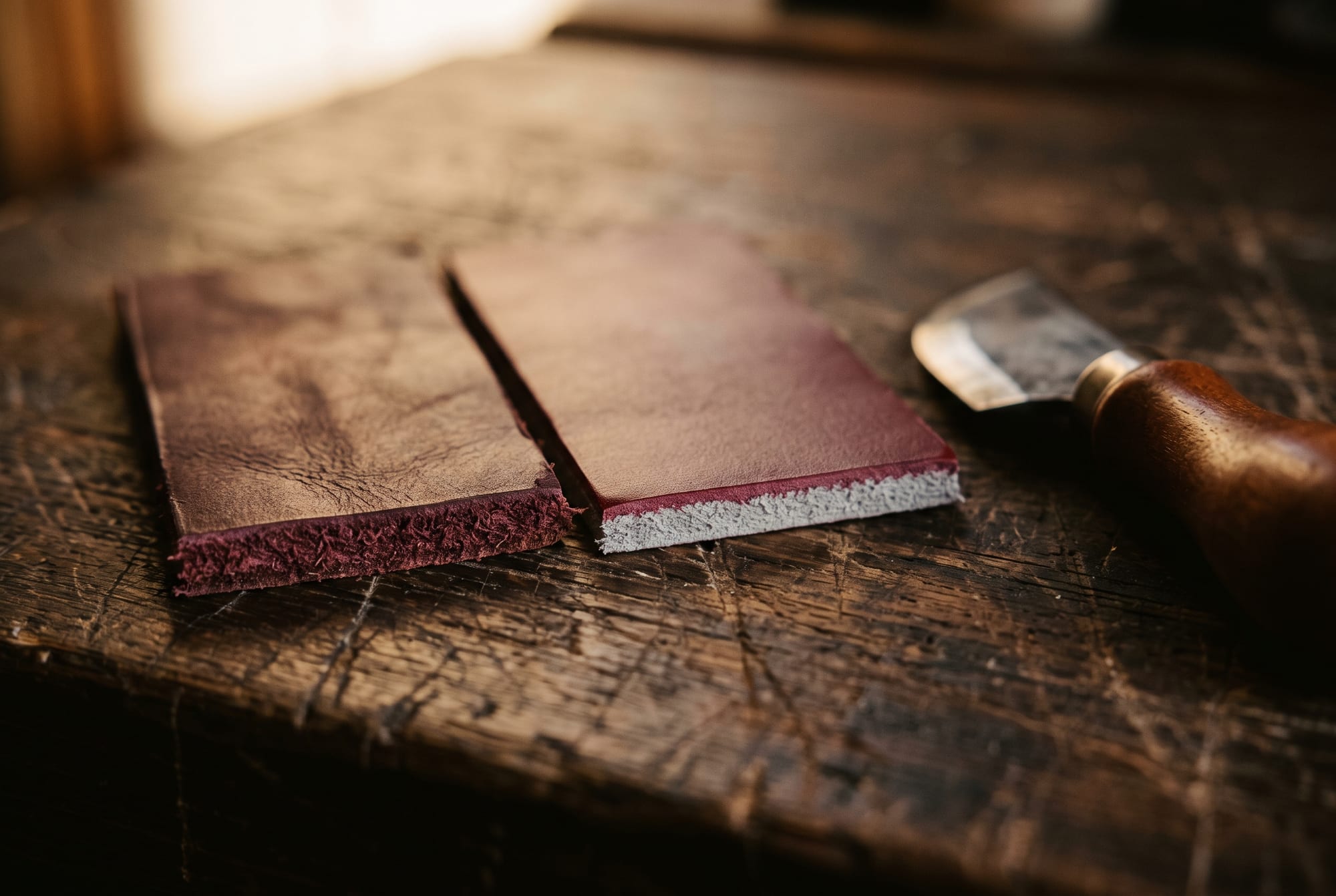
1 · Aniline dye on vegetable-tanned leather. Soluble dye is drummed into the hide until it soaks the fibre itself. The colour is translucent: every pore, scar and grain line shows through it, and no two panels are ever exactly the same wine. Red dyes are the most difficult in the tannery’s cupboard — they take longer, cost more and vary more — which is why honest aniline burgundy is rare and never cheap. It ages, in the good sense.
2 · A pigmented finish. A coat of coloured pigment — paint, in plain English — bonded to the surface, usually over chrome-tanned or corrected-grain leather. Perfectly uniform, perfectly matched across ten thousand bags, sealed against everything including its own future. This is where nearly all “fashion burgundy” comes from, because it’s the only way to make a whole collection the same wine. It doesn’t age. It wears, which is a different verb.
3 · Hand-dyed, small batch. Dye brushed or sponged onto natural veg-tan by a maker, then sealed with wax. Deliberately uneven, cloudy at the edges, the most alive of the three and the least predictable. You’ll find it at ateliers, not in shops with escalators.
How to tell dyed from painted in a shop
Three moves, thirty seconds, no tools. They’re the same instincts behind our 60-second inspection, aimed at colour.
- The cut edge. Find a raw edge — the end of a strap, the inside of a flap. Colour running through the full thickness means the hide was dyed. A pale or grey core under a thin coloured skin means it was painted.
- The fingernail. Press hard on an inconspicuous spot. Aniline leather lightens a shade and warms back with your thumb, like pull-up leather in miniature. A pigmented surface shows nothing at all — or a tiny permanent crease line where the coat has folded.
- The variation. Hold two panels of the same bag side by side under daylight. Dyed burgundy is never quite identical from panel to panel; that’s the fibre drinking unevenly. If the colour is perfectly, industrially even, you are looking at paint.
Burgundy is a colour red has to earn. On most leather, it hasn’t.
What burgundy becomes in ten years
This is the part that decides whether the trend is worth following. Dye lives in the fibre, so everything that darkens leather — your hands, the oils in the hide, the balm you feed it, the years — darkens the burgundy with it. Pigment lives on the fibre, so nothing can deepen it; it can only be rubbed off.
Wine into port — that’s the aniline story, and it is one of the most beautiful ageing curves leather can run, because the colour ends somewhere more expensive than it began. The pigmented story ends in the same place all coatings end: fine white crazing at the folds around year five, then the pale hide showing through at the corners. If you’ve read what patina means, you already know which one of these is a story and which is a receipt.
Brass, nickel or black?
The hardware decides what kind of burgundy you own. Antique or solid brass pulls the colour toward its brown side — heritage, warmth, a library in October; it’s what we would put on it, and it’s the only metal that ages alongside the leather. Polished nickel or silver pulls it toward its black side — cooler, sharper, more urban, the burgundy of a good coat rather than a good armchair. Black hardware is the most fashion-forward and the fastest to date; if you want the bag in a decade, don’t.
Burgundy at home
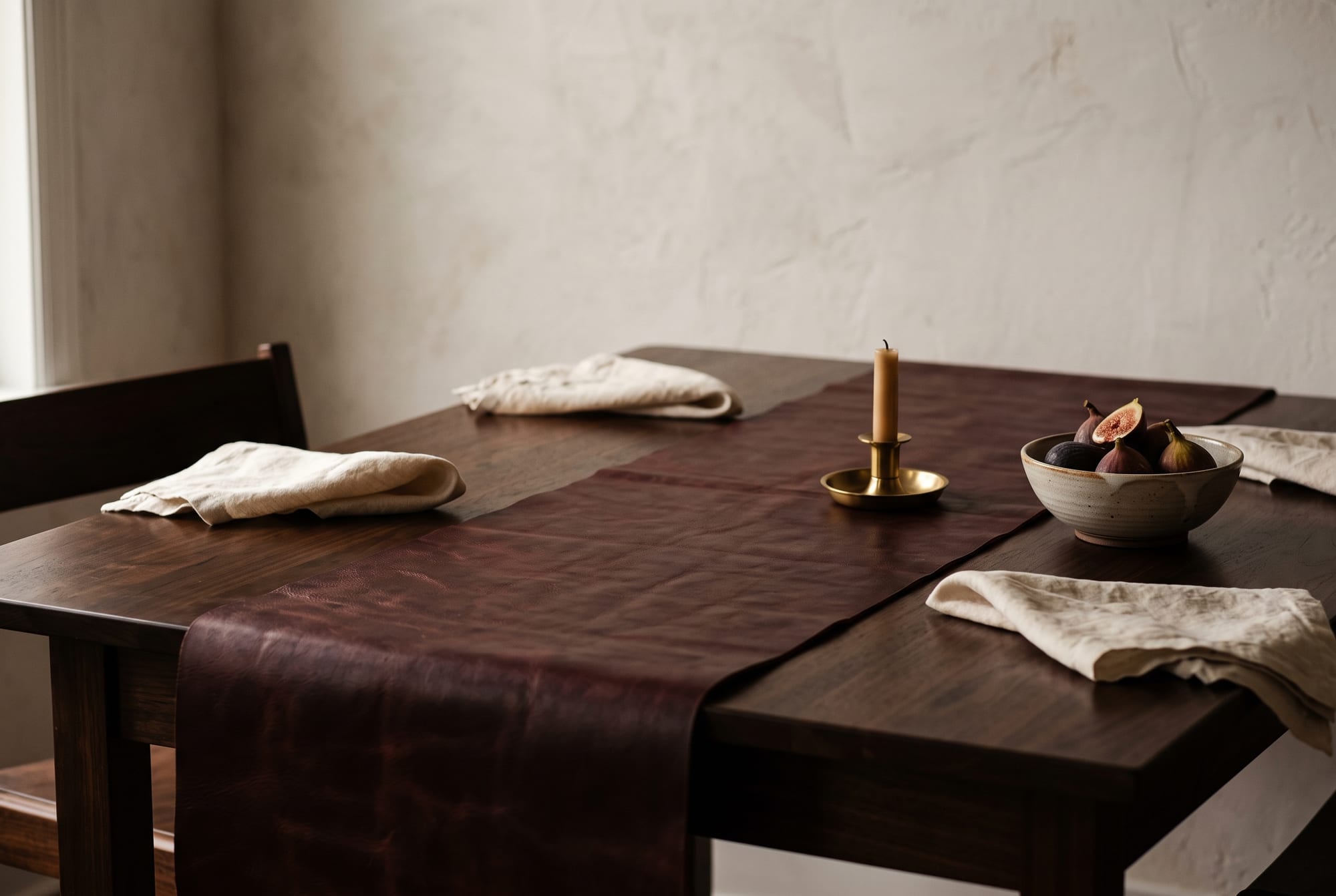
I’ll put my interior architect’s hat on for one paragraph. Burgundy leather on a table — a runner, a set of placemats — is one of the few colours that works on both pale wood and dark, but it does two different jobs. On oak or ash it is the anchor: the one deep note that stops a pale room floating away. On walnut it is the warmth: it picks up the red already hiding in the timber and makes the whole table glow. The rule in either case is the one I’d give for a wardrobe: one burgundy object per surface. Two is a theme. Three is a restaurant.
Three honest warnings
Dye transfer. Newly dyed red leather is the worst offender in the whole colour wheel for rubbing colour onto a cream coat or a pale sofa — makers call it crocking. Test before you commit: a damp white cloth pressed firmly on the inside of the flap should come away almost clean. A little pink on aniline leather in the first weeks is normal; a lot means the dye was never fixed. Carry it against dark clothes for the first month, and ask the maker whether the colour is sealed.
Sun. Red dyes are the least light-fast family there is. Aniline burgundy left on a windowsill turns a dull rust-brown in a single season, and no conditioner brings the colour back — balm restores oils, not dye. Store it away from direct light, as you should store any leather, only more so.
A trend colour on a thirty-year object. This is the one that matters. A full-grain piece lives thirty years; the trend cycle lives two. If you’re buying burgundy for life — or as a gift meant to outlast the occasion — buy the dark, brown end of it: oxblood, the colour of a cordovan shoe, and not the bright wine the shop window is pushing this month. Oxblood has been a neutral since before anyone wrote trend reports. Wine is a mood.
What we tell people who ask us for burgundy
Our own palette is the browns — natural, cognac, tobacco — because they are the colours our vegetable-tanned hides want to be, and because they age the way we promised they would. When someone asks us for burgundy, the conversation goes like this: yes to oxblood on veg-tan, no to wine on a coating, and a photograph of the actual swatch under daylight before anything is cut. It costs more, it varies from panel to panel, and for the first month it may leave a little of itself on your coat. Then it starts becoming port.
Buy the colour for the decade, not for the season. Oxblood will still be a neutral when burgundy is a memory.
Eyeing a burgundy piece and unsure whether it’s dyed or painted? Photograph the cut edge and send it to info@pazleather.com — we’ll tell you what you’re looking at.
Further reading
- Aniline, semi-aniline, pigmented: what a leather’s finish actually decides
- How to style a leather table runner: an interior architect’s six rules
- Which leather colour should you choose? What each one becomes in ten years
- Patina: the story your leather writes about you
- Vegetable-tanned vs chrome-tanned: what the tannage decides
- Why “real leather” doesn’t mean good leather
- Glossary: aniline leather