
Guide · 11 November 2026 · by Zafer
Why a leather bag loses its shape, and how one is built not to
“The leather stretched” is almost never what happened. A bag sags because a load had nowhere to go, and you can predict exactly where it will deform by following that load from the contents to the handles. Here is the path, the four places it breaks down, and why the crispest bag in the shop is often the first to fail.
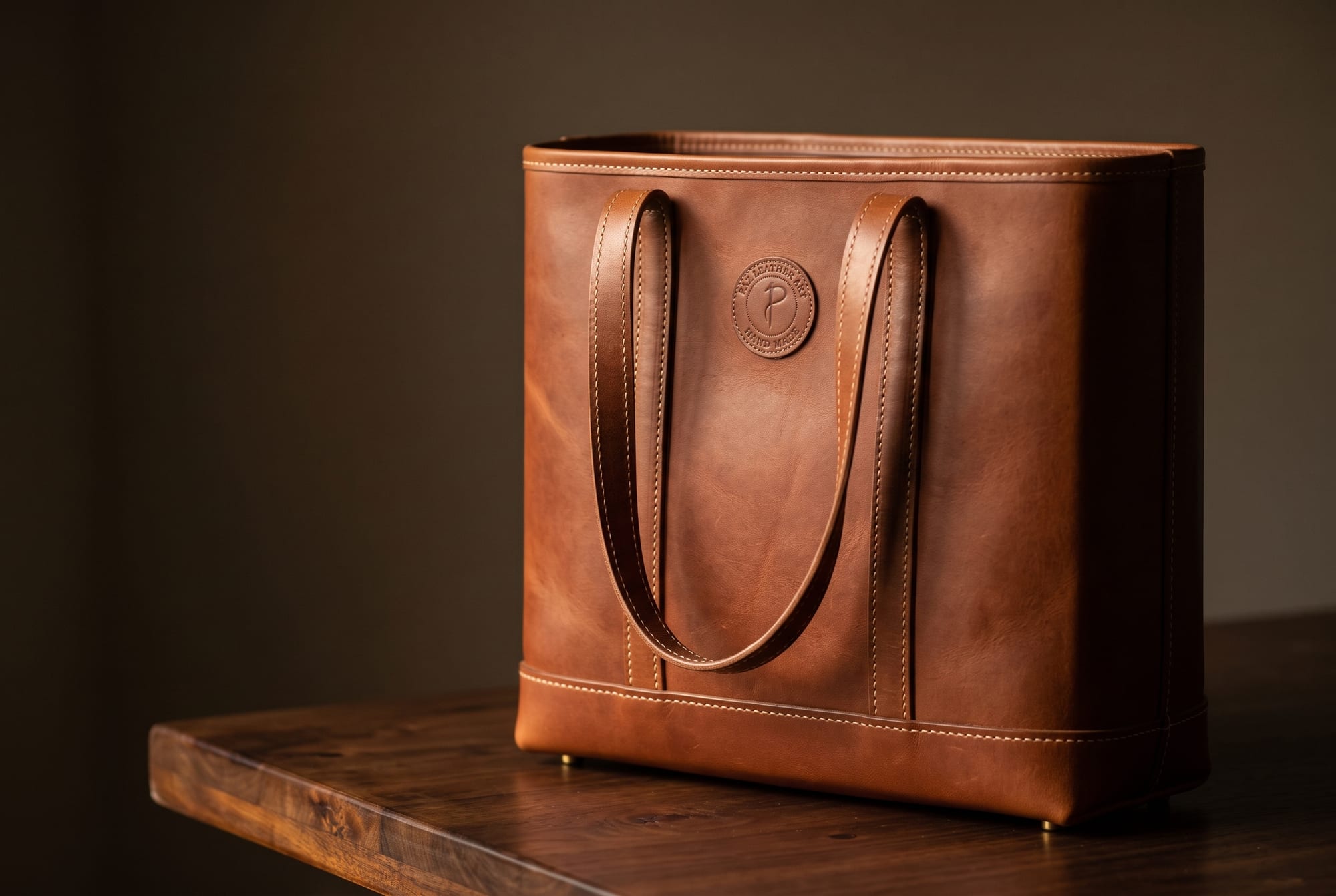
The short answer: a loaded bag hangs from its handles, so everything between the contents and the handle anchors is in tension. A bag keeps its shape when that tension has a continuous path to follow — a base panel stiff enough not to dish, a boxed gusset that holds the sides apart, and handle anchors that spread their load into a panel rather than into two rivet holes. Where the path is interrupted, the leather creeps under sustained load and the deformation becomes permanent. A lining contributes nothing to any of this.
People send us photographs of sagging bags fairly often, usually with an apology attached, as though they had done something wrong by using the thing. Occasionally they have — a bag left loaded for a year will take the shape of what was in it — but most of the time the bag was never built to carry what it was sold to carry, and the first six months simply found that out.
This is a mechanical subject rather than a taste one, which makes it unusually easy to check in a shop. You only have to know where to look.
Everything below the handles is in tension
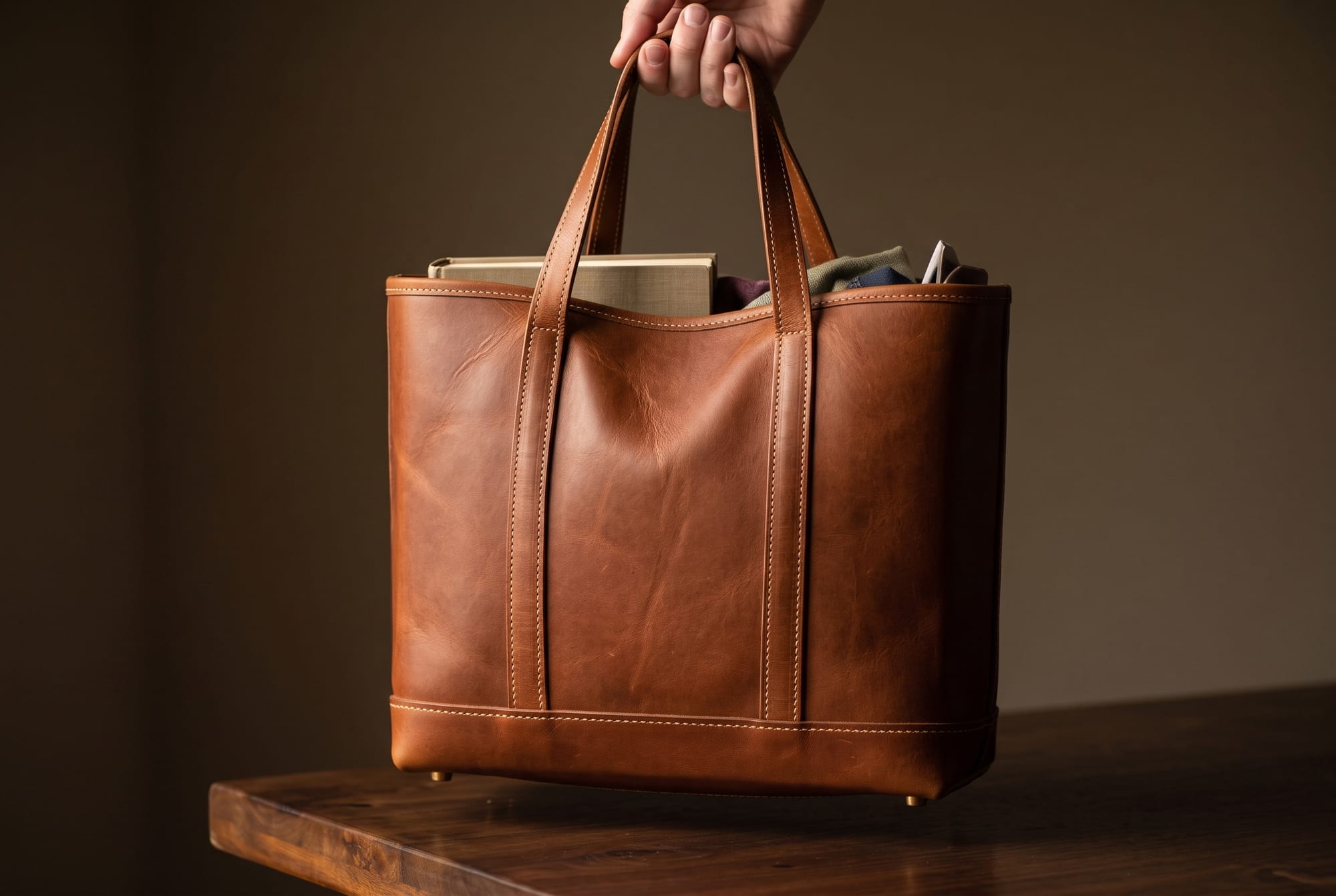
Pick a loaded bag up by the handles and the physics is immediate. The contents press down on the base. The base cannot fall, because it is attached to the side panels. The side panels cannot fall, because they are attached to the handle anchors. So the weight travels upwards through the leather as tension, concentrates at two small areas where the handles are fixed, and leaves through your hand.
Every shape failure in a bag is that path finding a weak link.
A bag is not a container with handles attached. It is a tension structure that happens to have a hole in the top.
And leather is a well-behaved material in tension — a 2 mm full-grain strap will hold far more than anyone puts in a handbag. The problem is never the ultimate strength. It is creep: under a load held for a long time, leather slowly and permanently extends, far below the load that would ever break it. Hang four kilos on a bag for one afternoon and it recovers completely. Leave four kilos in it for a year and the panels, the anchors and the gusset have all quietly taken a new set.
A lining is not structure
This is the belief I most often have to argue with, and it is understandable, because a lined bag feels more substantial in the hand.
A lining is a second thin leather or fabric layer attached at the edges. It stops small things escaping into the bag’s seams, it hides the flesh side, it protects the panel from keys, and it makes an edge easier to finish — all genuine jobs, set out in the piece on lined versus unlined. What it does not do is resist tension across a panel, because it is not under tension: it hangs loose inside, attached only at the perimeter. Hold up a lined bag and the lining is doing nothing but coming along.
Structure comes from three places and a lining is none of them: the thickness and temper of the panel hide, an interlining or stiffener deliberately bonded to the panel, and geometry — a boxed gusset, a separate base, a turned and stitched top edge. The third is the only one that is free, which is why it is the best indicator of whether a maker was thinking about the fifth year.
The crispest bag in the shop is often the first to fail
Here is the counter-intuitive part, and the reason a shop comparison can mislead you badly.
There is a very effective way to make a bag feel rigid and expensive on a shelf: build the panels from thin leather over a bonded board or heavy fused interlining. It holds a razor-sharp corner on day one and feels more serious than a bag made from 2 mm hide. But board does not creep, it creases, and a crease in board is a hinge that never recovers. Eighteen months of being set down on a desk and the corner has a permanent dent with a pale line through it, and because the thin outer hide is stretched over that hinge, that is where the surface starts to break up.
Soft leather sags and comes back. Board creases and does not. Given a choice between a bag that will relax and a bag that will crease, take the one that relaxes.
The test is simple and you can do it with one hand. Press a thumb firmly into the middle of a side panel. Good panel hide dents and springs back with a faint push. A board-backed panel gives a dull, flat yield and the dent stays visible for a few seconds. If it stays, the bag’s shape is being held by something that is not leather, and the label will not tell you.
The one detail worth paying for: where the handles go
Of the four failure points, number two is the one that turns a tired bag into a broken one, and it is also the one with the clearest hierarchy of solutions. In rising order of how long they last:
- Two rivets through a single panel. Cheapest, and the load is concentrated into two holes in one layer. The holes elongate into slots; once that starts it accelerates.
- A stitched tab on a reinforced patch. Much better. The patch spreads the load over a wider area of panel, and a stitched tab shares it between many holes rather than two.
- A tab stitched through panel and a hidden internal reinforcement, usually a strip of firmer leather or webbing. Now the panel is not carrying the concentration alone.
- A continuous strap that runs from the handle, down the outside of the panel and under the base. This is the one. The handle is no longer attached to the bag; the handle is the structure, and the contents sit on a strap rather than on a seam. You can see it on good satchels and on most well-made totes, and it is the single most reliable sign of a bag designed around load rather than around a photograph.
The metal matters less than people think, for the reasons in the piece on bag hardware: it is almost always the leather around a fitting, or the slider in a zip, that fails rather than the fitting itself. A brass ring on a thin tab is a strong part attached to a weak one.
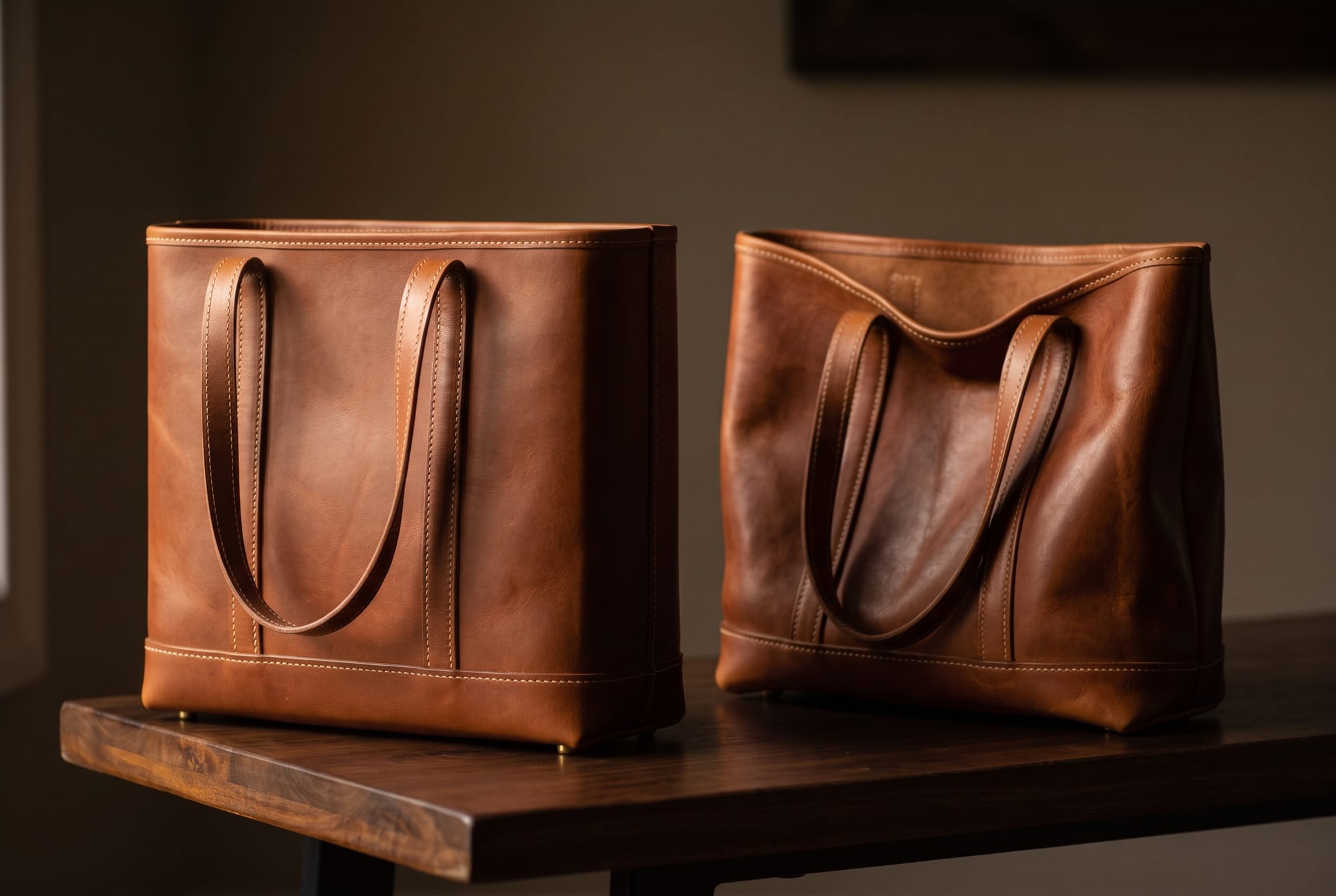
Three bags, two years apart
In a shop, in ninety seconds
- Stand it on the table, empty, and let go. If it is meant to be structured, it should stand without leaning on anything. A soft tote will fold, which is fine — as long as it was sold as one.
- Look underneath. Is there a separate base panel, with its own seam all the way round? Are there feet? A base that is simply the bottom fold of the sides will dish.
- Look at the gusset. Does the side have real width, cut as its own piece, or is it a crease where two panels meet? Pinch it: a boxed gusset has two seams and a flat face between them.
- Trace the handle. Does the strap continue down the panel? Can you see where it goes? If it stops at two rivets a centimetre below the mouth, that is the life of the bag.
- Press a panel with your thumb. Springs back: leather. Stays dented, feels dead: board.
- Then load it with your own things and pick it up by one handle. Watch the mouth and the anchor tabs. Any visible tilt or oval under a normal load is the deformation you will live with, previewed.
What you can fix, and what you cannot
Creep is partly reversible, which is more encouraging than it sounds. Leather that has slowly stretched under a constant load will recover a useful fraction of it if the load comes off and the shape is supported.
- Worth doing: empty it and stuff it firmly — acid-free paper, or an old cotton T-shirt, not newspaper, which transfers ink. Stand it upright on a shelf in a dry room and leave it for a fortnight. A sagging mouth and a dished base both improve measurably. The method and the reasons are in how to store leather, and it is also why a bag should never be hung by its handles for months.
- Worth doing: a cut-to-size base insert. Unglamorous, invisible, and it stops a dished base getting worse.
- Possible, with a maker: re-anchoring handles onto a larger reinforced patch, or adding the under-base strap that should have been there. We do this often enough that it is a standing repair rather than a favour.
- Not fixable: an elongated rivet hole, a hard crease through a board-backed panel, and a gusset fold that has gone permanently concave. Each of these is a geometry change rather than a surface one, and restoration can only ever treat surfaces.
One more habit, worth more than any of the repairs: do not leave it loaded. A bag emptied every evening recovers overnight, every night, for decades. The same bag used as a permanent shelf for a laptop and two books will take the shape of them within a year, and the leather will not have done anything wrong.
What we do, and what we do not make
We build few bags, and the ones we do are deliberately at the soft end: a hand-stitched tote in crazy horse, unlined, with the handles continuing down the panels. It is honest about being a soft bag. It will relax, it will go darker where it is held, and it will not stand to attention on a table in year three.
What we do not make is a structured, board-backed, sharply cornered bag, and the reason is the whole argument above. Doing that properly means interlinings, fused panels and moulded components, which is a different trade from ours and one where a factory with the right presses genuinely does it better than a bench with two people at it. If you want a crisp architectural bag, buy one from someone who makes those, and use the thumb test to find out whether the crispness is leather or board.
Where we do build shape into leather, we do it by wet-moulding the hide itself rather than by stiffening it — which is the same principle as the boxed gusset, taken to its conclusion: let the material’s own geometry hold the form, and add nothing that can crease.
Quick answers
- My bag sagged in six months. Was it badly made? Possibly, but check what it was sold as first. An unlined soft tote sagging is the design working. A structured bag sagging in six months is a structure problem, almost always at the anchors or the base.
- Will a heavier hide fix it? Less than geometry will. A 3 mm panel with a folded base and two rivets still deforms; a 1.8 mm panel with a boxed gusset, a base panel and an under-base strap holds its shape for years.
- Does conditioning help a sagging bag? No, and it makes it worse. Conditioner softens, and a softened panel creeps faster. Stuffing and rest are the treatment.
- How much weight is too much? As a rule of thumb, if the handles or the mouth visibly change shape while you are holding it, that load is above what the bag was built for — whatever the listing says.
- Are bag feet worth it? On any bag that gets set down on floors, yes, and more for the base than for the leather: they keep the base panel off the ground so it does not abrade and dish at the same time.
Further reading
- Bag hardware: why the metal fails long before the leather
- Lined or unlined leather: the three honest jobs a lining does
- Leather thickness: what an ounce means, and why thicker is not better
- Saddle stitch vs machine stitch: why one seam outlives the other
- How to store leather: why plastic is the villain
- Wet-moulded leather: how a flat hide becomes a bowl